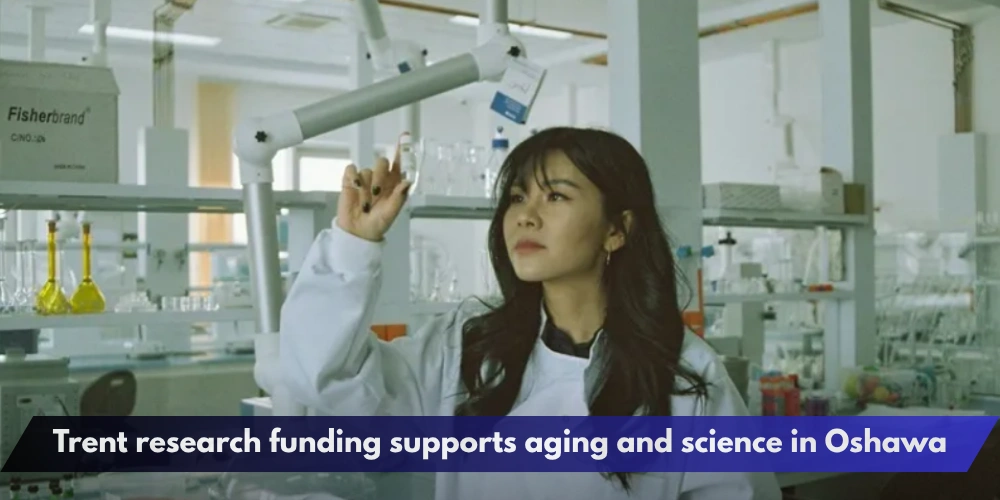
Three Trent University researchers are receiving a combined $643,477 in federal research infrastructure funding, with one of the projects based at Trent University Durham GTA in Oshawa.
The Trent research funding comes through the Canada Foundation for Innovation’s John R. Evans Leaders Fund and will support the purchase of advanced equipment for work in aging and dementia, environmental contaminants and medical innovation.


At the Durham GTA campus, psychology professor Dr. Raheleh Saryazdi will use the investment to expand research in the Cognition, Health, Aging, and Technology Lab, known as the CHAT Lab.


Oshawa research focuses on aging and communication
Saryazdi’s research examines how sensory and cognitive changes affect communication as people age.
Her team plans to use tools including eye-tracking equipment and a social robot to study communication between people and how older adults interact with emerging technologies.
The work could help researchers better understand the challenges faced by people experiencing hearing loss or dementia and support the development of interventions and technologies designed for Canada’s aging population.
The Durham-based project gives the funding a direct Oshawa connection. Trent University Durham GTA is located on Thornton Road South in the city and supports a growing range of teaching and research activities.
New equipment supports chemistry research
The Trent research funding will also support chemistry professor Dr. Michael Burt, who will acquire a titanium-sapphire laser for the Spectroscopy and Optics Lab at Trent Lightsource.
The equipment will allow researchers to observe how complex molecules change during chemical reactions.
Trent says the laboratory will support research with possible applications in areas such as greenhouse gas storage and medicinal chemistry.
Students working in the lab will also gain experience with ultrafast spectroscopy, mass spectrometry and scientific computing, providing specialized training in advanced scientific techniques.
Mass spectrometer to help detect contaminants
A third project, led by Dr. Mary-Claire Buell of the Trent School of the Environment and Forensic Science, will add a high-resolution liquid chromatography-mass spectrometer to Trent’s Water Quality Centre.
Buell leads a 14-person research lab studying per- and polyfluoroalkyl substances, commonly known as PFAS or “forever chemicals,” along with other emerging contaminants in freshwater and coastal environments.
The new equipment will allow researchers to detect contaminants at very low concentrations and measure how much is present in water, soil and traditional food sources.
Trent says the instrument will also be shared with researchers and students in Chemistry, Forensic Science, Biology, Anthropology and Physics, as well as collaborators in government, universities and the private sector.
More than 75 faculty, staff, students and post-doctoral researchers used Water Quality Centre facilities over the past year.
Federal funding expands Trent research capacity
The $643,477 awarded to the three Trent researchers is part of a broader national investment through the Canada Foundation for Innovation.
Trent says the new equipment will strengthen research capacity, help attract skilled researchers and students, and support discoveries in areas with direct relevance to Canadians.
For Oshawa, the Trent research funding adds new capacity at the Durham GTA campus in a field that is becoming increasingly important as Canada’s population ages.
The local CHAT Lab project will focus on how technology and communication can better support older adults, including people living with hearing loss or dementia, while the wider funding package strengthens Trent’s scientific research across multiple disciplines.