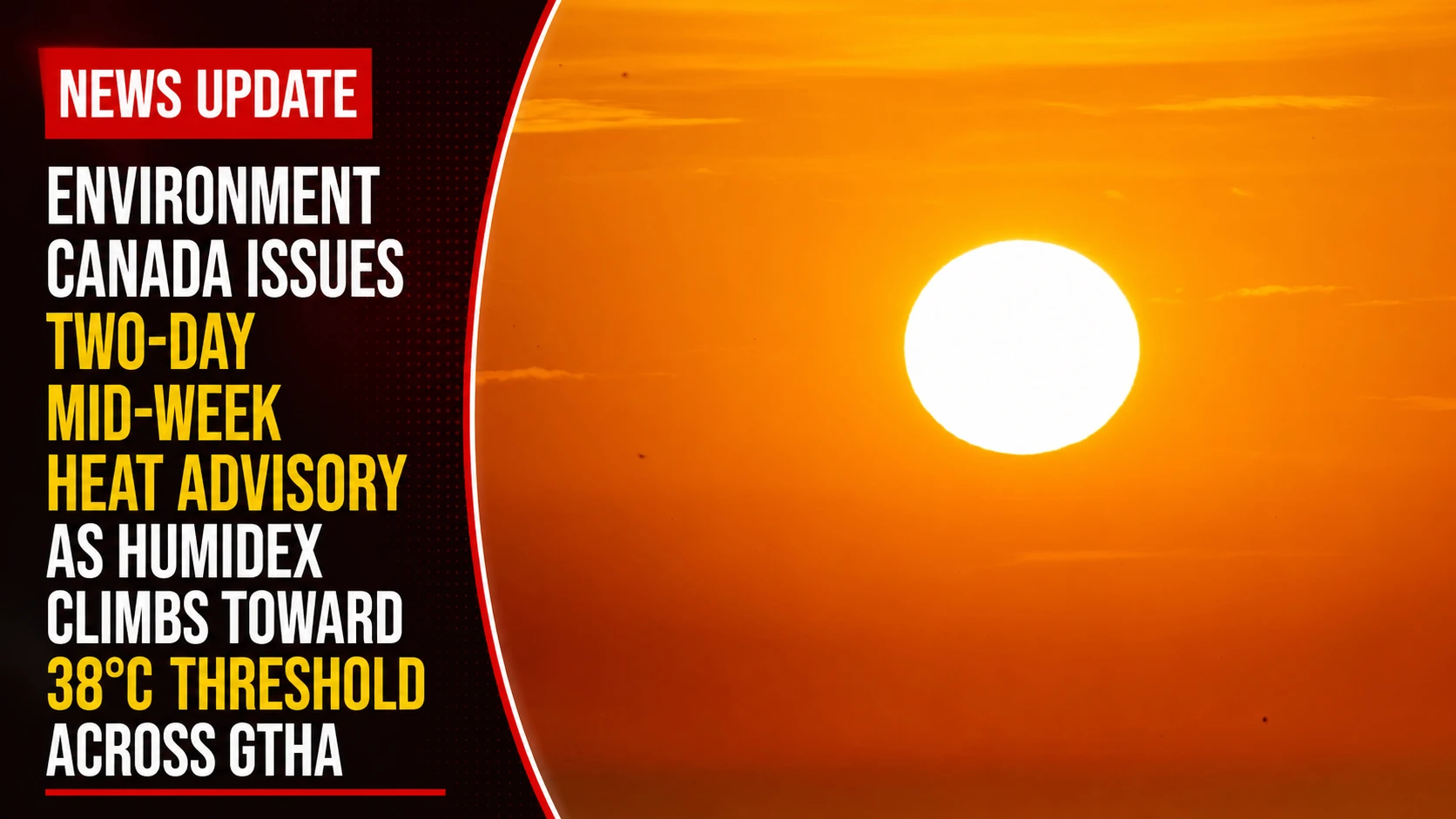
The public health inspectorates, emergency response divisions, and municipal community care centers across the Durham Region are shifting to elevated monitoring tiers. Tracked under federal climatological portfolios on Tuesday, July 7, 2026, severe weather desks finalized the regional safety advisory ‘Heat event’ could make it feel like 38 C in southern Ontario. Driven by a dense subtropical air mass stalling across the lower Great Lakes, a formalized two-day thermal event will settle over the area, trapping sticky daytime highs and warm overnight thresholds across the urban boundary.
Regional medical officers are warning that while this system tracks slightly below the criteria required for an extreme, extended multi-day heatwave, the sudden moisture buildup presents immediate health risks for vulnerable groups.


The Two-Day Atmospheric Profile and Heat Matrix
The incoming mid-week system introduces a tight thermal envelope, severely restricting natural overnight structural cooling across local residential zones.


-
The Exposure Timeline: The system is scheduled to push into the Durham Region early Wednesday morning, maintaining stable high-intensity parameters before a projected breakdown arrives late Thursday evening.
-
The Ambient Temperature Caps: Daily maximum ambient temperatures are forecast to hold steady between 29°C and 31°C for both Wednesday and Thursday afternoons under mostly clear skies.
-
The Humidex Real-Feel Ceiling: Heavy surface dew points will significantly inflate the thermal index, forcing localized real-feel humidex values to climb between a muggy 34 and 38.
-
The Overnight Retention Minimums: Nighttime cooling will be heavily restricted, with minimum temperatures refusing to drop below 19°C. This lingering overnight heat leaves un-air-conditioned indoor spaces progressively warmer heading into the second day of exposure.
Analyzing Vulnerability and Heat-Related Illness Vectors
Durham Public Health authorities emphasize that mid-30s humidex conditions can rapidly trigger localized medical crises if proper hydration measures are ignored.
| Observed Illness Phase | Primary Physiological Indicators | Immediate Tactical Action Required | Priority Vulnerable Risk Demographics |
| Heat Exhaustion | Heavy sweating, dizziness, nausea, intense headaches, elevated pulse rates | Move to air-conditioned shelter, apply cold mist, and drink water |
• Infants and young toddlers • Outdoor construction crews • Pregnant individuals |
| Heatstroke (Critical) | Red/hot skin, confusion, loss of consciousness, body temp above 39°C | Cease activity, immediately call 9-1-1, and pack ice onto groin/neck |
• Seniors (60+) living alone • Individuals on specific medications |
The Public Safety Vehicle Mandate
With ambient summer temperatures scaling past 30°C, emergency services are issuing an absolute zero-tolerance warning regarding enclosed vehicles. Under direct sunlight, internal cabin temperatures inside a locked car can break past 50°C in less than ten minutes. Residents who witness a child, vulnerable adult, or domestic pet left unattended inside a parked vehicle are instructed to bypass municipal animal services and immediately dial 9-1-1 for emergency extraction.
The Durham Region Health Department monitors the area’s Heat Alert Response Systems (HARS) to coordinate localized cooling assistance.
The Environment and Climate Change Canada significant weather desk handles all active municipal climate tracking.
Durham Region residents, logistics coordinators, and camp directors looking to monitor live humidex index maps, locate air-conditioned community centers and public libraries, or download specialized child-care safety sheets can find the data systems online at weather.gc.ca or monitor local health advisories via durham.ca/heat.