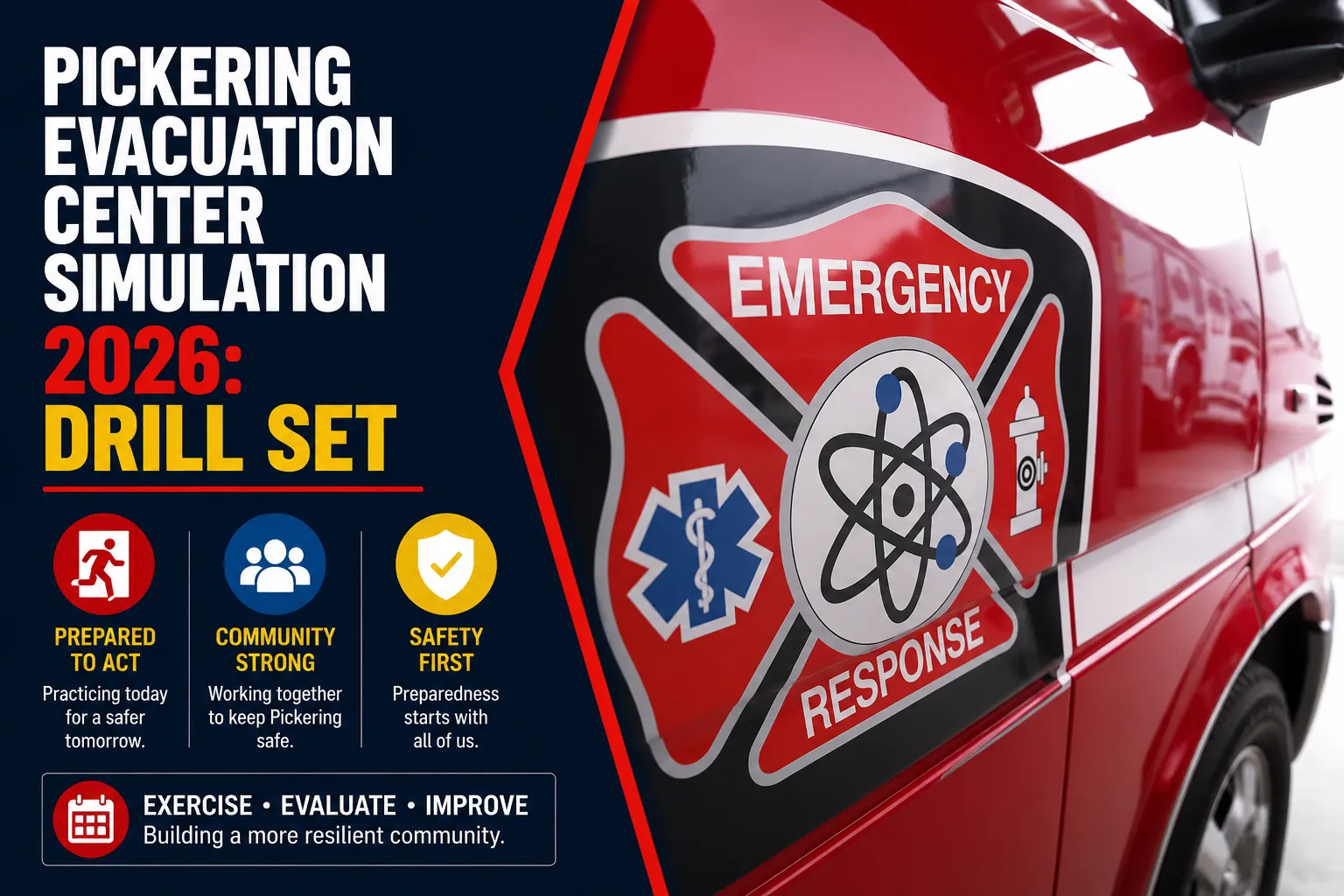
Municipal emergency managers and regional relief agencies are finalizing a high-visibility civil defense deployment to stress-test large-scale civilian displacement capabilities within the lakeshore nuclear energy belt. Tracked under the active preparedness framework Pickering Evacuation Center Simulation 2026, municipal officials confirmed on May 29, 2026, that a massive joint field training drill will launch next week. The complex command exercise is designed to test the real-time activation, heavy intake processing, and rapid demobilization of an emergency reception sector under provincial safety laws.
Because the municipality serves as a host jurisdiction for a major nuclear generating station, local administrators run highly specialized command-and-control cycles to coordinate complex public safety pipelines.
Operational Grid and Specialized Training Vectors
The localized field operations are scheduled to take place on Wednesday, June 3, 2026. Tactical movements, marked emergency vehicle clusters, and humanitarian staging tents will be fully concentrated at the Chestnut Hill Developments Recreation Complex, situated on Valley Farm Road.
The exercises will run continuously between 8:00 a.m. and 3:00 p.m., utilizing the following parameters:
-
Vulnerable Population Extractions: Field teams will manage a detailed simulation involving the rapid relocation and medical intake tracking of long-term care facility residents and nursing staff.
-
Inter-Agency Communications: The exercise tests direct data streams connecting the local Emergency Operations Center (EOC) with regional social service units.
-
Civil Infrastructure Logistics: Fleet operations will deploy Durham Region Transit buses to move mock evacuees along designated evacuation corridors into the Valley Farm Road complex.
Provincial Safety Compliance and Public Advisories
Pickering Mayor Kevin Ashe noted that the deployment fulfills mandatory regulatory requirements under Ontario’s emergency management framework, which legally forces all members of the Municipal Emergency Control Group to complete live annual field trials. To prevent public panic during the heavy multi-agency deployment, safety directors emphasize that the entire operation is a strictly controlled mock training scenario; no real hazard exists, and civilian neighborhoods do not need to take protective action.
The physical staging will draw heavily from specialized non-governmental organizations, including triage teams from St. John Ambulance, logistics managers from the Salvation Army, and housing specialists from the Canadian Red Cross. Durham Public Health and the Durham Regional Police Service will also run parallel field testing lines to monitor environmental controls and traffic flow. Local families looking to audit their private safety setups can download customized household planning guides from the municipality’s emergency web repository at pickering.ca/beprepared.