









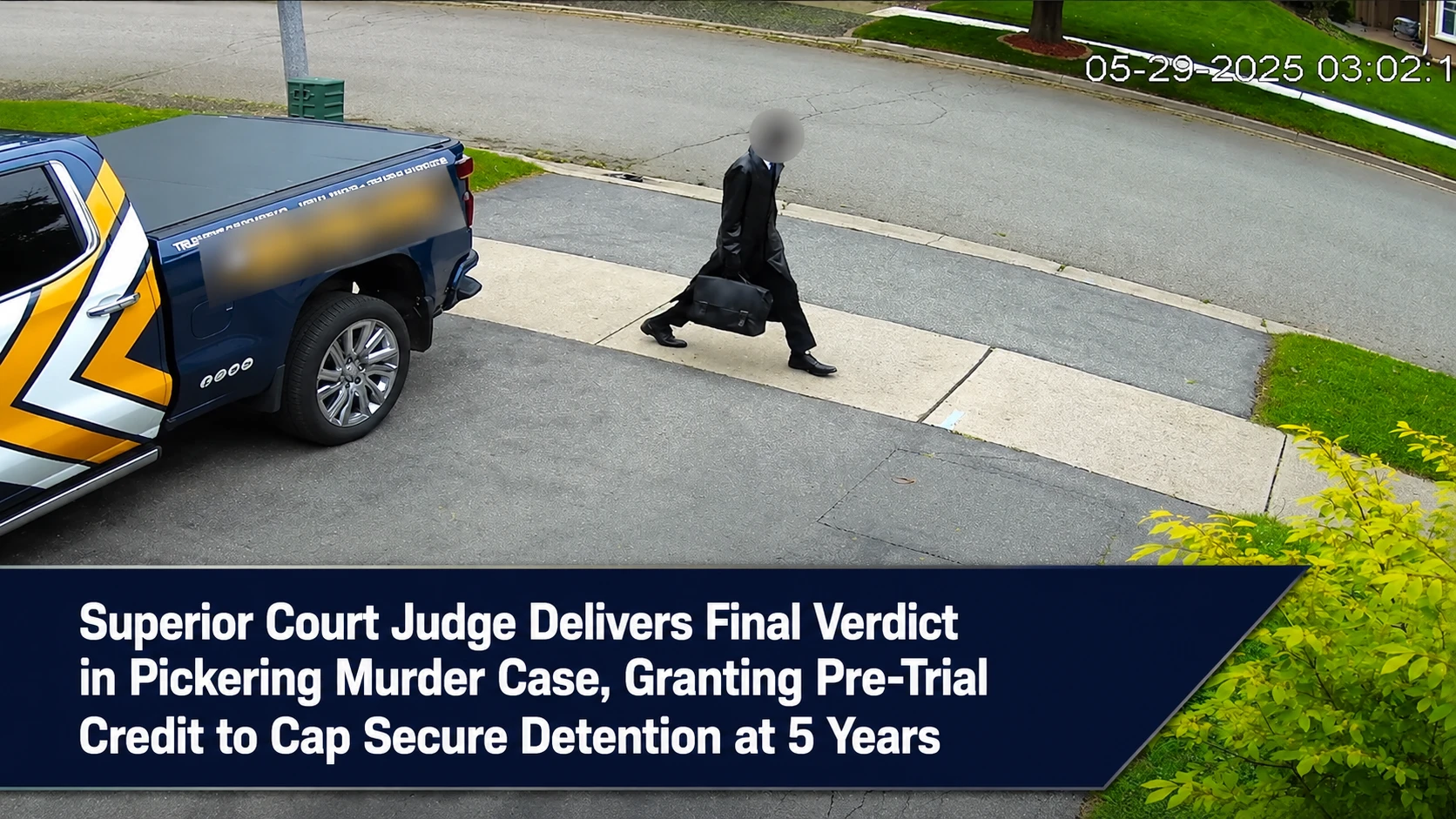
The regional judicial services, community safety advocacy blocks, and youth correctional boards within the Durham Region have reached the legal conclusion of an agonizing public safety file. Tracked under provincial criminal justice, court administration, and youth sentencing portfolios on Wednesday, July 15, 2026, legal analysts finalized the definitive case completion ledger Pickering teen receives maximum allowable sentence for murder of Eleanor Doney. Presiding Superior Court Justice Lisa Wannamaker formally handed down the maximum allowable ten-year framework permitted under the Youth Criminal Justice Act (YCJA) for first-degree murder. However, in a major legal calculation shift, Justice Wannamaker exercised her judicial discretion to reject the Crown’s hardline stance, granting the 15-year-old offender a full one-year credit deduction for time already served behind bars.
Court administrators note that the ruling locks the teen into exactly five remaining years inside a secure provincial youth facility before transitioning to mandatory intensive neighborhood surveillance grids.


The Anime Delusion and the Calculated Briefcase Ambush
The comprehensive sentencing records exposed a deeply disturbing mix of untreated psychological decompensation, severe neurodevelopmental gaps, and targeted operational calculation leading up to the fatal yard attack:


-
The Yoshikage Kira Blueprint: Psychological evaluations and agreed statements of fact revealed that the youth, who lives with unmanaged autism, had developed a severe, dark fixation on an anime villain character named Yoshikage Kira—a fictional serial killer who routinely stalks victims while disguised in a formal business suit and carrying a classic briefcase.
-
The Unprovoked Strike: On May 29, 2025, mirroring the fictional character, the 14-year-old Grade 8 student put on a long black trench coat, a ski mask, and gloves while carrying a briefcase through a quiet Pickering neighborhood. He targeted 83-year-old Eleanor Doney, a beloved retired kindergarten teacher. After engaging her in a deceptive conversation, he retrieved a knife from the briefcase and stabbed her eight times in the face, neck, and lower back.
-
The Pre-Incident Warning Flags: The investigation revealed the youth had been suspended from his elementary school just one day prior for carrying a knife. Furthermore, digital forensics uncovered extensive search histories regarding serial killers, stalking, and chats with classmates detailing plans to commit violent crimes and assume his chosen alter ego.
Analyzing the Definitive YCJA 10-Year Maximum Sentencing Grid
The final court order splits the ten-year sentence between high-security lockup and strict community tracking, overriding the Crown’s bid to deny pre-trial credits.
| Judicial Sentencing Component | Statutory Term Allocation | Active Custodial & Supervision Environments | High-Priority Legal Conditions Imposed | Core Rulings on Pre-Trial Credit |
| Phase 1: Secure Youth Custody |
6 Years Maximum (Reduced to 5 Years Active) |
Secured placement inside a provincial youth justice facility utilizing an Intensive Rehabilitative Custody and Supervision (IRCS) program. |
• Continuous forensic psychiatric care. • Mandatory behavior mitigation. • Managed under the specialized mental health program. |
1 Year Credit固定 Granted: Justice Wannamaker deducted one year of pre-sentence detention to avoid disrupting treatment if transferred post-20. |
| Phase 2: Community Supervision |
4 Years Maximum (Launches around 2031) |
Strict conditional release managed by specialized regional youth probation enforcement. | Absolute geographic limits, non-communication orders, curfews, constant mental health checks, and a lifetime weapons ban. | DNA Registry Order: Mandatory submission of the offender’s genetic profile into the federal criminal database. |
The Judicial Final Takeaway and Victim Impact Registry
The court noted the profound tragedy left behind, reading a poetic passage from the submission of Eleanor Doney’s husband, who described his late wife as a “cool breeze that would bring hope, love” when daily life brought trouble. Following the murder, her husband was forced to relocate to a long-term care home. While medical reports indicate the youth continues to struggle with violent fascinations and inconsistent remorse, Justice Wannamaker noted his willingness to engage in ongoing clinical therapy and his academic performance within secure custody. The judge explicitly warned the teen that any violation of his strict community release terms would instantly result in the remaining four years of the sentence being served entirely behind bars.
The Ontario Superior Court of Justice, the Ministry of Children, Community and Social Services Youth Justice Division, and the Durham Regional Police Service Major Crime Branch handle ongoing custodial enforcement, forensic mental health tracking, and local registry compliance.
Pickering residents, legal analysts, and community heritage advocates looking to review the official YCJA youth sentencing documentation, access historical case timelines, or connect with localized senior safety and trauma support networks can explore the platforms online through the central Ontario Court of Justice registry portal, read municipal updates via the Durham Regional Police Service media center at www.drps.ca, or track regional victim support initiatives through the Durham Region administrative network.