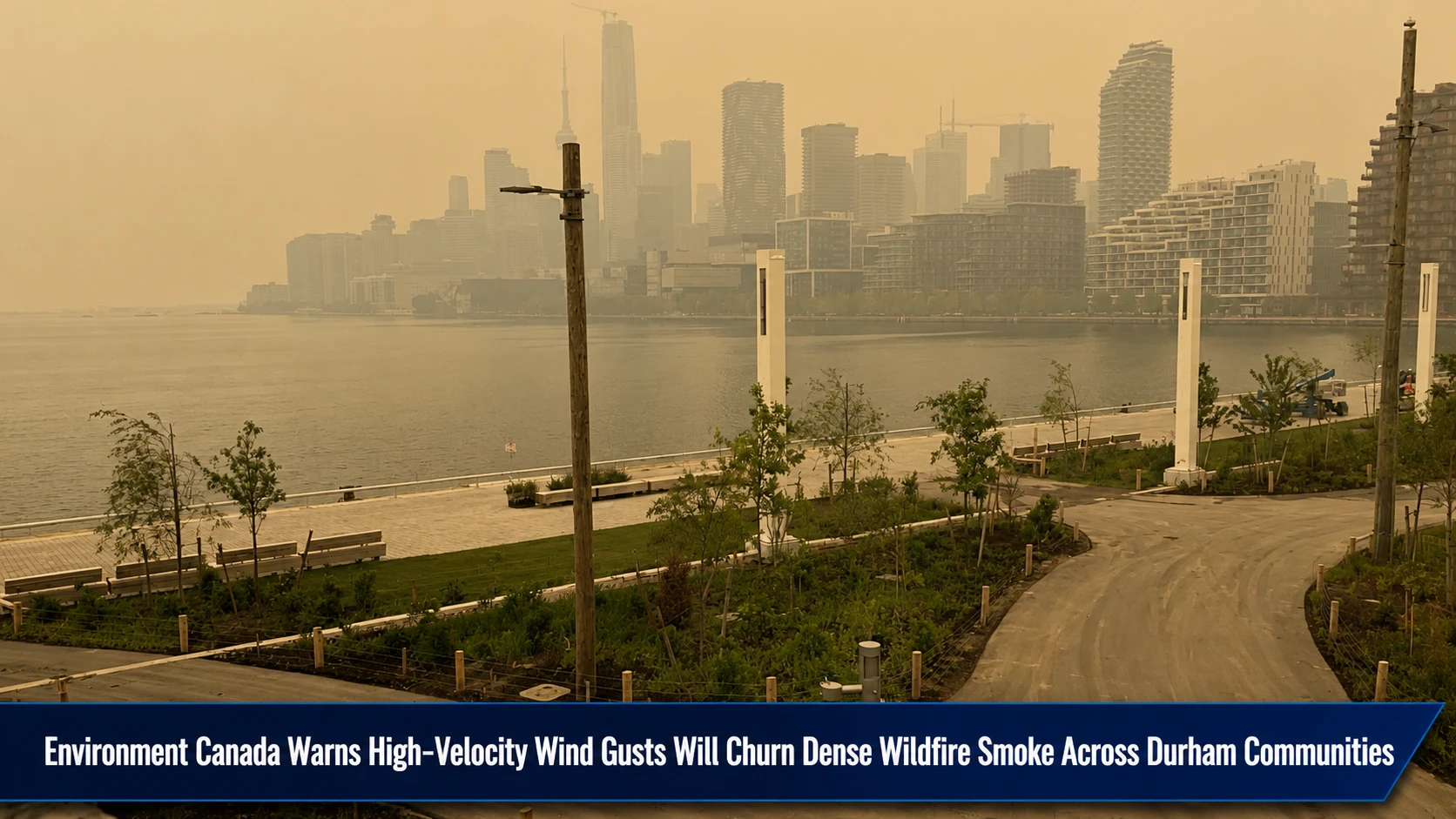
The emergency environmental desks, regional public health agencies, and municipal weather tracking centers within the Durham Region are updating localized air safety advisories. Tracked under provincial climatology, emergency environmental warnings, and municipal health mitigation portfolios on Thursday, July 16, 2026, severe weather meteorologists finalized the tactical timeline July 16 weather: More smoke with 50 km/h wind gusts in southern Ontario. While the intense mid-summer heat wave shows initial signs of breaking, Environment and Climate Change Canada has issued a high-priority alert confirming that heavy particulate soot from massive wildfires in northwestern Ontario will continue to blanket the region, accompanied by aggressive late-morning wind spikes.
Public health officials emphasize that because the fine particulate matter carries significant respiratory liabilities, strict indoor shelter protocols must be maintained until a definitive clean air front arrives at the end of the week.


The Turbulent Atmospheric Inversion and Respiratory Risk Profiles
The current weather pattern introduces a dangerous combination of high winds, intense solar radiation, and toxic particulate trapping:


-
The Wind Gust Escalation: Frontline weather tracking stations indicate a steady northwest wind blowing at 30 km/h, which is projected to kick up heavy gusts reaching up to 50 km/h during the late morning hours, violently churning smoke layers at ground level.
-
The Deceptive Temperature Ceiling: The actual ambient temperature will hover around a high of 29°C. However, due to lingering moisture traps, the humidex value will make conditions feel more like 33°C across the southern Ontario lakeshore.
-
The Radiation Warning: Despite the visible haze layer, the meteorological solar grid indicates a UV index rating of 9, formally classified as “very high,” meaning unprotected skin can burn within minutes.
-
The Overnight Dynamic: Thursday evening will bring clearing skies with sustained northern winds gusting up to 40 km/h, dropping temperatures to a stagnant overnight low of 19°C.
-
The Clear Horizon Timeline: Forecasters confirm the dense smoke fields are modeled to entirely clear out by Friday morning, July 17, giving way to a sunny 28°C daytime environment before a 40% chance of evening showers drops the overnight temperature to 17°C.
Analyzing the Air Quality Warning System and Vulnerability Triggers
Medical teams have isolated the specific physiological symptoms associated with this smoke inversion alongside the primary risk demographics.
| Documented Inversion Symptoms: Minor | Documented Inversion Symptoms: Severe | High-Priority Vulnerable Demographics | Mandatory Public Safety Directives | Upcoming Friday Transition Matrix |
|
• Acute eye irritation. • Nasal passages burning. • Scratchy throat soreness. • Low-grade headaches. • Mild persistent cough. |
• Persistent wheezing. • Deep localized chest pains. • Severe uncontrollable coughing fits. • Shortness of breath. |
• Older adults (seniors). • Infants and toddlers. • Pregnant individuals. • People with chronic heart/lung conditions. • Individuals with mobility limits. |
Seal Internal Structures: Keep all residential windows and doors closed tightly. | Clean Air Clearance: Weather transitions to full sun Friday morning. |
| Action: Move to air-filtered spaces. | Action: Seek immediate emergency medical aid. | Action: Initiate continuous wellness checks. | Reschedule Activities: Cancel all strenuous outdoor sports and physical training. | 40% Chance of Showers: Light evening rain loops will wash down remaining soot. |
The Public Health Protection and Environmental Directives
“Limit time spent outdoors when smoke levels are high, reduce or reschedule strenuous outdoor activities, and keep windows and doors closed when possible,” Environment Canada highlighted within its special health warning bulletin. Local health protection teams reiterate that fine wildfire soot bypasses standard upper-respiratory filters to lodge deeply within pulmonary tissue, creating severe vascular stress. While the high-velocity wind gusts will create the illusion of atmospheric movement, they are actively mixing the soot down into neighborhood breathing zones. Residents are urged to run internal HVAC systems on continuous recirculate settings and heavily restrict the outdoor exposure of family pets and young children until the clearing winds completely purge the Golden Horseshoe on Friday.
The Environment Canada Severe Weather Desk, the Ontario Ministry of the Environment Air Quality Branch, and the Durham Region Public Health Emergency Operations Center handle ongoing particulate monitoring, wind vector tracking, and respiratory safety coordination.
Durham families, outdoor construction crews, and sports league coordinators looking to download live air quality health index (AQHI) readouts, check real-time satellite smoke dispersion loops for Oshawa and Whitby, or review municipal emergency cooling shelter openings can find the tools online through the central Environment Canada tracking hub, check local health indexes via the Durham Region Public Health portal, or monitor real-time weather updates through the Durham Region public safety dashboard.