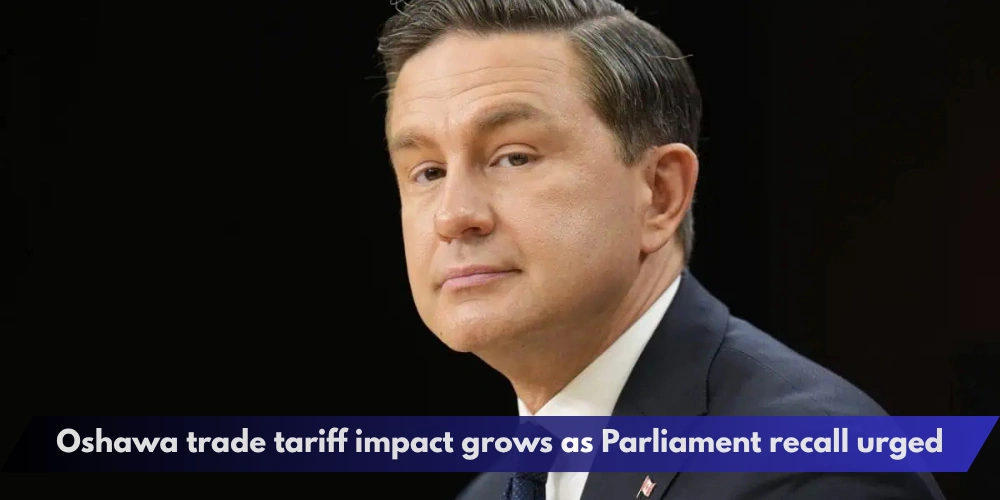
Canada’s escalating trade dispute with the United States is putting renewed attention on manufacturing communities such as Oshawa as Conservative Leader Pierre Poilievre calls for Parliament to be recalled to debate the rejected U.S. trade agreement.
The Oshawa trade tariff impact is particularly important because the city remains home to General Motors’ Oshawa Assembly Plant, where thousands of workers are represented by Unifor. The union says its latest negotiations with GM took place amid significant tariff uncertainty and growing U.S. trade pressure.


Poilievre sent a letter to Prime Minister Mark Carney on Sunday calling for Parliament to reconvene and demanding more information about the U.S. proposal Canada rejected.


Poilievre seeks details of rejected trade agreement
Poilievre argues Canadians should be allowed to see the proposed agreement so they can understand what concessions and tariff reductions were available before Ottawa walked away from negotiations.
He is also seeking information about the potential cost of retaliatory measures and how the federal government intends to protect Canadian jobs in industries including automobiles, steel, aluminum and lumber.
Carney suspended negotiations with the United States on Aug. 21, saying last-minute American demands would have restricted Canada’s ability to pursue trade agreements with other countries and affected Canadian protections involving language and culture.
The federal government maintains that accepting a poor agreement would have undermined Canada’s long-term economic interests.
Oshawa auto workers face tariff uncertainty
The national dispute has a direct connection to Durham Region through Oshawa’s automotive industry.
Unifor announced Aug. 22 that it had reached tentative agreements with General Motors covering more than 4,600 workers at Canadian facilities, including the Oshawa Assembly Plant.
The union described the negotiations as taking place during one of the most challenging periods for the Canadian auto industry, citing U.S. trade aggression and uncertainty surrounding tariffs.
That makes the Oshawa trade tariff impact more than a national political debate for local workers and families whose incomes depend directly or indirectly on automotive manufacturing.
The United States is already imposing tariffs on Canadian automobiles, while President Donald Trump has threatened to increase tariffs on Canadian vehicles and parts to 50 per cent beginning in 2027.
Any prolonged increase in the cost of exporting Canadian-built vehicles into the United States could create additional pressure on manufacturers deciding where to allocate future production and investment.
Canada prepares retaliatory measures
Carney has said Canada will respond with dollar-for-dollar counter-tariffs beginning after Labour Day.
Following the breakdown of negotiations, he met virtually with provincial and territorial premiers to discuss support for businesses and workers affected by U.S. tariffs.
The federal government says further details on assistance measures will be announced as the trade dispute develops.
Poilievre’s position is that Parliament should have an opportunity to scrutinize both the rejected agreement and Canada’s retaliation plans before the economic consequences deepen.
Trade dispute closely watched in Durham
For Oshawa, the debate comes at a sensitive moment.
GM and Unifor have just reached a tentative labour agreement covering Oshawa Assembly workers, with ratification meetings scheduled for Aug. 29 and 30.
The Oshawa trade tariff impact will therefore remain an important local issue as Canada and the United States move further into an escalating trade confrontation.
While no specific job losses at the Oshawa plant have been announced as a result of the latest dispute, the city’s dependence on automotive manufacturing means future tariff decisions, investment plans and trade negotiations will be closely watched across Durham Region.