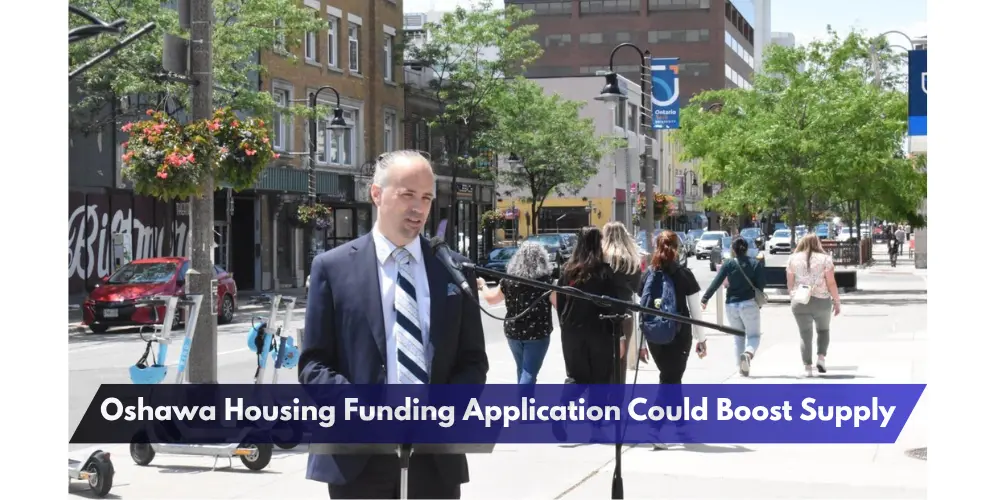
Oshawa has applied to a new federal-provincial program designed to lower residential development charges while helping municipalities pay for infrastructure needed to support new housing.
The Oshawa housing funding application is part of the Development Charge Reduction Program, a 10-year initiative under the Canada-Ontario Partnership to Build. The program prioritizes municipalities that commit to reducing residential development charges by at least 30 per cent, maintain those reductions for at least three years and identify infrastructure projects that can unlock additional housing.
Development charges are fees collected when new homes and other properties are constructed. Municipalities use the revenue to help fund growth-related roads, parks, fire facilities, libraries and other services. Oshawa also collects development charges on behalf of Durham Region and local school boards.
Oshawa Housing Funding Could Support Infrastructure
The City of Oshawa has not publicly identified the specific projects included in its application. In information provided to the original publication, the city said its proposed projects would address infrastructure constraints, prepare land for development, improve goods movement and support transit connections.
The proposed work could also include active transportation infrastructure, climate-resilience measures and lower-impact development practices.
The federal government says applications are evaluated according to the size of the proposed development-charge reduction, the number of homes expected to result and the municipality’s financial contribution. Municipalities must contribute at least 10 per cent of eligible project costs, while individual funding agreements will determine the final division of costs.
Oshawa Mayor Dan Carter previously said the city intended to submit projects that could accelerate housing and infrastructure development. He identified 1,600 residential units in the downtown development pipeline and at least 2,800 additional units city-wide that could potentially move forward within two years with appropriate funding.
According to the newer city response quoted in the supplied report, approximately 17,000 housing units have already received approval but have not moved into construction because builders are waiting for improved market conditions.
Reducing development charges could improve the financial viability of some projects. However, lower fees would not guarantee that every approved development immediately proceeds because construction decisions also depend on interest rates, market demand, financing and labour and material costs.
Councillor Raises Funding and Affordability Questions
Ward 4 Coun. Derek Giberson, who chairs Oshawa’s financial committee, said the program could help restart housing projects that have been delayed or placed on hold.
However, he cautioned that municipalities need predictable, long-term funding alternatives if senior governments expect them to become less dependent on development-charge revenue.
Participating municipalities must absorb at least part of the cost reduction. That creates a potential financial risk if federal and provincial funding does not fully replace the revenue Oshawa would otherwise collect from developers.
Giberson said any decision to participate would depend on the terms offered to Oshawa and the broader effect on the city’s finances and property-tax base.
The councillor also noted that lowering construction costs could eventually influence home prices. However, the program does not require participating projects to provide affordable or non-profit housing.
Toronto is the first major confirmed recipient. The city secured up to $1.5 billion over 10 years after committing to residential development-charge reductions of between 40 and 60 per cent for more than three years.
Oshawa Awaits Application Decision
The Oshawa housing funding application remains under review. If Oshawa is selected, city council would still need to examine the proposed agreement, municipal contribution and effect of reduced development-charge revenue before accepting an offer.
A successful application could support roads, transit connections and other infrastructure while helping approved housing projects move closer to construction.
However, the program would not independently solve Oshawa’s wider affordability challenges. Those issues also involve borrowing costs, construction expenses, market demand and the limited availability of deeply affordable and non-profit housing.