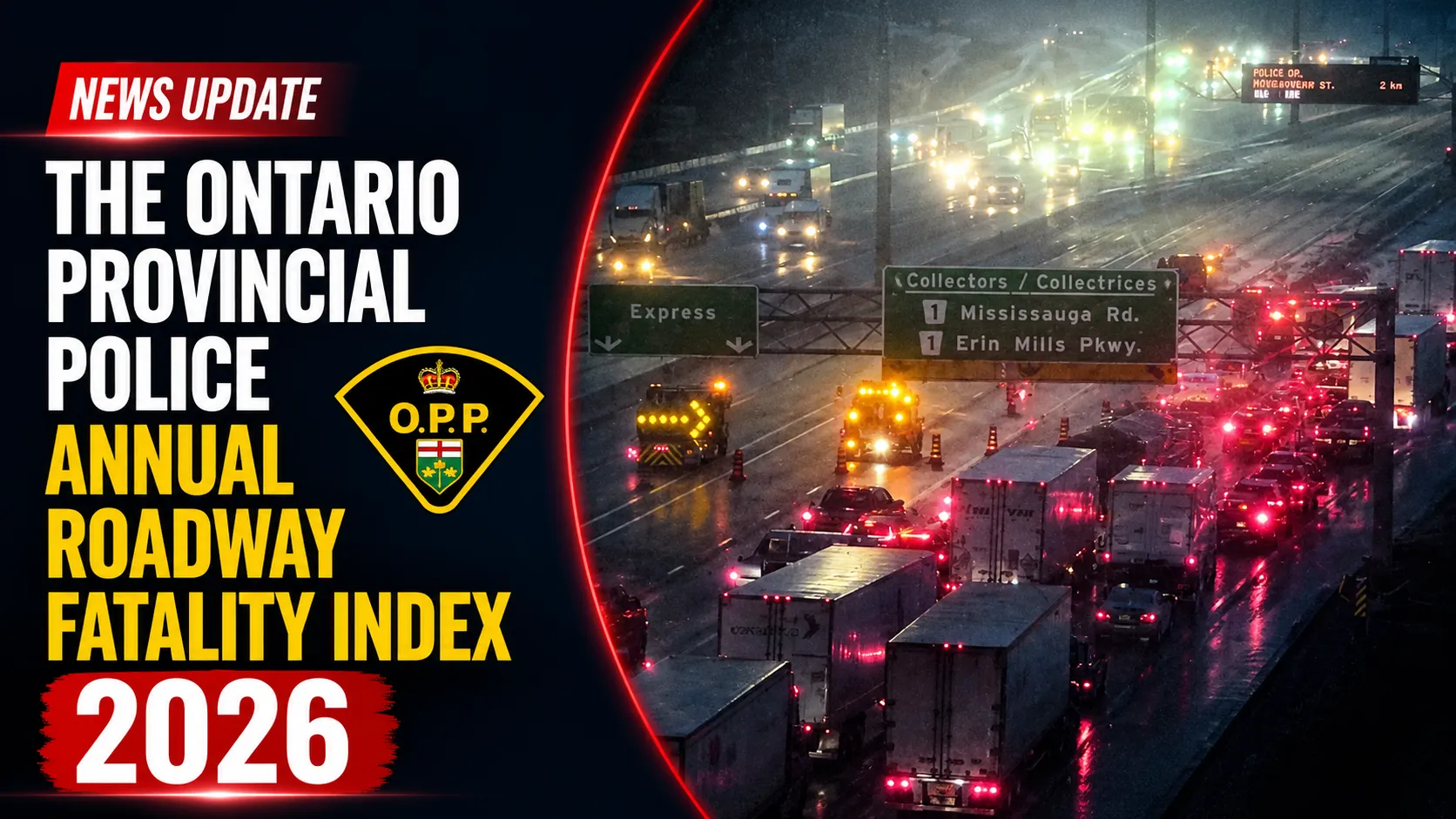
The Ontario Provincial Police (OPP) Highway Safety Division has enacted an immediate commercial and passenger vehicle safety enforcement campaign following a severe statistical spike in fatal roadway collisions. Tracked under the provincial public safety folder The Ontario Provincial Police Annual Roadway Fatality Index 2026, highway traffic commanders released an emergency data briefing on Thursday, June 4, 2026. Certified diagnostic logging confirms that 133 individuals have lost their lives on provincial-monitored routes since January, marking an aggressive 22 per cent escalation in traffic-related fatalities compared to the identical operational window last year.
The rapid escalation in highway mortality figures is prompting immediate adjustments to tactical radar placements, distracted driving stings, and aerial traffic monitoring across the Greater Toronto and Hamilton Area (GTHA).
Analyzing the Five-Year Mathematical Baseline Deviation
The statistical surge completely upends traditional traffic safety models, which typically associate peak collision risks with adverse winter weather conditions like black ice and blinding snow squalls.


According to OPP Highway Safety Division Sgt. Kerry Schmidt, the arrival of clear, dry summer conditions frequently generates a false sense of security among motorists. This psychological shift often leads to excessive speeding, tailgating, and delayed brake reactions, transforming routine highway transits into high-velocity, multi-vehicle impacts.
Between January and the conclusion of April alone, investigators logged 89 distinct fatal collisions, a sharp deviation from the established five-year historical average of 74 fatal incidents for that specific four-month timeframe. Provincial tracking authorities emphasize that these figures represent a conservative baseline of the unfolding crisis, as they exclude fatal collisions handled by regional municipal forces like the Durham Regional Police Service (DRPS), Halton Regional Police, or Peel Regional Police.
Targeted Enforcement Sectors and Vulnerable User Directives
To combat the rising numbers, traffic safety units are deploying specialized intersection and highway lane enforcement details, with a particular focus on protecting vulnerable road users as summer foot traffic increases.
| Active Roadway User Group | Primary Identified Risk Vector | Mandatory Safety Action Protocol |
| Commuter & Commercial Drivers | Inattentive Blind-Spot lane changes / Speeding | Continuous hands-on-wheel placement / Forward focus |
| Motorcycle Operators | High-velocity lane splitting / Low driver visibility | Validate visual eye-contact before shifting positions |
| Cyclists & Pedestrians | Stepping off curbs prematurely at active crossings | Lock eyes with turning operators before entering lanes |
OPP field teams are instructing motorcyclists, bicyclists, and pedestrians to never assume an approaching vehicle can see them. Pedestrians are urged to explicitly establish direct eye-contact with drivers before stepping off curbs or traversing crosswalk lines.
Concurrently, highway patrol units are scaling up their roadside distracted-driving enforcement, reminding the motoring public that keeping eyes up and completely focusing on the physical task of driving remains the single most effective way to reverse the current lethal trajectory on Ontario’s transportation corridors.