Whitby traffic calming requests now follow a new town-wide process that uses road data, eligibility rules and community consultation to decide which locations should move forward.
The Town of Whitby announced the new approach on September 8 after council approved its Traffic Calming Policy on June 22, 2026. Residents can now submit an online request for an eligible Town road, rather than relying on a less consistent case-by-case system.
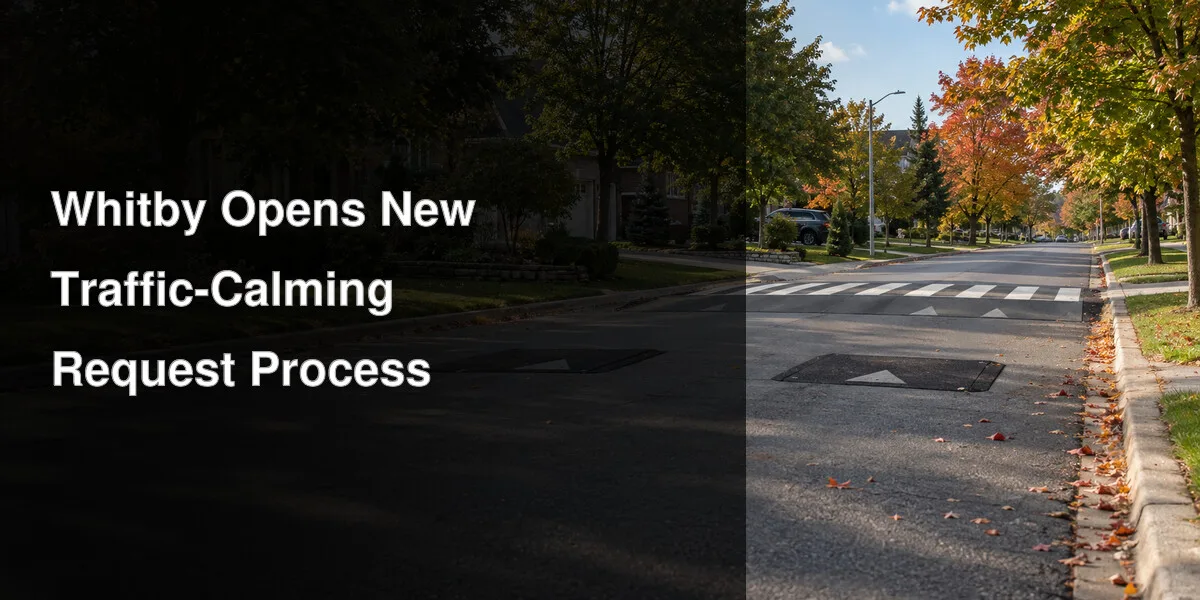
Traffic calming refers to physical changes intended to reduce vehicle speeds and support safer neighbourhood streets. Whitby says possible measures include speed humps, speed cushions, raised crosswalks, curb extensions and mini-roundabouts.
How Whitby traffic calming requests are reviewed
The process begins when a resident files a request through the Town’s online form. Municipal staff will first determine whether the road is eligible. Where appropriate, they will then collect and review traffic and road data.
Locations that meet the policy’s criteria will be assessed and ranked against other eligible streets across Whitby. The Town will gather community input before a proposed measure proceeds.
Eligible streets are limited to local roads, collector roads and select Type C arterial roads with a posted speed limit of 50 km/h or less. During initial screening, staff may use speed surveys, traffic counts and origin-destination studies. A request that passes screening must also demonstrate support from at least 30 per cent of households in the study area before a full technical assessment begins.
That ranking step is important because submitting a request does not guarantee that a speed hump, raised crossing or another traffic-calming feature will be installed. The policy is intended to give staff a consistent way to compare requests and direct resources to locations with the strongest demonstrated need.
Streets that qualify are scored using existing traffic and roadway conditions. Measures will be installed according to available budget and the location’s priority relative to other requests. Where a street does not reach the threshold for physical changes, the Town may consider education or enforcement measures instead.
The Town says more than 900 people contributed feedback through a survey and interactive mapping exercise while the policy was being developed. The leading concerns identified during that engagement were speeding, traffic volume, dangerous driving, cut-through traffic and safety around schools.
Not every Whitby road is covered
The process applies only to eligible roads under the Town of Whitby’s jurisdiction. Regional roads, provincial highways and private roads are excluded because the Town does not control those routes.
Residents should therefore check the eligibility information before completing a request. Whitby’s traffic-calming page explains the types of measures that may be considered and links to the request form.
The policy responds to a long-standing challenge for the municipality. Whitby receives many neighbourhood traffic-calming requests each year, but previously did not have one town-wide policy establishing how they would be evaluated and prioritized. The new framework is designed to make decisions more transparent and data-driven while ensuring residents are consulted before street changes are installed.
Residents can review the traffic-calming information and eligibility guidance or use the Town’s online traffic-calming request form.
Featured image: original AI-generated editorial illustration by AllAboutDurham.com; it does not depict a specific Whitby street.
Sources: Town of Whitby news release; Town of Whitby traffic-calming information