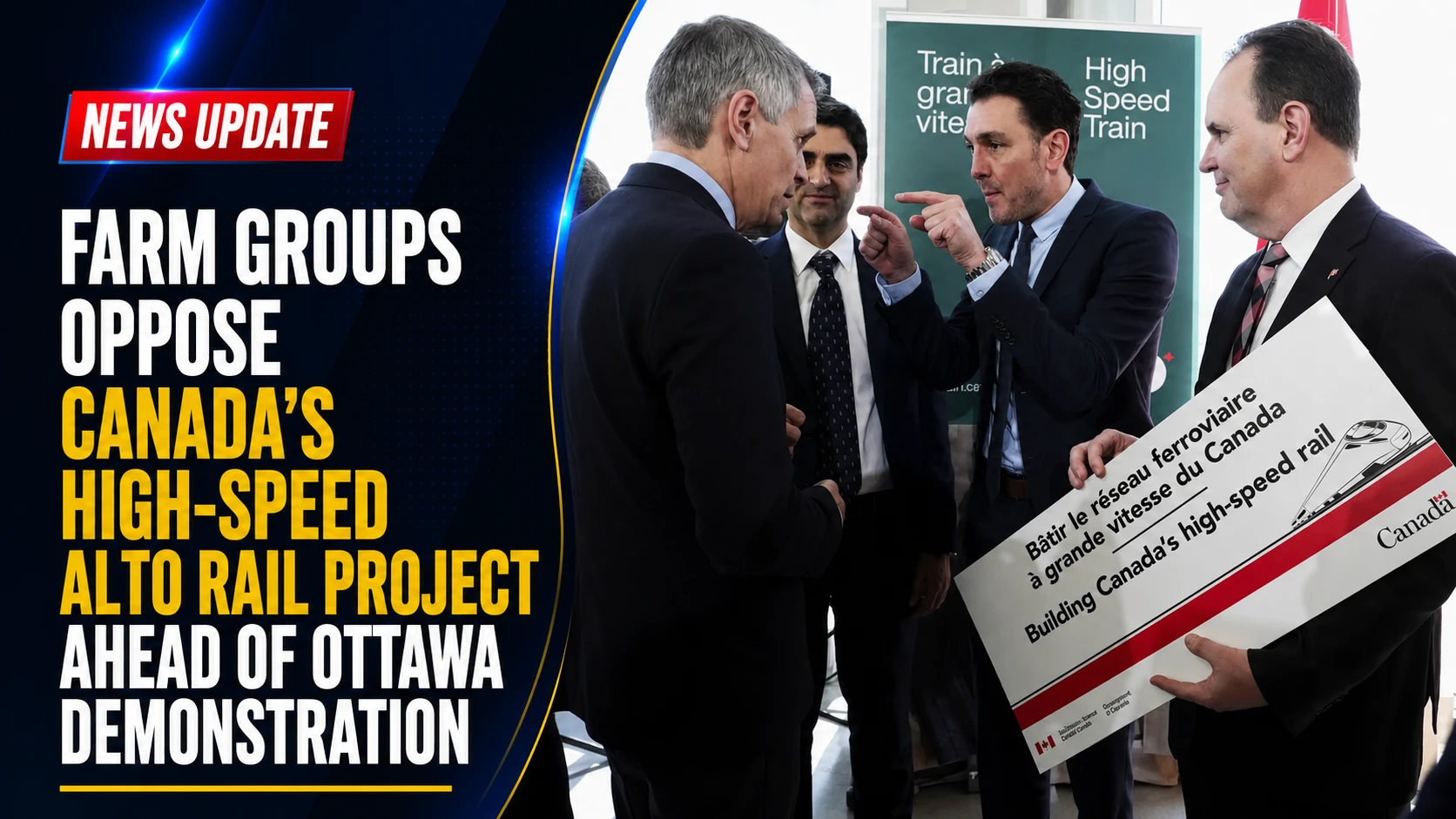
Farm organizations from across Quebec, Ontario, and Canada are calling on the federal government to thoroughly reconsider the proposed Alto high-speed rail line between Quebec City and Toronto, warning the project could cost far more than projected and cause lasting damage to agricultural land.
The Union des producteurs agricoles, Quebec’s largest farm organization, joined the Canadian Federation of Agriculture and the Ontario Federation of Agriculture at a press conference Monday in Berthierville, Quebec, to demand a new review. A peaceful demonstration is planned in front of Parliament in Ottawa on June 10.


The proposed 1,000-kilometre corridor would cut directly through valuable farmland across Ontario and Quebec, including areas near Durham Region, as it connects Canada’s two largest cities at speeds up to 300 kilometres per hour.


“We are not opposed to progress, but progress cannot come at the expense of the people and the farmland that feeds our communities and this country,” said Drew Spoelstra, president of the Ontario Federation of Agriculture.
The groups cited a September 2025 study by researchers from HEC Montreal, Universite Laval, and the University of Waterloo estimating the project would generate approximately 48 billion dollars in economic benefits over 40 years, far short of Alto’s projected 60 to 90 billion dollar price tag.
Jacques Roy, a professor at HEC Montreal and one of the study’s authors, pointed to France’s latest high-speed rail extension costing roughly 112 million dollars per kilometre. Applied to the Alto corridor, that translates to approximately 112 billion dollars, with some Ontario researchers estimating the final bill could reach 140 billion dollars.
For farmers in Ontario, including those in and near Durham Region, the concern extends well beyond mere cost. The rail corridor would divide fields, separate farm buildings from farmland, and create significant operational challenges lasting generations.
Although Alto has proposed overpasses and underpasses, the farm organizations said many producers would still face lengthy detours to reach sections of land separated by the rail line.
Martin Caron, president of the Union des producteurs agricoles, is also asking Ottawa to release the analyses behind choosing high-speed rail over a high-frequency alternative that would use existing corridors and require less new infrastructure.
“There are less costly solutions, easier to implement, that will disturb fewer people,” said Roy. “We just want them to be studied and for a transparent comparative analysis to be presented.”
The initial 200-kilometre segment between Montreal and Ottawa, expected to begin construction as early as 2029, would affect approximately 1,700 properties including at least 500 agricultural properties.
Durham Region has already been engaged in Alto discussions, with Whitby council passing a motion earlier this year demanding input on corridor planning and residents raising concerns about local impacts.
The June 10 demonstration in Ottawa is expected to draw farmers from across Ontario and Quebec, calling for a full, transparent review before the project permanently reshapes the agricultural landscape for decades.
“This is a cry from the heart we are making today,” said Caron. “It is a legacy we leave for generations and generations.”