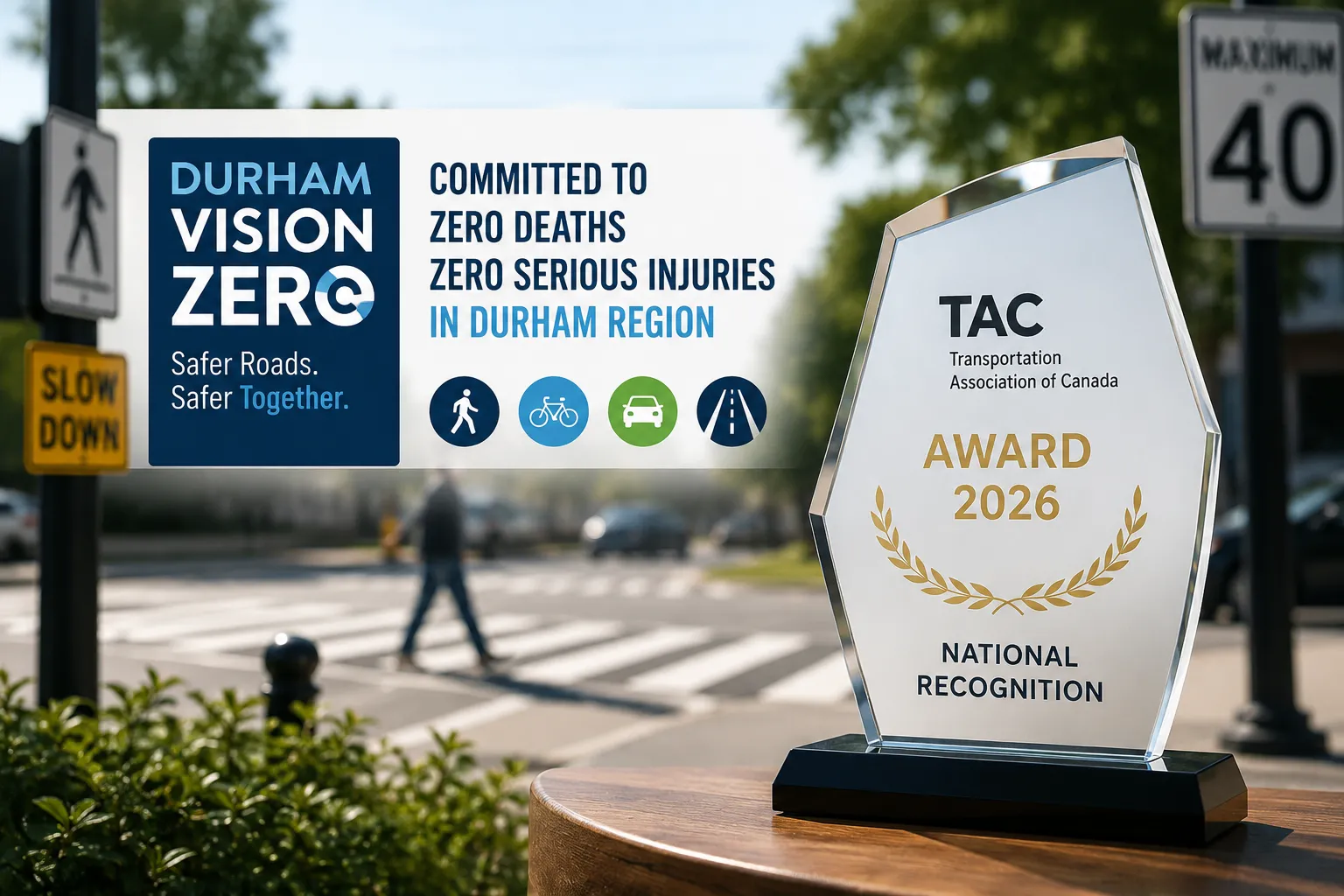
The Regional Municipality of Durham has officially been named the recipient of the 2026 Transportation Association of Canada (TAC) Road Safety Achievement Award. This prestigious national accolade recognizes the structural success of the Durham Vision Zero TAC Award 2026 initiative, celebrating the region’s comprehensive Strategic Road Safety Action Plan (SRSAP) and Report Card spanning 2019 to 2024. Produced in an engineering partnership with consultancy group CIMA+, the data-driven framework has positioned Durham as a leading model for municipal traffic intervention across Canada.
The foundation of the Vision Zero philosophy is built upon a single, non-negotiable moral anchor: no loss of life or serious injury on municipal transit networks is acceptable. Rather than treating traffic fatalities as unavoidable accidents, the regional strategy transforms road design, community enforcement, and public education into a unified system to insulate vulnerable road users from human error.
Targeted Action Across Eight Priority Demographics
The award-winning SRSAP framework deliberately concentrated its capital outlays and staffing allocations across eight highly specialized priority sectors where data indicated collision rates were disproportionately concentrated:


-
Vulnerable Road Users: Focused heavily on infrastructure separating pedestrians and cyclists from high-speed vehicular traffic.
-
Behavioral Reductions: Deploying multi-agency assets to combat aggressive driving, distracted driving, and driving under the influence of drugs or alcohol.
-
High-Risk Operators: Structuring targeted educational and monitoring loops tailored specifically toward younger novice drivers and operators of heavy commercial vehicles.
-
Conflict Geographies: Engineering physical improvements to manage complex traffic movements at standard intersections.
To move beyond theoretical goals, Durham Region paired each target zone with dedicated municipal budgets, explicit delivery timelines, and permanent engineering staff, ensuring that safety countermeasures were physically built rather than simply debated.
Exceeding the Five-Year Collision Reduction Target
When the five-year strategic plan was originally ratified by Regional Council, staff set an aggressive baseline target to achieve a absolute 10% reduction in fatal and injury-causing collisions across all regional roadways. According to the validated metrics published in the final Vision Zero Report Card, Durham successfully surpassed this threshold, locking in an official 11% net reduction in severe collisions by the close of the operational window.
This systemic decline was engineered through the rapid rollout of more than 260 localized physical countermeasures across the region’s eight lower-tier municipalities. Key physical infrastructure assets deployed during the campaign included the construction of modern traffic roundabouts to eliminate high-impact T-bone collisions, the installation of durable center median barriers, and the application of transverse tactile rumble strips to prevent rural lane departures.
Pedestrian protections were similarly modernized through the introduction of Leading Pedestrian Intervals (LPIs)—which grant walkers a head start at traffic lights before vehicles are permitted to turn—alongside dedicated bicyclist crossrides and advanced radar feedback signage. These physical changes were reinforced by ongoing regional awareness initiatives, including National Teen Driver Safety Awareness Week and specialized anti-aggressive driving campaigns. Following the TAC announcement, regional transit teams will present a detailed retrospective webinar on June 11, 2026, outlining how peer municipalities can clone Durham’s data-driven framework.