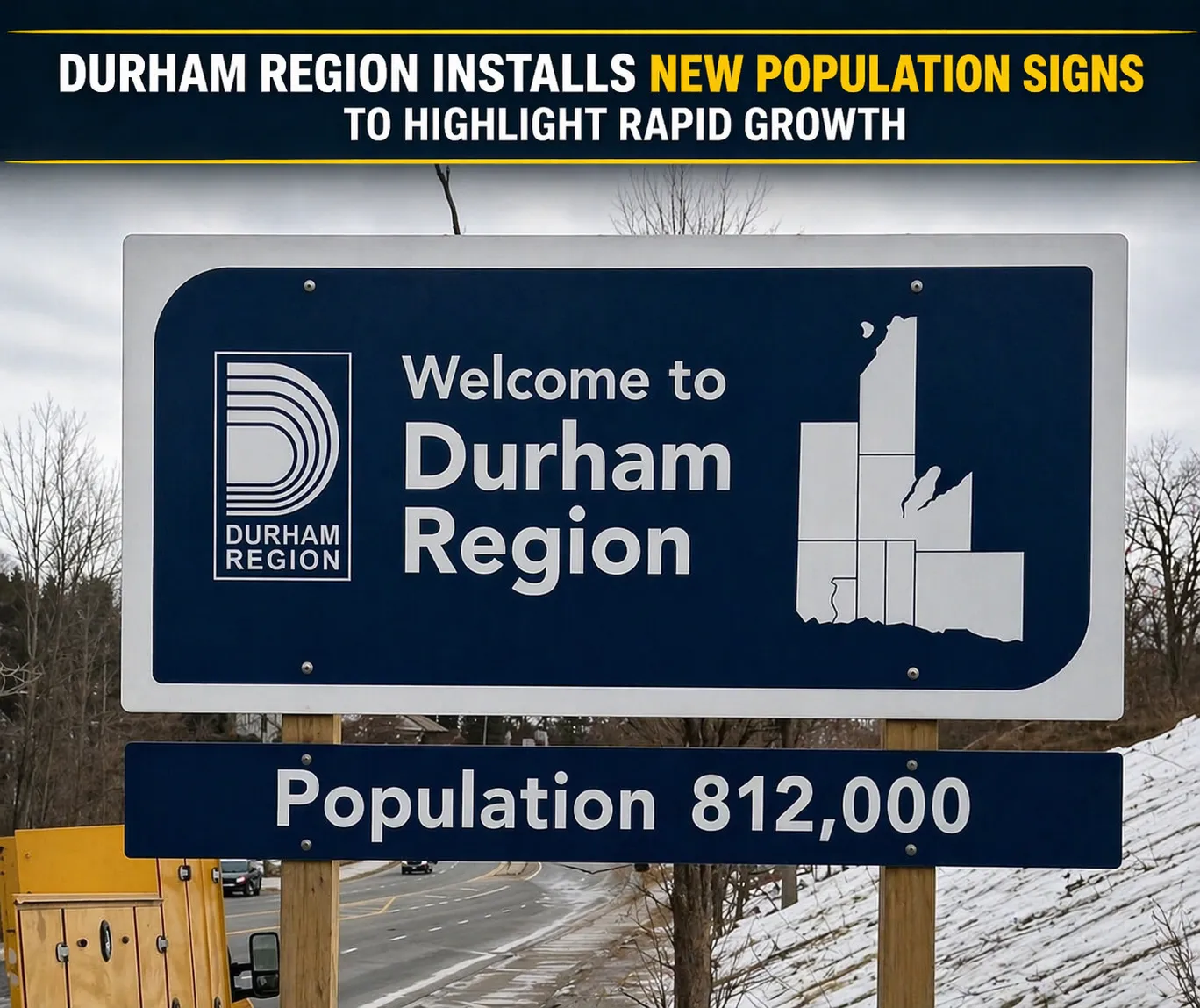
Travelers entering Durham Region will soon be greeted by a striking visual representation of the area’s booming expansion. The Regional Municipality of Durham has begun the installation of 23 new boundary signs that prominently display the region’s current population of 812,000. As of Tuesday, April 21, 2026, 12 signs have already been erected at key entry points, including Kingston Road in Pickering. The project, spearheaded by Oshawa Regional Councillor John Neal, aims to correct public misconceptions about the scale of the region and provide a clear indicator of just how quickly the “Gateway to the East” is growing.
The Durham regional population signs arrive at a time of unprecedented demographic shifts. In 2000, the region’s population sat at approximately 561,000; by 2023, it had climbed to 753,090. The current figure of 812,000 represents a nearly eight per cent growth surge in just the last three years. Projections from regional planners suggest this is only the beginning, with Durham expected to reach a staggering 1.3 million residents by 2051. Councillor Neal noted that many residents are “shocked” by these figures, as the perceived scale of the community often lags behind the reality of the high-density developments appearing across the landscape.

The signs are being strategically placed at major provincial and regional borders to ensure maximum visibility for commuters and visitors. In the south, motorists will see them on Taunton Road and Kingston Road at the Scarborough-Pickering line. To the north and west, signs are being installed at the York-Durham border in Uxbridge and along Simcoe Street in Brock and Scugog. These markers serve as a reminder that Durham is no longer just a collection of “bedroom communities” for Toronto, but a massive, self-sustaining economic engine in its own right.


The installation project is expected to be completed within the next few months. Beyond simply providing a number, the Durham regional population signs are intended to foster a sense of regional identity. As the municipality grapples with the logistical challenges of such rapid growth—including the need for expanded transit, housing, and emergency services—officials believe that transparency regarding the population scale is vital for informed public discourse. “It’s really important that people know,” Neal emphasized, noting that the signs provide a baseline for understanding why regional infrastructure investments are so critical.
Residents can expect to see the remaining 11 signs pop up throughout the spring at locations such as Ganaraska Road in Clarington and Regional Road 13 in Brock. The initiative has already sparked conversation among locals, with many taking to social media to discuss the implications of reaching the 800,000-person milestone. As Durham continues its march toward the one-million mark, these signs will remain a permanent fixture of the changing landscape, documenting the region’s evolution from a rural-suburban hybrid into a major urban metropolis.