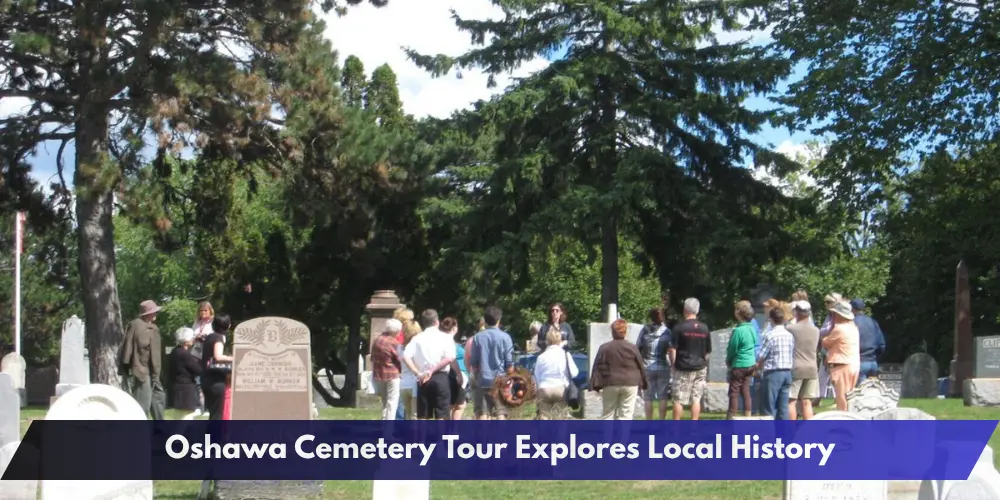
The Oshawa Cemetery Tour will give residents and visitors an opportunity to explore nearly two centuries of local history during a guided walk through Union Cemetery on Saturday, August 8.
Presented by the Oshawa Museum, the tour will begin at 2 p.m. at the cemetery’s main gates at 760 King Street West. Participants will learn about political leaders, business owners, innovators and everyday residents who helped shape Oshawa and the surrounding area.


Tickets cost $5.72, while members of the Oshawa Historical Society can attend free of charge.


Stories behind Oshawa’s development
Union Cemetery is Oshawa’s largest cemetery and one of its oldest historic sites.
Its earliest memorials date to the 1830s, reflecting the early development of Oshawa and East Whitby Township. A City of Oshawa heritage study notes that the property contains memorials belonging to some of the community’s earliest pioneer families, with some dating to 1837.
The guided tour will examine how Oshawa gained electricity, developed its industrial economy and became home to a major General Motors manufacturing operation.
Visitors will also hear stories about the election of Oshawa’s first female political representatives and the people whose names remain connected to local streets, institutions and neighbourhoods.
Oshawa Museum representative Lisa Terech said the tours highlight both prominent historical figures and residents whose quieter contributions still form an important part of the city’s story.
Former premier buried at Union Cemetery
Among the best-known figures buried at Union Cemetery is Gordon Conant, who served as premier of Ontario.
His gravesite is marked by a provincial flagpole and bronze memorial recognizing his service as a former provincial leader.
Thomas Nicholson Gibbs, Oshawa’s first member of Parliament and the namesake of Gibb Street, is also buried at the cemetery.
The tour provides an opportunity to learn how these political figures influenced the development of Oshawa and Ontario.
McLaughlin family played major industrial role
Several members of the McLaughlin family are buried at Union Cemetery.
Robert McLaughlin built an internationally successful carriage-manufacturing business before his sons, Sam and George McLaughlin, encouraged the company to expand into automobile production.
That transition ultimately contributed to the establishment of General Motors operations in Oshawa and helped define the city’s industrial identity for generations.
The family’s influence can still be seen throughout Oshawa through historic properties, institutions and landmarks carrying the McLaughlin name.
Everyday residents also remembered
The Oshawa Cemetery Tour will not focus only on politicians and industrial leaders.
Eli Edmondson, who helped bring electricity to Oshawa during the late 1800s, is among the lesser-known local figures whose story may be discussed.
Visitors may also learn about Evelyn Bateman, who became Oshawa’s first female councillor during the late 1940s.
Other stories include residents who contributed to the First World War effort in different ways and were later buried near one another despite having no known connection during their lives.
The Oshawa Museum says these accounts help show the diversity of experiences that shaped the city.
Cemetery shared by Oshawa and Whitby
Union Cemetery is located near the border between Oshawa and Whitby and was historically used by residents from both communities.
It originally served Presbyterian families before surrounding land was acquired and developed as a non-denominational cemetery.
The grounds were designed by landscape architect H.A. Engelhart, who also worked on Toronto’s Mount Pleasant Cemetery. Union Cemetery was later donated to the Town of Oshawa in 1922.
The City of Oshawa continues to operate the cemetery and provides information about its history and services.
Tour begins Saturday afternoon
Participants in the Oshawa Cemetery Tour should meet at Union Cemetery’s front gates before the 2 p.m. start time on August 8.
The Oshawa Museum has offered cemetery tours for decades, typically attracting local residents and visitors from surrounding communities.
Because the event is outdoors and involves walking through cemetery grounds, participants should wear suitable footwear and dress for the weather.
The tour offers a chance to experience Oshawa’s history through the lives of the people who helped build the community.