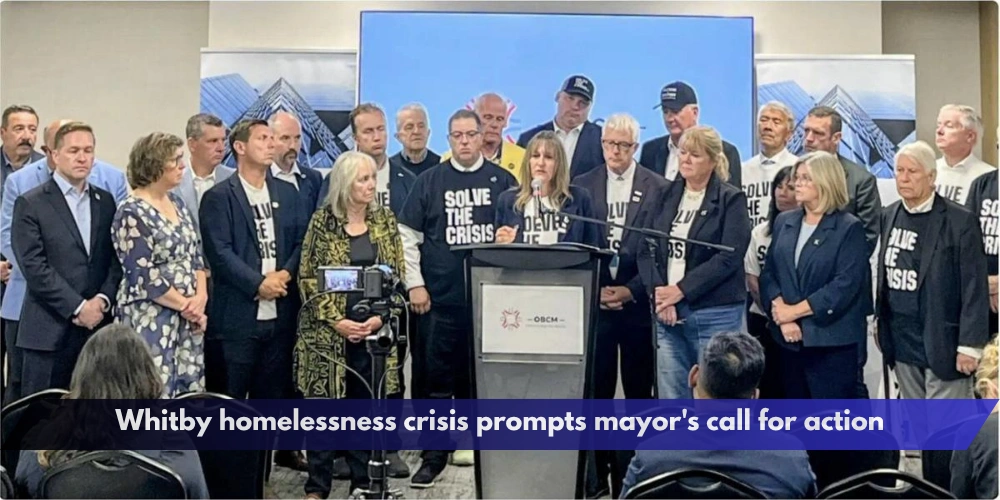
Whitby Mayor Elizabeth Roy is joining Ontario’s Big City Mayors in renewing calls for stronger provincial action on homelessness, mental health and addiction, arguing that municipalities cannot carry the growing financial and social burden alone.
The Whitby homelessness crisis is part of a broader challenge affecting communities across Durham Region and Ontario. Roy recently joined more than two dozen mayors and regional leaders in Ottawa to support the next phase of the Solve the Crisis campaign, known as Reaction to Recovery.

Mayors call for expanded recovery services
The campaign calls for faster access to treatment and recovery services, a dedicated provincial ministry focused on mental health and addictions, and changes to legislation governing mental health care and consent. It also asks governments to expand addiction treatment and rehabilitation programs in correctional institutions and formally recognize the scale of the crisis.


Durham Region has been significantly affected by homelessness. Recent figures cited by the Town of Whitby indicate at least 1,871 people are experiencing homelessness across the region, including 338 in Whitby.
Local governments have responded with shelters, transitional housing and other supports, but Roy says those measures are not enough without sustained help from senior levels of government.
Whitby housing and recovery supports expanding
One of the Region’s largest responses is the shelter at 1635 Dundas Street East in Whitby, which opened in 2024. The federal government later announced $40 million toward Phase 2 of the site.
The expansion is expected to add supportive and transitional housing along with wraparound services such as addiction recovery support, palliative care and a medical clinic.
Whitby is also part of Ontario’s Homelessness and Addiction Recovery Treatment initiative. A HART Hub serving Whitby was launched in partnership with Durham Community Health Centre, with services initially being delivered through an interim partner location while a permanent Whitby site is planned.
The model is intended to connect people facing homelessness, mental health challenges and substance use concerns with coordinated treatment, primary care, housing supports and recovery services.
Roy and the Ontario Big City Mayors say municipalities have already invested heavily in emergency shelter, housing and community support programs, but local property tax systems were not designed to fund health and social services at the scale now required.
Reaction to Recovery campaign seeks provincial action
Reaction to Recovery is intended to shift the focus from responding to emergencies toward creating longer-term pathways into treatment, housing and stability. The mayors are pressing the province to increase treatment capacity and provide more predictable funding so people can access help when they are ready to enter recovery.
Roy has said the issue is especially important to her as Whitby’s mayor and as chair of Durham Region’s health and social services committee. She has pledged to continue advocating for coordinated action from provincial and federal governments.
The Whitby homelessness crisis remains closely connected to broader concerns about mental health, addiction, housing affordability and access to care. Municipal leaders argue that lasting progress will require cooperation between local, provincial and federal governments rather than relying on municipalities to respond on their own.
Residents who want to learn more about the campaign or support its calls for action can visit the Solve the Crisis initiative online.