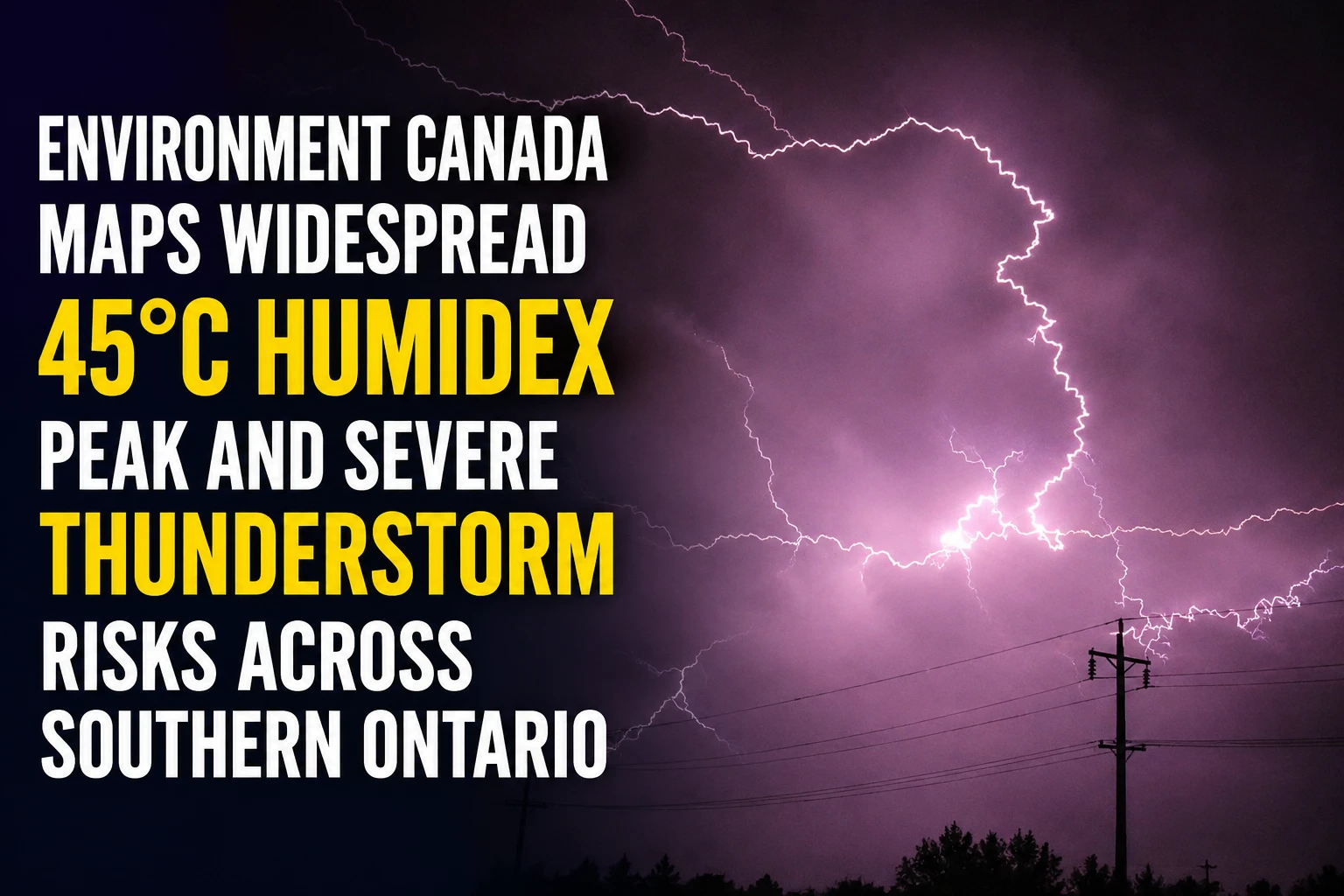
The regional public safety networks, municipal emergency services, and weather forecasting grids across the Greater Toronto Area are on high alert as an aggressive multi-day convective weather setup locks down the province. Tracked under provincial meteorology registries on Monday, June 29, 2026, Environment Canada finalized severe tracking frameworks for the Severe thunderstorm risk for parts of southern Ontario amid heat wave. An unseasonably intense sub-tropical thermal ridge has combined with stagnant, high-density lower-atmospheric moisture to drive real-feel heat indicators deep into dangerous territory, while simultaneously supplying the raw environmental energy required to fuel severe localized thunderstorm cells.
Because the system is rapidly building strength over parched ground, regional authorities are warning communities to prepare for sudden wind damage, localized downpours, and structural power grid disruptions.


The Multi-Day Extreme Heatwave and Localized Humidex Tracking
The primary weather threat stems from an expanding heat dome that will systematically intensify as the week progresses.


-
The Tuesday Thermal Spike: Ambient afternoon temperatures are projected to climb to an actual baseline of 34°C across the Greater Toronto Area on Tuesday. When factoring in the extreme water vapor content in the air, the humidex value is mapped to spike directly to 42°C.
-
The Mid-Week 45°C Humidex Peak: The apex of the heatwave will settle heavily over eastern Durham and southern Ontario on Wednesday and Thursday. Daytime ambient ranges will hover between 33°C and 36°C, forcing the real-feel humidex up to a staggering 40°C to 45°C.
-
The Convective Threat (Location C / Grey Zones): While the highest severe storm risks (including risks of large hail, damaging straight-line winds, and isolated tornadoes) track northeast toward Ottawa and Kingston, the Durham Region and broader GTA remain under an active convective threat. Forecasters warn that isolated, moisture-rich storms could erupt rapidly within the grey-mapped zones, dropping up to 30 mm of rain locally within an hour and triggering rapid street flooding.
Analyzing the Environment Canada Multi-Day Micro-Climate Projection
The combining forces of extreme heat and convective storm energy require continuous tracking across municipal power and water infrastructure nodes.
| Targeted Calendar Timeline | Ambient High Temp Range | Projected Maximum Humidex Peak | Dominant Convective Threat Profile | Local Rain Volume Thresholds |
| Monday Operational Core | 31°C to 33°C Base | 38°C Real-Feel Margin | Isolated cells northwest of GTA | Trace amounts / High cloud decks |
| Tuesday Heat Expansion | 34°C Flat Base | 42°C Extreme Threshold | Widespread storm risk / High uncertainty | Up to 30 mm locally under storm cores |
| Wednesday Apex Windows | 33°C to 36°C Base | 45°C Dangerous Spike | Heat warning active / Unstable air mass | Predictability too low for exact maps |
| Thursday Extended Surge | 33°C to 36°C Base | 45°C Dangerous Spike | Heat warning active / Unstable air mass | Predictability too low for exact maps |
Meteorologists note that the extreme atmospheric instability means storm paths remain highly unpredictable. If these high-energy cells successfully break through the mid-level capping inversion, the resulting downburst winds will easily possess enough velocity to toss loose backyard objects, down mature tree branches, and cause localized power outages across regional neighborhoods. Emergency services are advising families to keep cooling systems running efficiently and to double-check backup power supplies as the electrical grid faces peak air-conditioning loads.
Durham Region homeowners, construction site foremen, and transit commuters looking to monitor live interactive Doppler precipitation radars, track changing municipal cooling center locations, or receive real-time weather warning alerts can access the central provincial data repository online at weather.gc.ca.