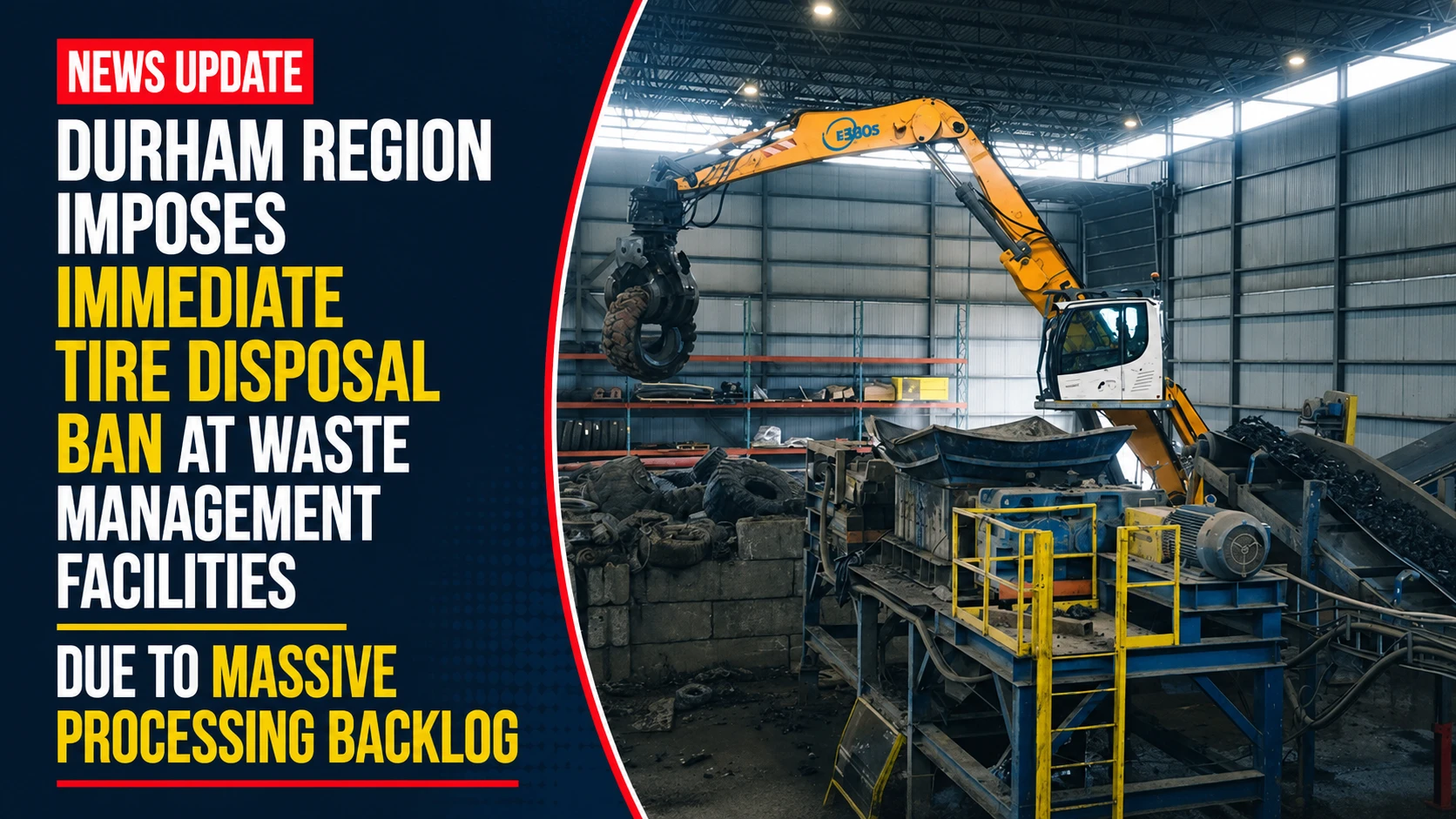
The municipal waste management networks, regional environmental compliance divisions, and local circular economy frameworks within the Durham Region have enacted an emergency intake freeze. Tracked under regional service registries on Monday, June 29, 2026, administrative staff finalized the operational parameters for No more tires at waste facilites in Durham Region ‘until further notice’. Spurred by a systemic failure in the provincial third-party haulage network, the region has completely suspended the acceptance of scrap tires across its major public disposal depots to prevent local sites from violating their legally mandated storage caps.
The unexpected logistics freeze forces local automotive body shops, regional tire retailers, and residential property owners to find alternative private storage or recycling options for their scrap rubber.


The Broken Haulage Chain and Environmental Storage Compliance
The temporary ban highlights a growing friction point between municipal processing speeds and provincial producer-responsibility recycling frameworks.


-
The Affected Drop-Off Stations: The tire suspension is active immediately at the region’s three core hubs: the Oshawa Waste Management Facility (1640 Ritson Road North), the Scugog Waste Management Facility (1623 Reach Street), and the Brock Waste Management Facility (C22480 Brock Sideroad #17).
-
The Compliance Overstock Catalyst: Each regional depot operates under a strict provincial Environmental Compliance Approval (ECA) tied to the Waste Diversion Act. These certificates dictate hard limits on the maximum volume of rubber that can be stored on-site to mitigate severe environmental and fire hazards.
-
The Systemic Logistics Deficit: Regional staff revealed that under the current Used Tire program, local consumer volume is dramatically outpacing the speed at which third-party program haulers and contracted processors are clearing the bins, causing massive, unauthorized stockpiles.
Analyzing the 2026 Durham Regional Tire Diversion Interruption
Local administrators are directing residents to hold onto their tires or navigate past municipal sites to use provincial producer-responsibility networks.
| Targeted Regional Facility Asset | Immediate Material Intake Status | Primary Operational Bottleneck | Recommended Public Workaround Route |
| Oshawa WMF (Ritson Road N.) | Total Suspension / Closed to Tires | Exceeded ECA storage volume limits | Search localized retail drop-off maps |
| Scugog WMF (Reach Street Hub) | Total Suspension / Closed to Tires | Hauler collection frequency deficit | Store rubber assets securely on private land |
| Brock WMF (Brock Sideroad #17) | Total Suspension / Closed to Tires | Hauler collection frequency deficit | Utilize RPRA digital locator toolsets |
| Clarington Special Waste Depot | Monitored Under Separate Framework | Baseline sorting volume restrictions | Call facility to confirm active item rules |
The collection freeze matches similar inventory actions across other southern Ontario jurisdictions, where a recent drop in provincial producer target metrics from 85% down to 65% has led private recycling organizations to scale back their collections from municipal yards. To help ease the strain, the region is steering residents away from municipal drop-offs toward the Resource Productivity & Recovery Authority (RPRA). Their database links users to local automotive mechanics, commercial dealerships, and licensed private scrap yards that still accept old tires for recycling.
Durham Region residents, commercial tire technicians, and independent mechanics looking to verify active wait times, look up the status of the material ban, or locate an alternative drop-off site can map out verified locations online via rpra.ca/where-to-recycle or track regional facility status at durham.ca/WMF.