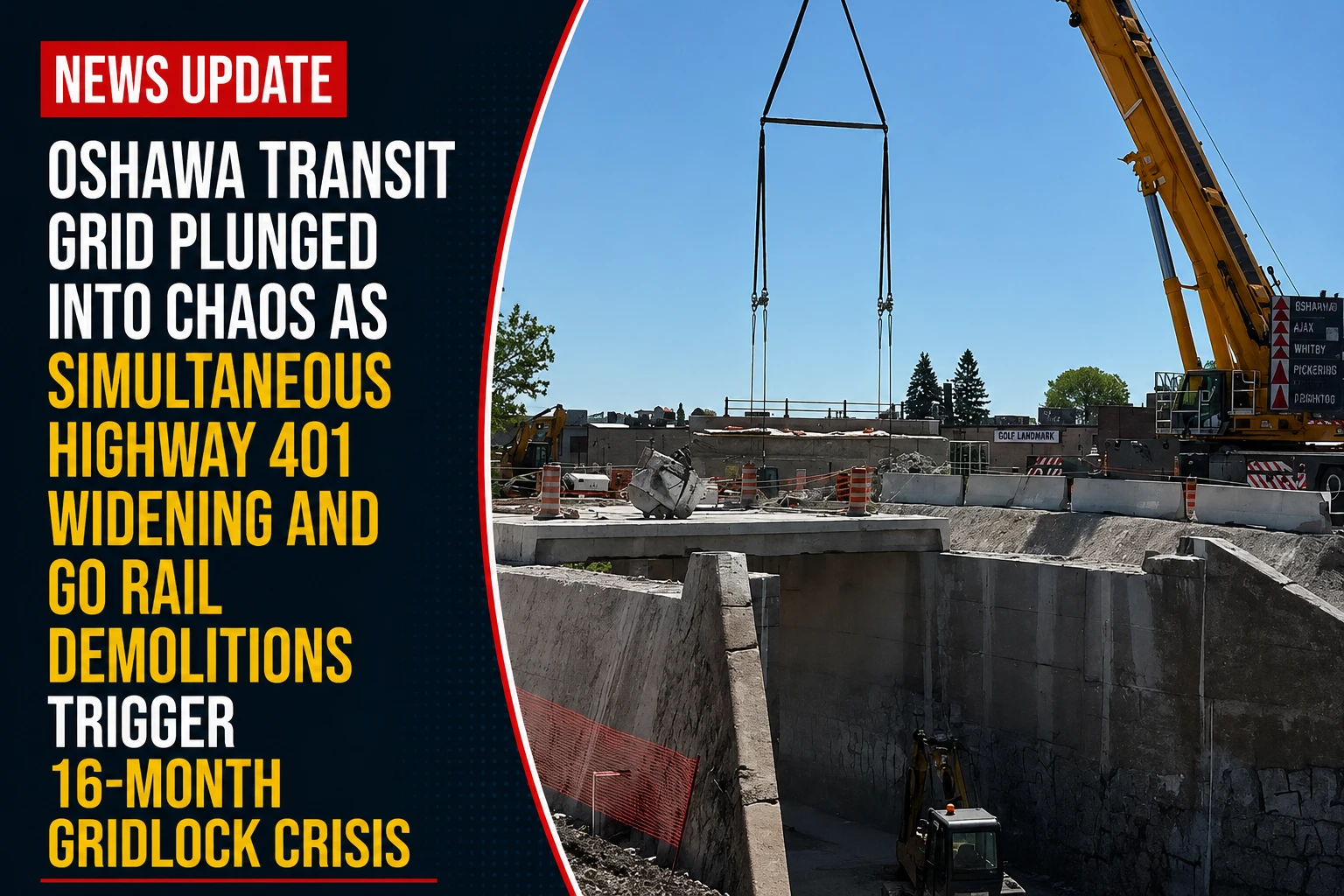
The municipal engineering directorates, regional traffic management centers, and neighborhood safety councils within the Durham Region are responding to a severe gridlock emergency. Tracked under local transit registries on Monday, July 6, 2026, corporate planning staff finalized the infrastructure impact file Traffic chaos in Oshawa from GO train, highway work getting worse with more closures. Erupting from a major coordination failure between Metrolinx and the Ministry of Transportation (MTO), simultaneous long-term bridge replacements have severed the primary north-south arteries connecting downtown Oshawa to Highway 401 and the waterfront, converting local residential streets into high-speed detour vectors.
Ward councillors are reporting a massive surge in public complaints as provincial agencies push forward with consecutive road closures, completely bypassing traditional municipal consultation channels.

The South Oshawa Construction Conflict and Closure Grid
The overlapping provincial construction schedules have created a bottleneck, systematically shutting down alternative routes across the southern sector of the city.


-
The Metrolinx Line Barrier: Motorists are already dealing with a massive two-year full closure of a portion of Simcoe Street South to accommodate heavy structural alterations for the Metrolinx Bowmanville GO train rail expansion.
-
The MTO Overpass Blitz: Compounding the Simcoe Street closure, the MTO has aggressively moved up its Highway 401 widening timeline, forcing the total reconstruction of multiple highway overpass networks ahead of schedule.
-
The Park Road Interdiction: Already hit by an initial weekend closure on June 27–28, Park Road—from Bloor Street to College Avenue—will shut down completely to all traffic on Monday, July 13, 2026. This closure directly severs a primary commuter route utilized by thousands of daily shift workers at the massive General Motors Assembly Plant.
-
The Secondary Artery Shutdowns: The secondary link of Cubert Street has been barricaded to replace its aging overpass structure. Concurrently, the Wilson Road overpass replacement has forced a total closure of Wilson from Dieppe Avenue to Bloor Street. Both the Cubert and Wilson projects are locked into a 16-month construction timeline, remaining closed until at least the fall of 2027.
Analyzing the Residential School Zone and Pedestrian Safety Risks
As thousands of vehicles try to bypass the provincial barricades, south Oshawa homeowners are reporting severe traffic infiltration through fragile school zones.
| Impacted Residential Corridor | Observed Traffic Stressor | Primary Public Safety Risk | Required Municipal Mitigation |
| Laval Drive / Hillside Avenue | Commuters traveling at 70–80 km/h down tight residential corridors | High-velocity vehicle strikes in designated 40 km/h zones | Immediate installation of physical radar traps and speed cushions |
| Salisbury Street & Laval Drive | High volumes of bypass traffic completely running past marked stop signs | T-bone collisions at intersections directly bordering child daycares | Deployment of dedicated emergency regional police enforcement units |
| South Oshawa School Pods | Heavy commercial and commuter spillover cutting past three local schools | Complete loss of safe walking paths for elementary students | Urgent deployment of regional crossing guards before September |
The “Told, Not Asked” Governance Dispute
Oshawa Councillor Brian Nicholson has launched a fierce public critique of both Metrolinx and the MTO, accusing provincial managers of showing a total lack of concern for municipal safety. Nicholson stated that local staff are being “told, not asked” about major route changes, asserting that provincial authorities would have shuttered these vital arteries without providing any warning to the city had municipal workers not proactively reached out to investigate the construction zones.
In response to growing community anger, city staff are working to finalize emergency vehicle and pedestrian detours. Local representatives are pressuring regional staff to implement immediate traffic-calming measures on residential streets to protect families before the school year begins.
The City of Oshawa public works division and the Ministry of Transportation handle ongoing project updates.
Oshawa commuters, GM assembly plant employees, and local property owners looking to download official detour map packages, track live transit delays, or log neighborhood speeding complaints can access the traffic portal online at oshawa.ca, metrolinx.com, or monitor highway lane closures via 511on.ca.