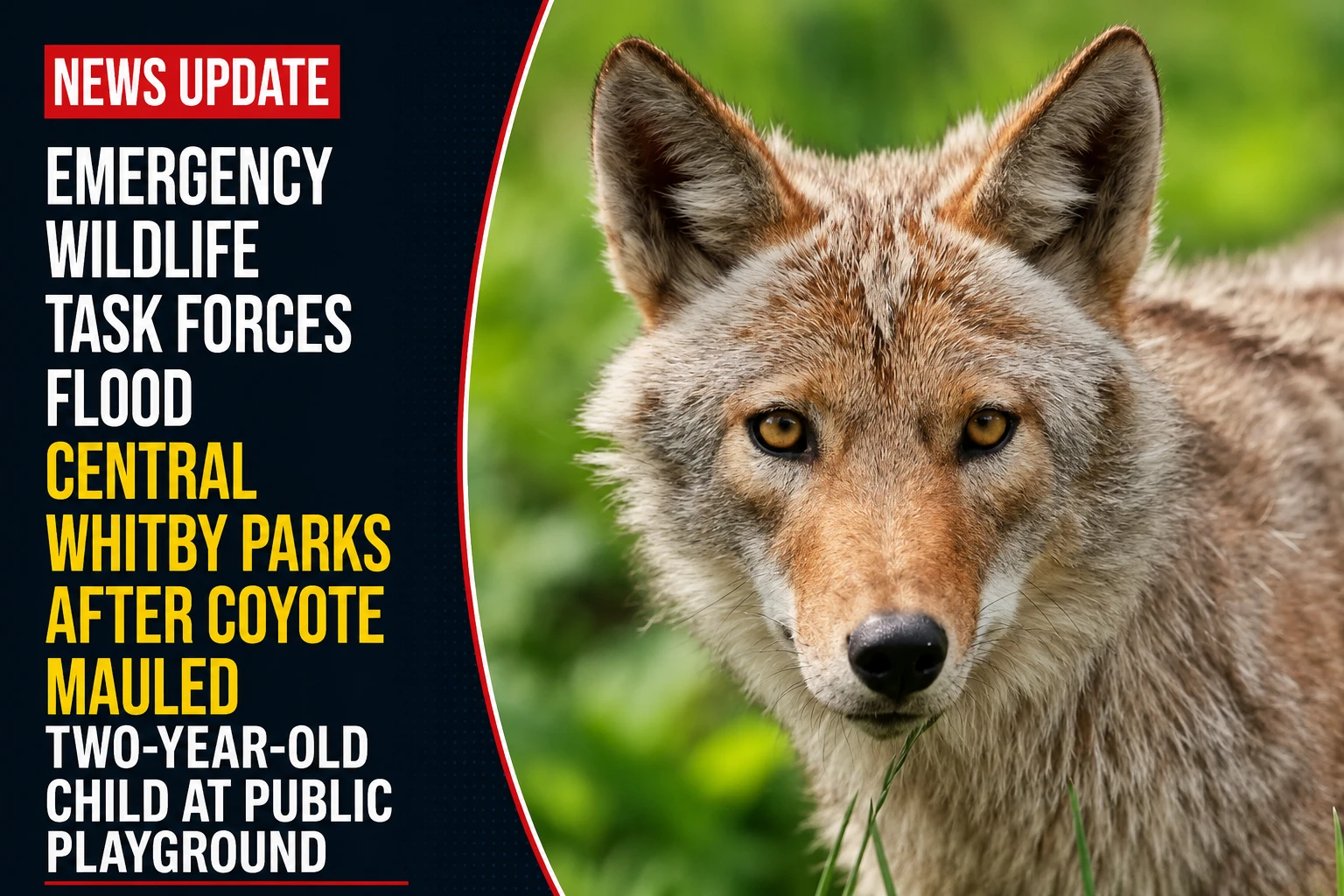
The regional paramedic services, wildlife enforcement divisions, and municipal health management bureaus within the Durham Region are coordinating a priority safety response. Tracked under local emergency dispatches on Monday, July 6, 2026, tactical operators finalized the critical response log 2-year-old bitten in the face by coyote in Whitby playground. Interrupting mid-evening family recreational activities at a neighborhood park, an unprovoked coyote breached an urban playground footprint and directly targeted a toddler, inflicting serious facial injuries before being driven back by a crowd of bystanders.
The dangerous encounter represents the second severe predatory attack on a young child within the same municipal sector inside a two-week window, prompting emergency safety protocols across local green spaces.

The Vanier Park Breach and Consecutive Midnight Incident Grid
First responders and wildlife tracking units had to manage two separate, rapid coyote encounters across the town’s residential core within a tight one-hour operational block.


-
The Playground Attack (8:30 p.m.): Dispatches received an urgent request to assist paramedics at Vanier Park (located near Brock Street North and Rossland Road East). A two-year-old boy was playing in the designated youth playground zone when a bold, unprovoked coyote entered the area and bit the toddler directly in the face.
-
The Bystander Counter-Intervention: The child’s guardian, backed by several nearby park visitors, immediately swarmed the animal, yelling and waving their arms to break up the attack and force the coyote to retreat back toward the tree line.
-
The Triage Status: The child suffered serious, deep bite trauma across his facial profile and was rushed by emergency emergency services to a local hospital. Doctors have since stabilized the toddler, classifying his condition as non-life-threatening.
-
The Secondary Sighting (9:20 p.m.): Less than an hour later, patrol cruisers were pulled to a second call near Harriet Street and Annes Street. Local homeowners found a separate coyote in severe distress wandering through residential yards. DRPS officers intercepted the animal and safely removed it from the neighborhood without further injuries to the public.
Analyzing the Escalating Regional Wildlife Threat Matrix
Public health data lists these recent incidents as part of a highly unusual, aggressive cluster of predatory behavior within Durham’s urban boundaries.
| Chronological Sighting Block | Target Incident Location Matrix | Victim Profile / Age Tier | Core Operational Outcome |
| Monday, June 22, 2026 | Public field near tree line at Coronation Rd. & Rossland Rd. | Male toddler youth | Bitten while walking; transported to a specialized Toronto-area trauma center |
| Sunday, July 5, 2026 | Active playground zone inside Vanier Park (99 Vanier St.) | 2-year-old male infant | Bitten in the face; currently hospitalized with serious physical trauma |
| Sunday, July 5, 2026 | Residential boundary at Harriet St. & Annes St. | None (Animal in distress) | Targeted canine successfully located and removed by responding DRPS units |
The Multi-Agency Joint Action Directive
Confronted by this spike in aggressive wild animal behavior, the Durham Regional Police Service has launched a joint investigation alongside the Town of Whitby, the Durham Region Health Department, and Whitby Animal Services. Multi-agency field crews are actively deploying automated tracking gear, increasing uniform patrols near playground borders, and auditing park perimeters to pinpoint hidden food attractants or potential den coordinates.
Emergency Coyote Defense and Encounter Guidelines
Municipal animal control officers are instructing all neighborhood residents to review defensive safety protocols immediately:
-
Enforce Absolute Distance: Never approach, photograph, feed, or attempt to domesticate any urban coyote.
-
Deny Attractants: Secure all household garbage bins, remove outdoor pet food bowls, clean up fallen lawn fruit, and clear out low bird-feeder seed piles.
-
Stand Ground and Hazing: If confronted, never turn your back or run, as this trips the animal’s predatory chase reflex. Instead, stand tall, open your jacket to look as large as possible, make loud noises, and aggressively wave your arms to push the animal away.
The Town of Whitby Animal Services Division and the Durham Health Unit manage the central wildlife sighting and tracking database.
Whitby families, elementary school administrators, and local property owners looking to submit an automated wildlife sighting report, check updated park hazard signage grids, or download personal family and pet safety toolkits can find the official portals online at whitby.ca, drps.ca, or log sightings through the geographic mapping network at survey123.arcgis.com.