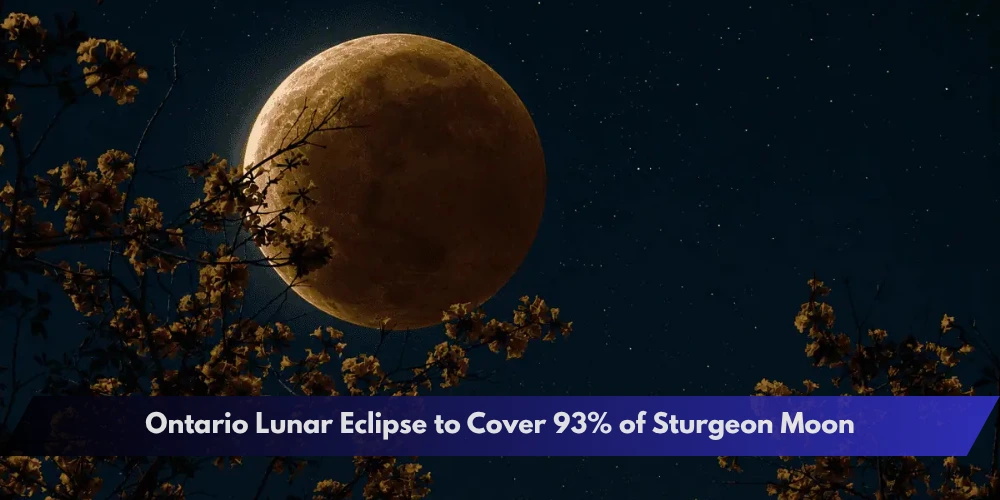
An Ontario lunar eclipse will darken nearly the entire Sturgeon Moon overnight from Thursday, August 27, into Friday, August 28. The deep partial eclipse will be visible across Durham Region and most of the Americas, provided clouds do not block the view. At maximum, approximately 93 per cent of the Moon’s diameter will be covered by Earth’s dark central shadow.
Although it will not technically become a total lunar eclipse, the event may look similar to one near its peak. Most of the lunar surface could take on a copper, orange or reddish appearance, while a narrow bright section remains outside Earth’s umbral shadow.

Ontario Lunar Eclipse Begins Thursday Evening
For Toronto and surrounding areas, including Durham Region, the penumbral stage begins at approximately 9:23 p.m. on August 27. During this early phase, Earth’s lighter outer shadow moves across the Moon, producing shading that may initially be difficult to notice.


The more visible partial eclipse begins at approximately 10:33 p.m. A dark curved shadow will gradually spread across the Moon as it moves deeper into Earth’s umbra.
Maximum eclipse is expected at approximately 12:12 a.m. on Friday, August 28. At that point, the Moon will be about 34 degrees above the horizon in the south-southeastern sky when viewed from Toronto. Viewing circumstances in Durham should be nearly identical.
The partial stage ends at approximately 1:51 a.m., while the weaker penumbral phase continues until about 3:01 a.m. The entire event lasts roughly five hours and 38 minutes, with the easily visible partial stage lasting about three hours and 18 minutes.
Sturgeon Moon Peaks Shortly After Midnight
The August full Moon reaches its official peak at approximately 12:18 a.m. EDT on August 28, only minutes after the eclipse reaches maximum. The name Sturgeon Moon is popularly connected to the period when large sturgeon were historically caught in greater numbers in the Great Lakes and other major North American waterways.
Full-Moon names vary among cultures and communities, and Sturgeon Moon is not a universal name. It is one of several traditional or popular names associated with August’s lunar cycle.
Why the Moon May Turn Red
A lunar eclipse occurs when Earth moves between the Sun and the full Moon, causing Earth’s shadow to fall across the lunar surface. A partial eclipse happens when only part of the Moon passes through the darkest section of that shadow.
Some sunlight still passes through Earth’s atmosphere before reaching the eclipsed Moon. Shorter blue wavelengths are scattered more strongly, while red and orange light can continue through the atmosphere and illuminate the lunar surface. Atmospheric dust and clouds can affect how bright or dark the colour appears.
How to Watch the Eclipse in Durham
No special protective glasses are required for the Ontario lunar eclipse. Unlike a solar eclipse, a lunar eclipse is completely safe to watch directly with the naked eye. Binoculars or a small telescope can provide a closer view but are not necessary.
Viewers should choose an outdoor location with a clear southern or southeastern horizon and limited artificial lighting. Parks, rural roads and open waterfront locations may offer better visibility than brightly lit areas.
The most dramatic viewing period should be between approximately 11:30 p.m. on August 27 and 12:45 a.m. on August 28. Residents should check the local forecast shortly before the event because cloud cover will determine whether the eclipse can be seen.