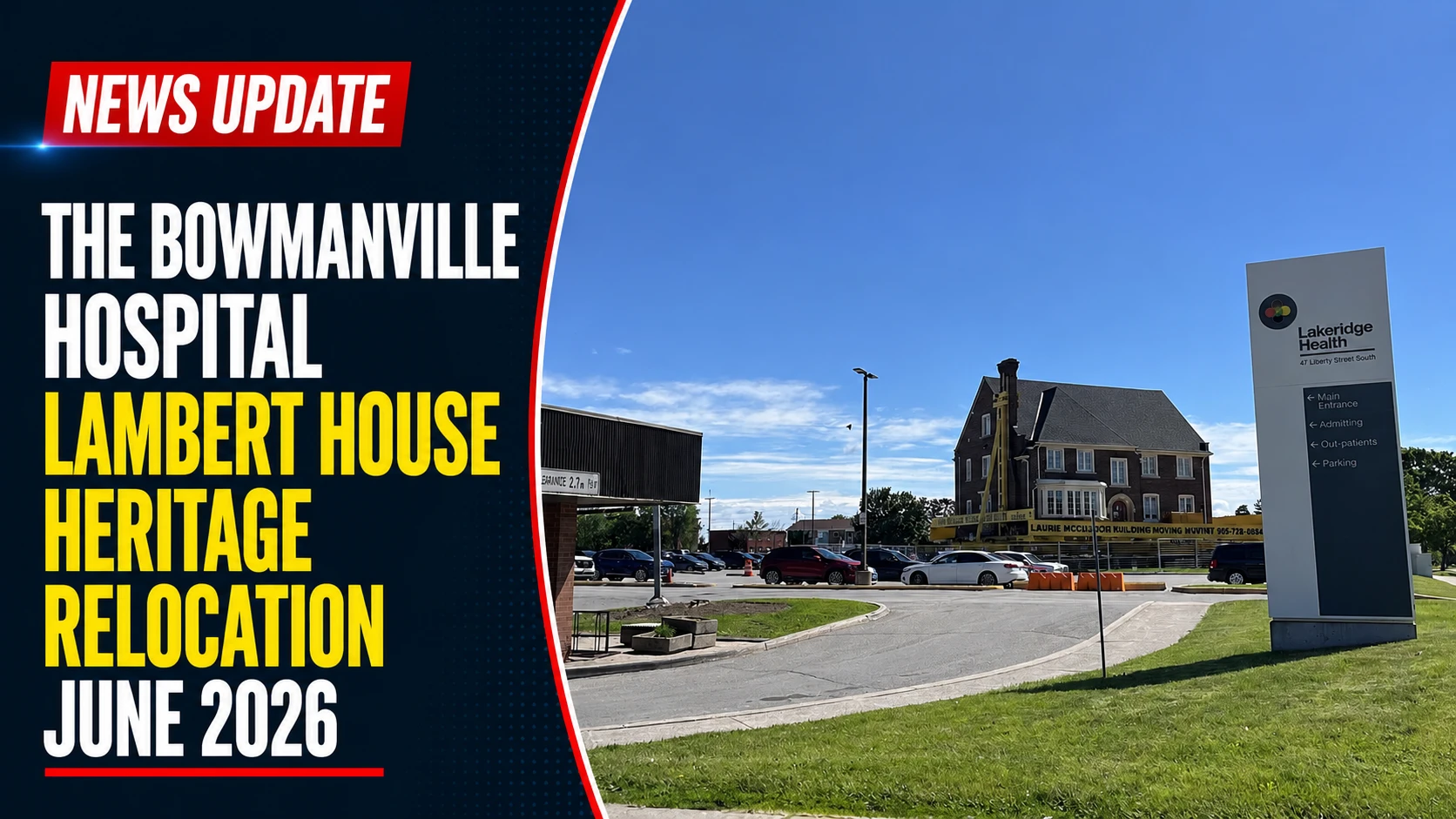
The healthcare infrastructure and historical architectural landscape within the Municipality of Clarington have achieved a major operational milestone following a complex engineering feat on the weekend. Tracked under regional public works and hospital facility portfolios on Monday, June 22, 2026, Lakeridge Health project managers finalized the structural transport files for The Bowmanville Hospital Lambert House Heritage Relocation June 2026. The precision project saw heavy structural moving rigs safely lift and transport a century-old brick heritage building a few hundred meters across the hospital grounds, shifting it from its legacy footprint on Mabel Bruce Way to a new permanent location facing Prince Street.
The delicate relocation project was required to clear real estate for a massive hospital expansion while simultaneously preserving Clarington’s early medical history.


The Engineering Framework and Campus Spatial Realignment Matrix
The successful execution of the building move marks the culmination of months of meticulous planning between municipal planners, structural engineers, and heritage preservation specialists.


-
The Original Architectural Asset: Built in 1926, the two-story brick landmark originally served as the central home for the Bowmanville Hospital’s specialized nurse training program until 1941, before transitioning into office spaces for regional health units.
-
The Internal Routing Shift: Initial engineering proposals called for moving the heavy structure completely out of the complex and onto public surface routes like Liberty Street. However, logistics teams designed an internal bypass path that kept the house entirely within the hospital boundaries, preventing disruptive city-wide road closures.
-
The New Gateway Placement: The building now sits directly at the main Prince Street entrance of the future healthcare complex, serving as a transitional visual buffer between the high-density medical facilities and the residential neighborhoods to the east.
Analyzing Healthcare Demand Drivers and Upgraded Capacity Targets
The relocation clears the physical footprint required to double the size of the existing hospital, resolving long-standing infrastructure constraints in one of Ontario’s fastest-growing commuter zones.
| Monitored Campus Asset Node | Legacy Operational Capacity Profile | Post-Redevelopment Infrastructure Target |
| Lambert House Footprint | Administrative Office Layout | Main Hospital Core & Expanded Inpatient Wings |
| Critical Care Department | Outdated, limited capacity beds | State-of-the-Art Level 3 Intensive Care Unit |
| Specialized Dialysis Services | High out-of-region travel dependency | Brand-New Regional Haemodialysis Centre |
| Emergency Transit Access | Surface-level ambulance transfers | High-Velocity Rooftop Medical Helipad |
The massive hospital redevelopment project comes amid rapid demographic changes, with the Durham Region’s total population projected to double by 2041. This rapid population influx has placed severe strain on local emergency rooms and clinical spaces, frequently forcing local patients to travel to Oshawa or Toronto to receive specialized critical care.
Lakeridge Health CEO Cynthia Davis and Clarington Mayor Adrian Foster highlighted the building move as a clear sign that modern urban expansion and historical preservation can successfully coexist. With the heritage house safely settled on its new foundation, excavation teams are prepared to break ground on the new hospital wing, bringing a rooftop helipad and modern ambulatory clinics to local families.