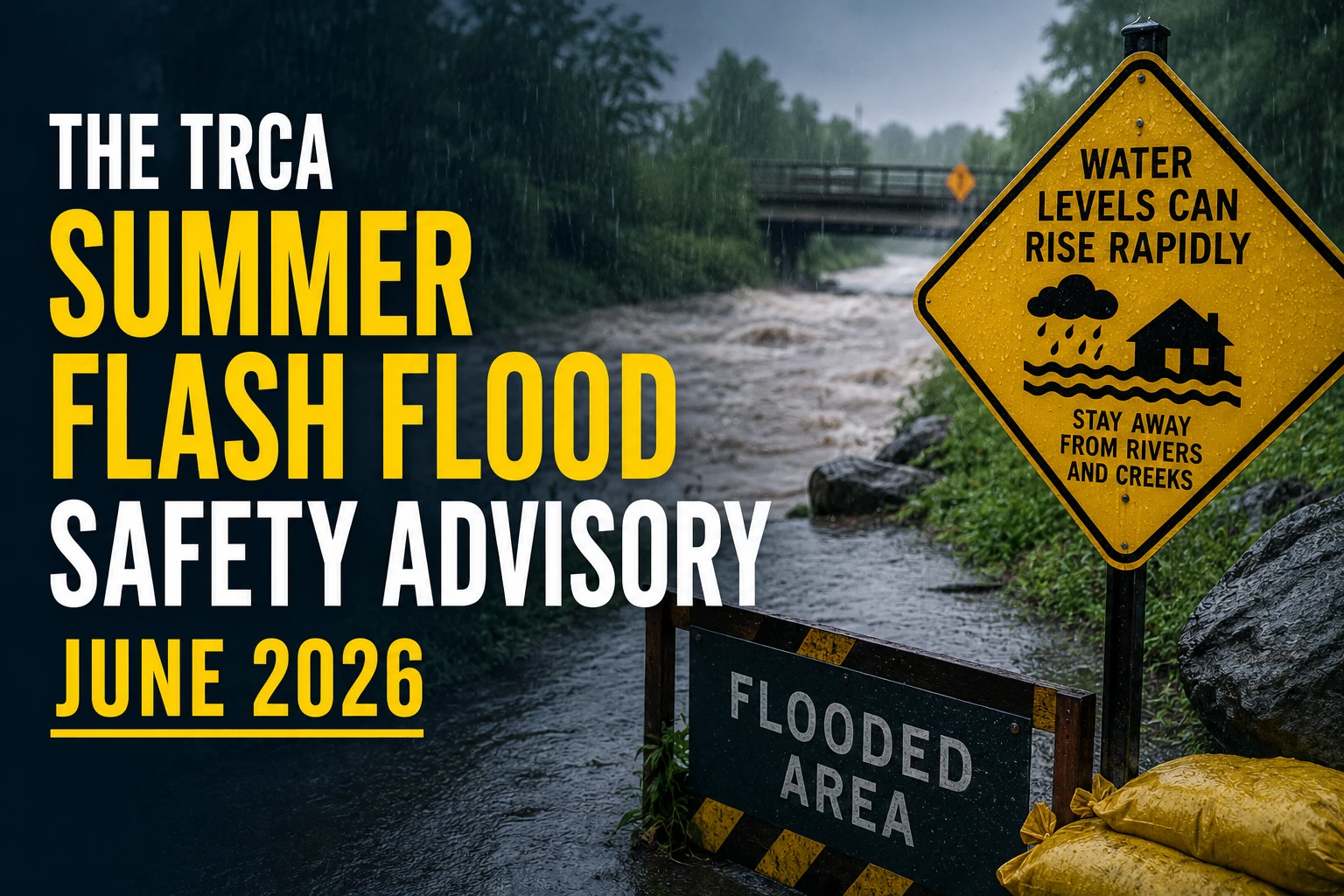
The environmental safety frameworks and emergency management protocols governing the western watersheds of the Durham Region have entered a phase of heightened alert. Tracked under regional environmental safety files on Monday, June 22, 2026, the Toronto and Region Conservation Authority (TRCA) officially launched The TRCA Summer Flash Flood Safety Advisory June 2026. The comprehensive seasonal directive serves as an immediate warning to millions of residents across the Greater Toronto Area that the arrival of intense summer convective heat conditions can spark localized, fast-moving downpours capable of overwhelming municipal infrastructure and triggering hazardous flash flooding within low-lying urban sectors.
The multi-agency communications campaign is designed to prepare local emergency management departments and frontline first responders for severe convective events, rapid thunderstorm cell formations, and sudden tropical weather remnants.

The Urban Watershed Dynamics and Digital Early-Warning Infrastructure
Metropolitan river systems and urbanized drainage networks across Pickering, Ajax, and Uxbridge respond with extreme speed to severe rainfall, converting standard precipitation into fast-moving surface runoff within minutes.


-
The Automated Gauge Network: To help local populations track changing water levels, the conservation authority has synchronized its automated regional telemetry network at trcagauging.ca. The public platform provides real-time water level readouts and rainfall accumulation metrics directly from dozens of solar-powered monitoring stations positioned along local creek beds.
-
The Municipal Communication Loop: When data sensors indicate a high probability of banks overflowing, the TRCA’s specialized Flood Forecasting and Warning Program instantly transmits high-priority flood messages. These digital bulletins go out to municipal public works yards, regional school boards, emergency transit dispatchers, and local media channels to execute pre-planned flood-mitigation protocols.
-
The Active Commuter Restrictions: Civil safety specialists emphasize that pedestrians, cyclists, and motorists must completely avoid low-lying recreational trails, riverbanks, and underpasses during active storm cycles, reminding the public to immediately alter transit routes when encountering water on roadways.
Analyzing Flood Risk Levels and Emergency Preparedness Matrices
The conservation authority’s monitoring operations cover nine separate regional watersheds, utilizing structured risk classifications to protect local communities.
| TRCA Flood Alert Level | Technical Condition Profile | Mandatory Public Safety Action |
| Watershed Conditions Statement | Watercourses tracking higher than normal; high flows | Exercise extreme caution near riverbanks and pools |
| Flood Watch | Potential for flooding exists in low-lying sectors | Prepare personal property; secure local shorelines |
| Flood Warning | Flooding is actively occurring or absolutely imminent | Move to high ground; obey emergency road closures |
The long-standing regulatory body, which has managed regional water safety since its establishment under the provincial Conservation Authorities Act in 1957, maintains millions of dollars worth of vital flood-control infrastructure, including dams, channels, and automated monitoring sensors. As climate models point to a significant increase in short-duration, high-intensity rain events across southern Ontario, the agency is expanding its digital communication infrastructure to allow residents to sign up for instant emergency alerts via text message and email.
Local administrative teams confirmed that while regional public works departments are actively clearing debris from storm sewer grates to maximize flow capacities, individual property owners should review personal emergency kits and check home drainage systems to mitigate urban runoff risks.
Durham Region residents, outdoor recreational groups, and local property managers looking to review real-time stream flows, register for automated weather alerts, or download emergency planning guides can explore the centralized conservation repository online at trca.ca.