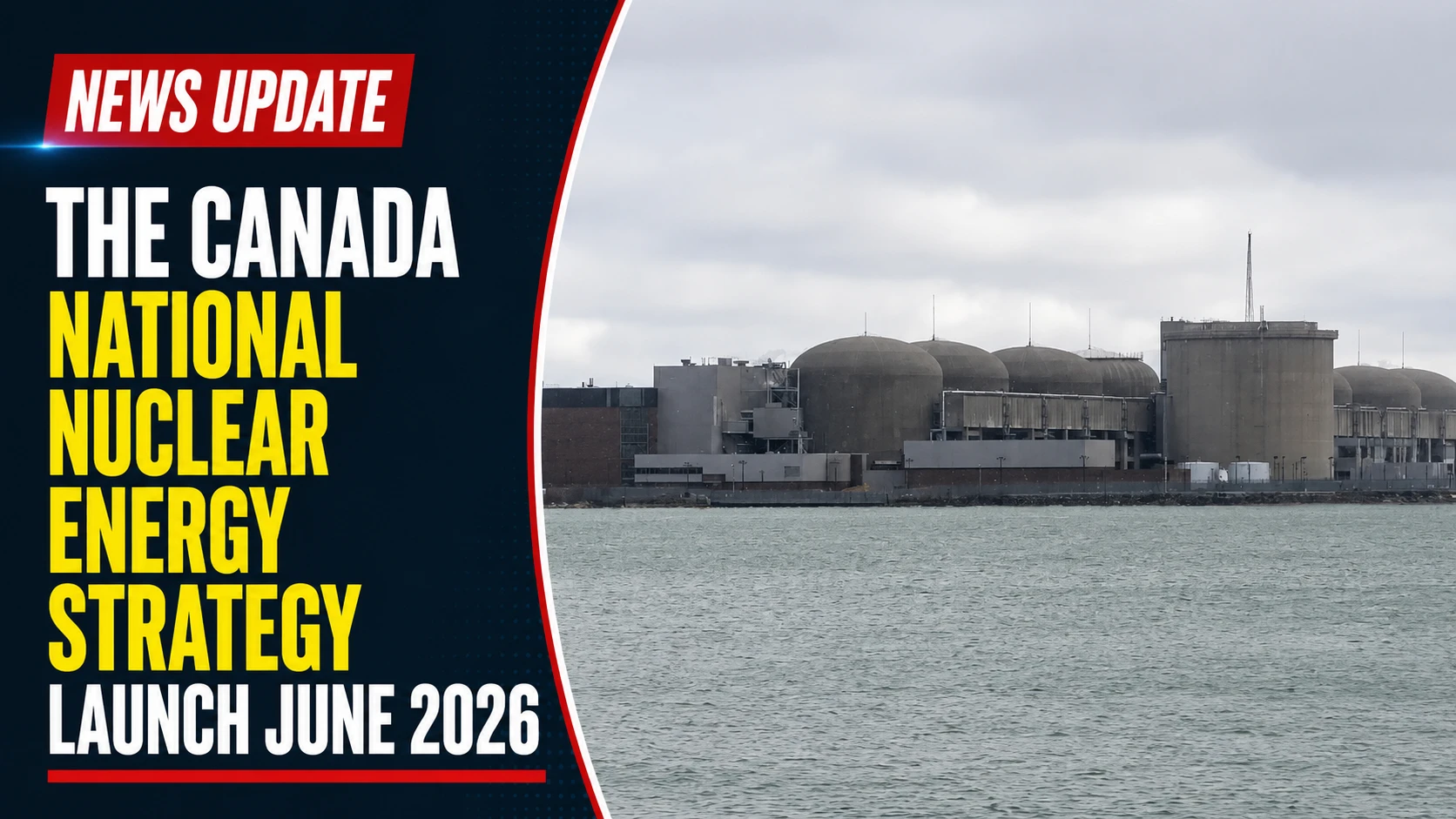
The long-term infrastructure architecture and macroeconomic energy blueprints governing the Dominion of Canada have undergone a massive statutory reorganization. Tracked under federal resource planning files on Monday, June 22, 2026, Energy Minister Tim Hodgson formally unveiled The Canada National Nuclear Energy Strategy Launch June 2026 during a national press assembly in Newmarket, Ontario. The sweeping policy represents a multi-decade capital commitment designed to double the country’s total electrical grid capacity by 2050, allocating more than $100 billion to trigger what federal officials are explicitly calling a modern civilian nuclear renaissance.
The policy pivot aims to secure domestic energy sovereignty while positioning localized heavy manufacturing assets as dominant players in global utility exports.


The Statutory Timelines and Capital Financing Framework
The overarching energy package maps out an aggressive, phased construction layout meant to establish an uninterrupted pipeline of baseload infrastructure over the next fifteen years.


-
The Domestic Build Target: The blueprint mandates that initial construction must break ground on at least two brand-new, large-scale nuclear reactors by 2035. An additional five next-generation facilities must enter formal engineering planning or advanced site selection phases by 2040.
-
The Geographic Diversification: To break traditional single-province centralization patterns, the strategy dictates that at least one major utility reactor must be actively under construction outside the borders of Ontario by 2035, with Saskatchewan and Alberta explicitly identified as target development partners.
-
The Microreactor Deployment: Technical parameters within the document require the finalization of a completely Canadian-designed microreactor system by 2035, with the goal of deploying the modular units to provide stable power to remote northern communities by the late 2030s.
Analyzing Grid Capacities and Geopolitical Export Projections
The sweeping strategy seeks to leverage historical domestic intellectual property to break into changing international fuel and technology markets.
| Monitored Strategy Asset Node | Current National Operational Baseline | Proposed 15-Year Targeted Influx | Core Geopolitical / Sector Objective |
| National Nuclear Energy Strategy | 15% of National Power Generation | Build up to 10 Next-Gen Units | Double total electrical grid by 2050 |
| Domestic Sector Employment | 90,000 High-Skilled Positions | 180,000 Total Active Positions | Double sector workforce via infrastructure |
| International CANDU Fleet | 30 Active Operational Units Abroad | Enter 4 New Sovereign Trade Markets | Displace foreign enriched uranium reliance |
| Uranium Resource Exporting | Standard Western Alliance Influx | Double Overall Upstream Shipments | Position Canada as primary secure partner |
While Natural Resources Canada officials estimate the total capital expenditures could quickly surpass the $100 billion mark, the strategy suggests leveraging the Canada Growth Fund and the Canada Infrastructure Bank to attract deep private equity pools, sovereign wealth assets, and major pension investments.
The strategy also aims to aggressively market modified Candu reactor technologies abroad to ally nations looking to detach their energy supply chains from Russian enriched uranium networks. Because the unique Canadian design runs entirely on natural, unenriched uranium, federal strategists frame the technology as a vital tool for international energy security.
However, the plan has drawn sharp political criticism. Conservative Leader Pierre Poilievre immediately questioned the announcement from Vancouver, dismissing it as a series of expensive promises from the Carney government that lack real-world execution. Simultaneously, environmental groups and Indigenous councils have raised concerns over a parallel federal proposal that would shift major environmental reviews over to the Canadian Nuclear Safety Commission, prompting officials to extend public consultation windows before any bills are formalized in Parliament.