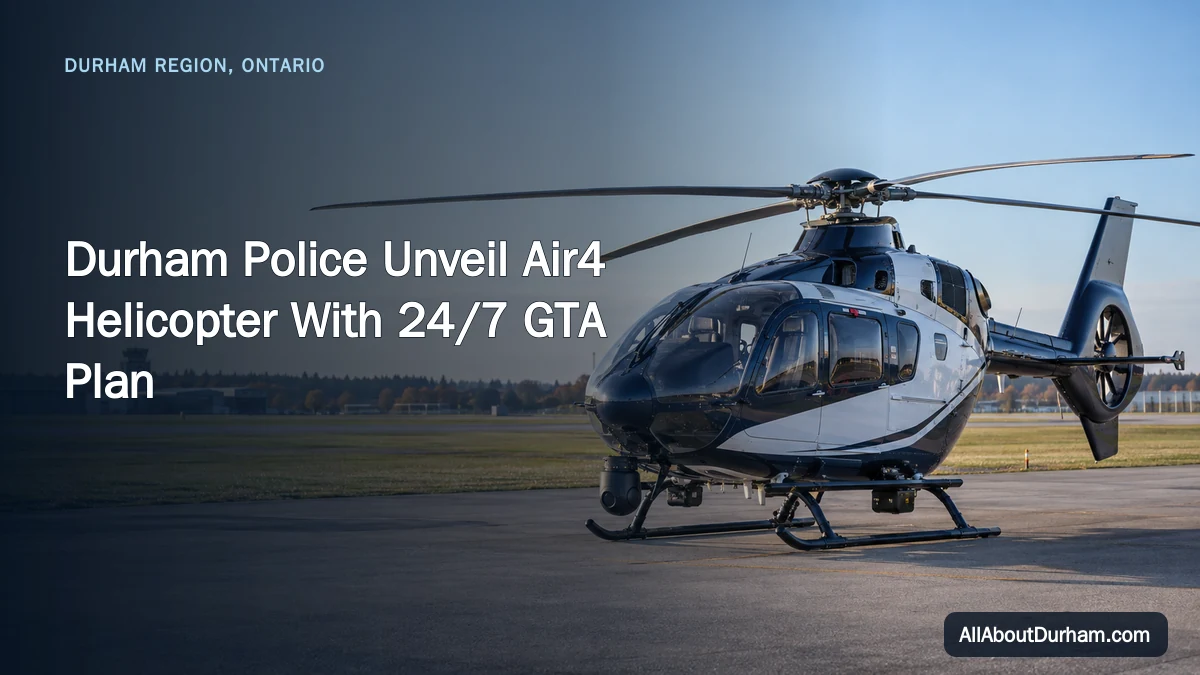
The Durham police Air4 helicopter has been officially unveiled, adding a new Airbus H125 to the regional service’s airborne public-safety operations.
Durham Regional Police Service says Air4 will be operated by its Combined Air Support Unit. The aircraft is intended to give frontline officers real-time intelligence and a broader view during critical incidents, missing-person searches, major investigations, emergency responses and proactive policing.


The unveiling is a material follow-up to the service’s September announcement that the aircraft would be presented at Oshawa Executive Airport. Police have now released operational, staffing and equipment details that were not available before the ceremony.


Air4 equipment and range
The H125 carries thermal-imaging and day-and-night camera systems, high-definition video, real-time video transmission, a high-intensity searchlight, mapping and situational-awareness tools, and a public-address system.
According to the police release distributed by Skies Magazine, the helicopter can remain airborne for up to 4.5 hours and travel at speeds of up to 250 km/h. Police say those capabilities will support searches for missing and vulnerable people, suspect and stolen-vehicle tracking, and emergency response.
Regional staffing and coverage
Durham police plan to staff the Combined Air Support Unit with civilian pilots and tactical flight officers. Eight full-time tactical flight officers, supported by part-time members, are expected to work with aviation professionals.
Air4 is part of Ontario’s Joint Air Support Unit initiative involving Durham, Peel, Halton and Toronto police. The participating services are working toward coordinated aviation coverage around the clock across the Greater Toronto Area.
The province funded the regional initiative. Durham police chief Peter Moreira described the aircraft as an investment in public safety, operational flexibility and regional partnerships.
The release does not state that Air4 will replace all ground operations or respond to every call. Its role is to provide aerial information and specialized support when an incident warrants it.