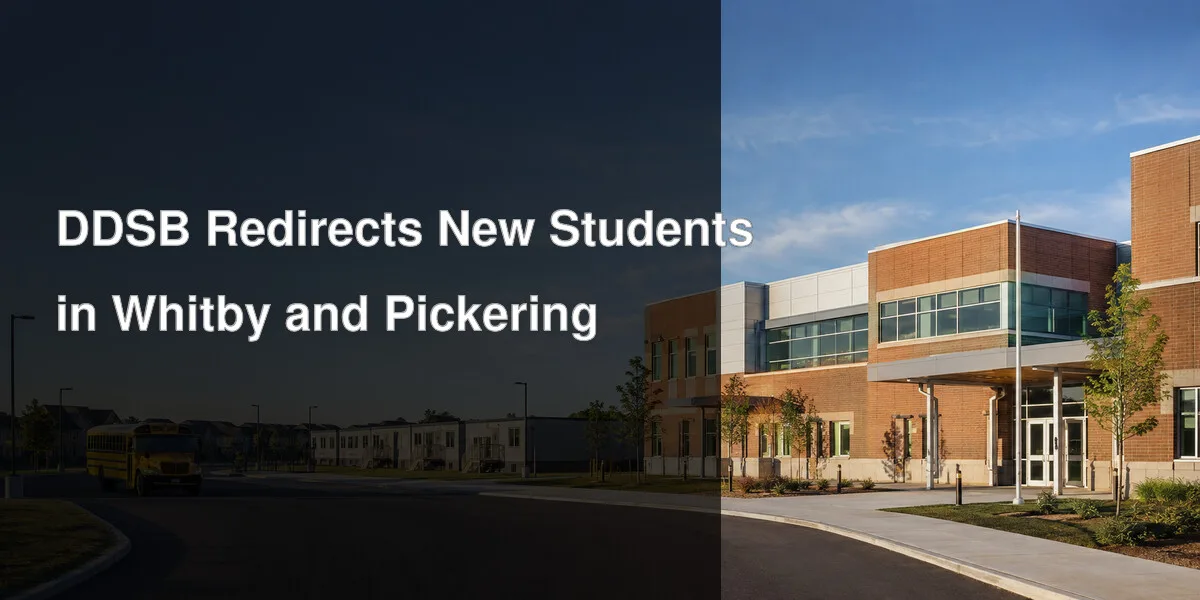
DDSB overflow placements are redirecting some new students from fast-growing neighbourhoods in Whitby and Pickering as the public school board manages enrolment pressure for the new school year.
The Durham District School Board says pupils who were already enrolled at Whitby Meadows Public School or Josiah Henson Public School will remain at those schools. The current growth-boundary and overflow measures apply to registrations received after June 30, 2026, and affected families will be contacted directly.

How the Whitby placements work
New students living within the identified Whitby Meadows Public School growth-boundary area who registered after June 30 are assigned to Robert Munsch Public School. DDSB has also added 13 portables at Whitby Meadows to provide more classroom space.


Continued registrations have created a second layer of pressure. The board says new registrations within the broader Whitby Meadows boundary are currently being directed to E.A. Fairman Public School through an overflow process.
A growth boundary temporarily assigns children from a defined area to a nearby partner school with space. An overflow designation is used when a pupil’s regular school cannot accommodate another student in the appropriate class. Subject to available room, overflow students may return to their home school the following September.
Pickering families face similar changes
In Pickering, new students registered after June 30 within the Josiah Henson Public School growth-boundary area are assigned to Highbush Public School. Josiah Henson is beginning the school year with 14 portables.
The current overflow arrangement also sends new registrations from the Josiah Henson boundary to Highbush. Students who were already enrolled at Josiah Henson are not being moved under the announcement.
DDSB says it has tried to keep siblings together while balancing class sizes, transportation, staffing, school capacity and safe learning conditions. More receiving schools could be identified if registrations continue and available classroom space changes.
The distinction matters for families: a growth-boundary assignment is tied to a defined neighbourhood, while an overflow placement responds to the availability of a seat in a particular class. Both tools are temporary ways to use capacity across nearby schools, but the receiving school can differ as enrolment conditions change.
Rapid housing growth drives enrolment pressure
The board attributes the changes to rapid residential development and continued student registrations in two of Durham Region’s fastest-growing communities. Although new schools add permanent spaces, student populations can increase quickly as newly built homes are occupied.
Portable classrooms, temporary boundaries and overflow schools allow the board to distribute enrolment while longer-term facilities are planned. New school construction requires provincial approval and capital funding, followed by design and construction work that can take several years.
Families receiving an alternative placement should rely on information sent directly by DDSB for their child’s school assignment and transportation arrangements. The board says it will continue monitoring registrations and space across surrounding schools as the year begins.
The update does not announce a broad reassignment of existing students. Its immediate effect is on newer registrations in the specified Whitby and Pickering areas, with each affected household receiving placement details from the board.
Sources: Durham District School Board; Daily Durham