Donald Trump has floated changing the name of Lake Ontario to “Lake America” as the U.S.-Canada trade dispute intensifies, a proposal with a direct geographic connection to Durham Region’s waterfront communities.
The Lake Ontario name change was raised by the U.S. president in a Truth Social post on Tuesday, Aug. 25. Trump said the United States was giving serious consideration to the idea while criticizing its economic relationship with Ontario.


Lake Ontario forms the southern edge of Durham Region, touching the waterfronts of Pickering, Ajax, Whitby, Oshawa and Clarington. Any debate over the lake’s name therefore has a local connection for communities that use it for recreation, tourism, environmental protection and transportation.


Canada still officially recognizes Lake Ontario
Despite Trump’s comments, Canada’s official geographical-name system continues to list “Lake Ontario” and “Lac Ontario” as the approved names for the Great Lake.
Natural Resources Canada maintains the Canadian Geographical Names Database, which records official geographical names recognized by federal, provincial and territorial naming authorities.
As of Aug. 25, Trump’s statement was a proposal rather than a completed international name change. No equivalent White House executive order formally renaming Lake Ontario was identified.
That distinction matters because the lake is shared by Canada and the United States. A U.S. decision about terminology used by its own federal agencies would not automatically change the official name recognized by Canadian geographical authorities.
Trump points to worsening trade dispute
The Lake Ontario name change suggestion came amid another escalation in the trade dispute between Canada and the United States.
Trump has been trading increasingly sharp criticism with Canadian political leaders following the breakdown of trade negotiations and new tariffs. His Aug. 25 social-media post linked his naming suggestion directly to his criticism of future business between the United States and Ontario.
The dispute is particularly relevant to Durham because of the region’s connections to manufacturing and the automotive sector, including Oshawa.
However, Trump did not announce any specific Durham Region policy as part of his Lake Ontario statement. The local angle comes primarily from the lake itself and the broader effects of Canada-U.S. relations on Ontario communities.
Similar move occurred with Gulf of Mexico
Trump previously used U.S. federal authority to change the terminology used by American agencies for another major body of water.
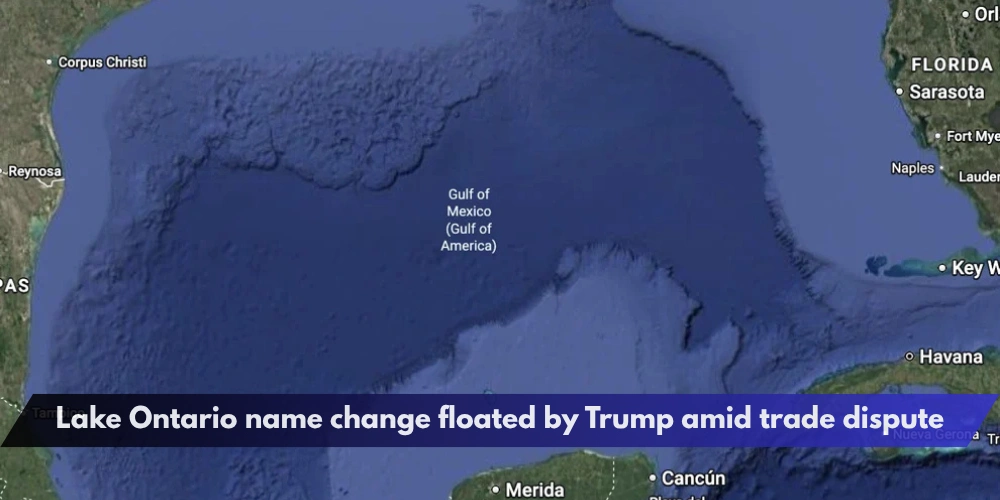
On Jan. 20, 2025, he signed an executive order directing federal authorities to use “Gulf of America” for the portion of the Gulf of Mexico defined by the order and to update the U.S. Geographic Names Information System.
The move changed terminology used within the U.S. federal government, but it did not compel other countries to adopt the same geographical name.
The Lake Ontario situation has not reached that stage. Trump has publicly raised the possibility, but no comparable executive order was identified as of Tuesday.
Durham waterfront remains Lake Ontario
For Durham residents, Canadian federal geographic records and regional maps continue to identify the large body of water along the region’s southern boundary as Lake Ontario.
Durham Region extends from Lake Ontario in the south toward Lake Simcoe in the north, with five southern municipalities bordering the Lake Ontario shoreline.
The Lake Ontario name change proposal is therefore locally relevant, but for now it remains part of a broader political and trade dispute rather than an official Canadian geographical change.
Unless Canadian naming authorities announce otherwise, Lake Ontario remains its official name in Canada.