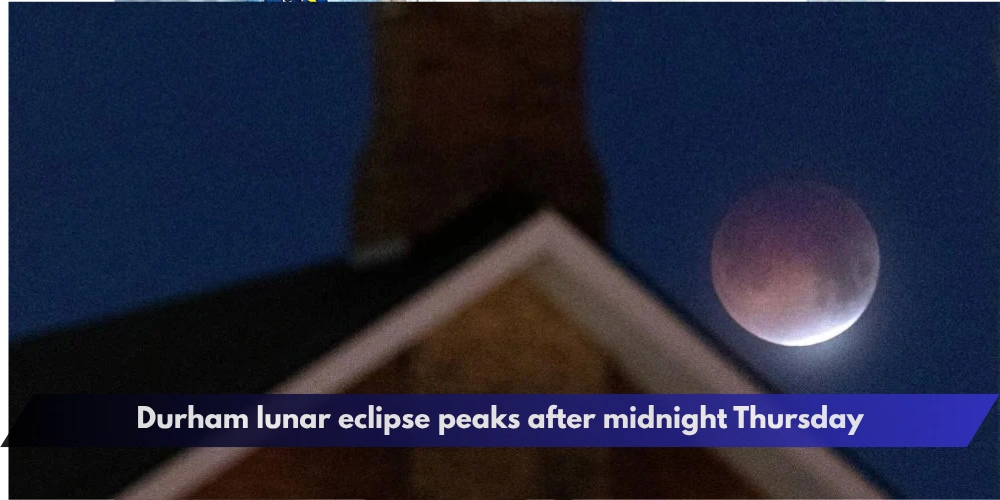
Durham Region skywatchers will have a chance to see a deep partial lunar eclipse late Thursday, Aug. 27 and into the early hours of Friday, Aug. 28, weather permitting.
The Durham lunar eclipse will be visible across southern Ontario as the Moon passes through Earth’s shadow. NASA lists the event as a partial lunar eclipse with an umbral magnitude of 0.9299, meaning almost 93 per cent of the Moon’s diameter will be inside Earth’s darker umbral shadow at maximum eclipse.


The eclipse can be viewed safely with the naked eye. Binoculars or a telescope can make the colour and shadow boundary easier to see, but no special eye protection is required for a lunar eclipse.


When the eclipse starts in Durham
NASA’s eclipse calculations place the beginning of the penumbral phase at approximately 9:24 p.m. EDT on Aug. 27. During this early stage, the Moon may only appear slightly dimmer because it is moving through the lighter outer portion of Earth’s shadow.
The more noticeable partial phase begins at approximately 10:34 p.m. EDT. That is when Earth’s darker umbral shadow begins moving visibly across the lunar surface.
Maximum eclipse is expected at about 12:13 a.m. EDT on Friday, Aug. 28.
The partial phase ends around 1:52 a.m., while the final penumbral shading ends shortly after 3 a.m.
Most of the Moon will enter Earth’s shadow
At maximum eclipse, the Moon will not be completely covered, so this is not a total lunar eclipse.
NASA gives the eclipse an umbral magnitude of 0.9299, meaning nearly 93 per cent of the Moon’s diameter will pass into Earth’s umbra at the deepest point.
Because most of the lunar surface will be inside the darker shadow, observers may see part of the Moon take on a reddish or copper colour.
The effect occurs because sunlight passing through Earth’s atmosphere is filtered and bent toward the Moon.
The remaining portion will stay outside the deepest part of the shadow, preventing the event from becoming a total eclipse.
Where to watch in Durham Region
The Durham lunar eclipse should be visible anywhere in the region with a reasonably clear view of the night sky, including Pickering, Ajax, Whitby, Oshawa, Clarington, Uxbridge, Scugog and Brock.
A location away from bright streetlights can provide better contrast, although dark-sky conditions are not essential because the Moon itself is bright.
Viewers do not need special equipment. A chair and clear sightline are enough, while binoculars can provide a closer look at the shadow moving across the lunar surface.
Clouds could affect Durham viewing
The biggest uncertainty for local viewers is the weather.
Environment Canada’s current Oshawa forecast for Thursday night calls for cloudy periods with a 30 per cent chance of showers and a low near 14 C. Ajax and Courtice currently have similar Thursday-night forecasts.
The forecast could change before Thursday night, so residents planning to watch should check conditions closer to eclipse time.
Even broken cloud cover could provide opportunities to see portions of the event because the eclipse lasts several hours.
Best time to watch
For residents who do not want to watch the entire event, the most dramatic period should fall around maximum eclipse shortly after midnight.
The Durham lunar eclipse reaches its maximum at approximately 12:13 a.m., with the partial phase lasting from about 10:34 p.m. until 1:52 a.m.
NASA lists the next lunar eclipse after this event as a penumbral eclipse on Feb. 20, 2027. The next partial lunar eclipse in its catalogue occurs Jan. 12, 2028.