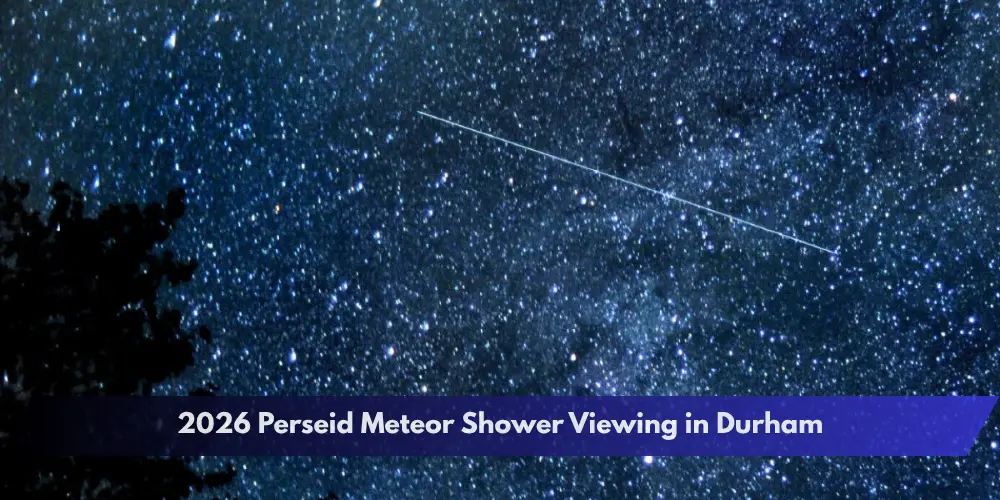
The 2026 Perseid Meteor Shower will give skywatchers across Durham Region an opportunity to see one of the year’s most anticipated celestial displays when it reaches its peak overnight on August 12 and 13.
Residents in Oshawa, Whitby, Ajax, Pickering, Clarington, Uxbridge, Scugog and Brock may be able to see dozens of meteors crossing the night sky, provided local weather conditions remain clear.


Viewing conditions are expected to be particularly favourable this year because the peak coincides with a new moon. With little or no moonlight brightening the sky, observers will have a better chance of seeing fainter meteors that might otherwise be hidden.


When the Perseid meteor shower peaks
The Perseids are active annually from approximately mid-July until late August. In 2026, the strongest activity is expected during the night of Wednesday, August 12, continuing into the early morning of Thursday, August 13.
Although some meteors may become visible after approximately 10 p.m., the best viewing period is expected after midnight and before dawn. During that period, the constellation Perseus will be higher in the northeastern sky, placing the shower’s radiant point in a better viewing position.
Under ideal conditions away from artificial lighting, observers may see between 50 and 100 meteors per hour. Actual numbers will vary depending on cloud cover, light pollution and the observer’s location.
Where Durham residents should look
Observers can begin by facing northeast, toward the constellation Perseus. The meteors appear to originate from that area, although they may streak across any part of the sky.
A telescope or binoculars are not necessary. Because those devices restrict the viewer’s field of vision, the Perseids are generally best observed with the unaided eye.
Rural areas in northern Durham Region, including parts of Uxbridge, Scugog and Brock, may offer darker conditions than heavily developed urban areas. Residents should only use public locations where nighttime access is permitted and should avoid entering private property.
Those viewing from Oshawa, Whitby, Ajax or Pickering should try to move away from bright buildings, parking lots and streetlights. Even finding a location shielded from direct lighting can improve visibility.
Allow time for your eyes to adjust
People attending the 2026 Perseid Meteor Shower should allow approximately 20 to 30 minutes for their eyes to adapt to the darkness. Looking at a bright phone screen during that period can interfere with night vision.
A reclining chair or blanket can make viewing more comfortable because observers may need to watch patiently before seeing a meteor. Warm clothing may also be useful if temperatures cool overnight.
Insect repellent is recommended for anyone watching from parks, fields or wooded areas. Visitors should also check for ticks after spending time in grassy locations.
Partial solar eclipse also expected
August 12 will also feature a partial solar eclipse visible from Ontario during the daytime. The eclipse will be limited from southern Ontario, but residents may still be able to observe a portion of the Sun being covered by the moon.
Anyone watching the eclipse must use certified solar-eclipse glasses or another approved solar-viewing method. Regular sunglasses do not provide adequate protection, and viewers must never look directly at the Sun through binoculars, cameras or telescopes without properly installed solar filters.
The combination of the partial eclipse and the 2026 Perseid Meteor Shower will make August 12 an unusual day for astronomy enthusiasts. Weather will ultimately determine visibility, so Durham residents should check the local forecast before selecting a viewing location.