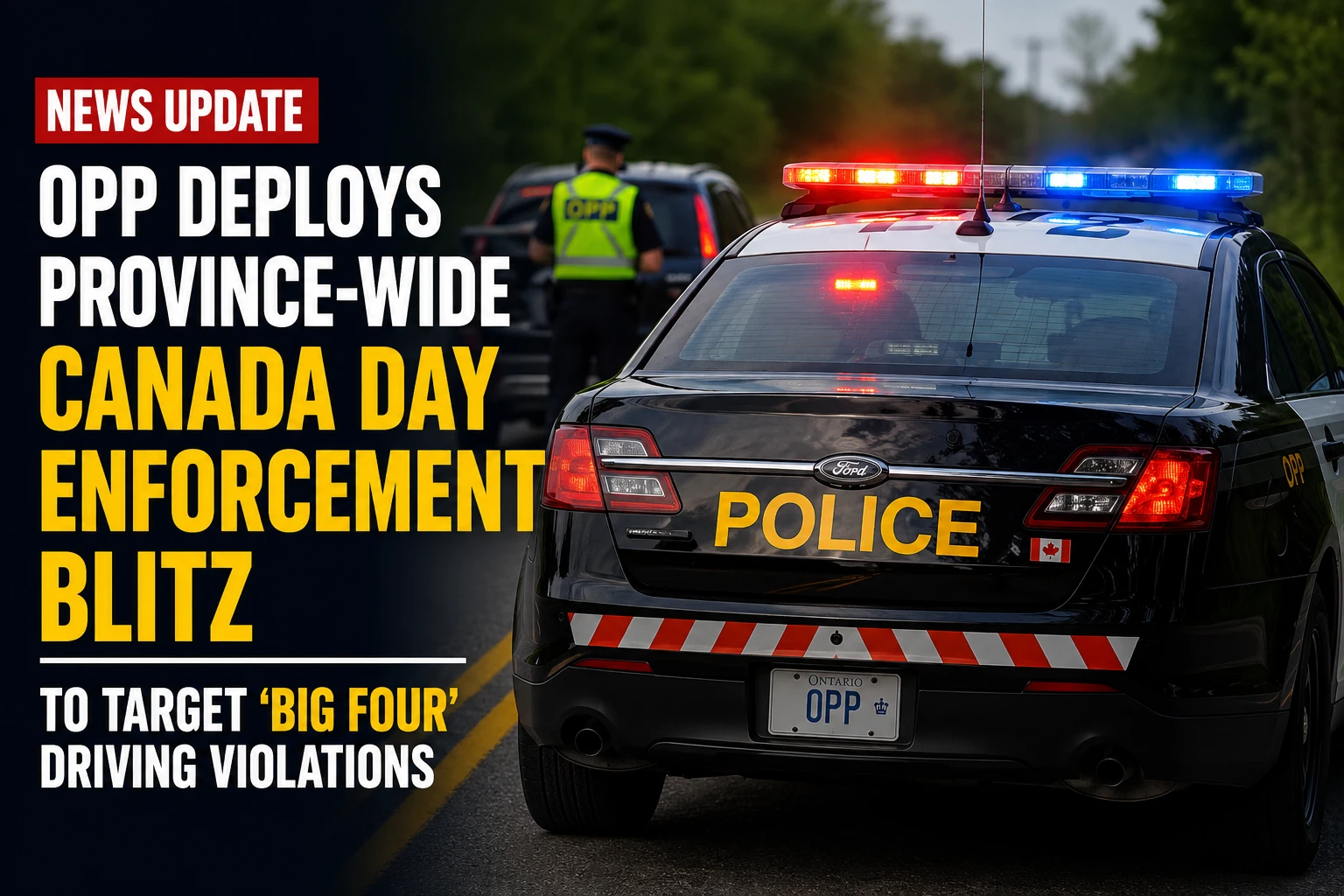
The provincial transportation corridors, regional marine routes, and tactical highway safety divisions across Ontario have entered a period of heightened structural enforcement. Tracked under provincial safety registries on Monday, June 29, 2026, command officers from the Ontario Provincial Police (OPP) finalized the deployment parameters for the Expect more police on Ontario roads as Canada Day enforcement campaign begins. Triggered by the end of the school year and a massive seasonal surge in holiday travel, the annual Canada Day Week Traffic and Marine Campaign has flooded the province’s transit corridors with high-visibility patrol units, targeting high-risk operators across roadways, local waterways, and trail networks.
The intensive enforcement blitz comes on the heels of a sobering milestone, as provincial traffic analysts reveal that over 160 commuters have already lost their lives on provincial roadways since the start of the year.


The Enforcement Lifespan and the ‘Big Four’ Risk Factors
The integrated safety campaign spans a full ten-day window, combining active highway intercepts with targeted remote trail and marine safety checks.


-
The Operational Window: The highly visible enforcement campaign officially kicked off on Friday, June 26, and will remain continuously active through Sunday, July 5, 2026.
-
The Core Targeting Mandate: Patrol teams are strictly focusing on the “Big Four” driving behaviors that historically drive severe personal injury and fatal collision metrics: impaired driving, distracted driving, aggressive driving (including extreme speeding), and seatbelt non-compliance.
-
The 2026 Fatality Toll: OPP tracking confirms that heading into the mid-summer holiday stretch, a staggering 164 people have died in motor vehicle crashes across OPP-patrolled roads since January.
-
The Diversified Interdiction Units: The safety blitz extends past standard highway cruiser patrols. Specialized marine units are actively boarding vessels to verify the presence of properly fitted life jackets, while off-road units are tracking provincial trailways to check helmet compliance on ATVs and dirt bikes.
Analyzing the 2026 OPP Holiday Traffic Enforcement Thresholds
First responders are utilizing a zero-tolerance framework for distracted driving and high-velocity pacing violations, maintaining a dense network of R.I.D.E. checkpoint lines throughout the week.
| Monitored Transit Network Node | Targeted Unsafe Operator Behavior | Immediate Statutory Penalty Vector | Primary On-Scene Countermeasure |
| Provincial Expressways (400-Series) | Distracted Driving (Mobile Devices) | Strict fine schedules & demerit points | Randomized multi-lane cruiser pacing |
| Arterial Highway Corridors | Aggressive Speeding ($\ge$ 20 km/h over) | Immediate ticketing / Demerit loss | Moving & stationary radar interception |
| Regional Navigable Waterways | Boating Under Influence / No Life Jackets | Vessel impoundment / Criminal charges | Active marine unit boarding checks |
| Multi-Use Off-Road Trailways | Helmet non-compliance / Unsafe riding | Provincial trailway summary fines | All-terrain vehicle patrol sweeps |
The OPP noted that early enforcement actions are already hitting high-risk drivers, highlighting an incident on Highway 17 where a driver was hit with a $107.50 fine and three demerit points for traveling 112 km/h in a posted 90 km/h zone. Traffic coordinators emphasize that the primary objective of the multi-agency campaign is to proactively prevent holiday tragedies rather than simply inflate ticket volumes.
Ontario commuters, local boaters, and recreational trail riders who witness aggressive driving behaviors, observe unsafe boating maneuvers, or suspect a motorist is operating a vehicle under the influence of alcohol or drugs are urged to call 9-1-1 immediately to launch a rapid police intercept.