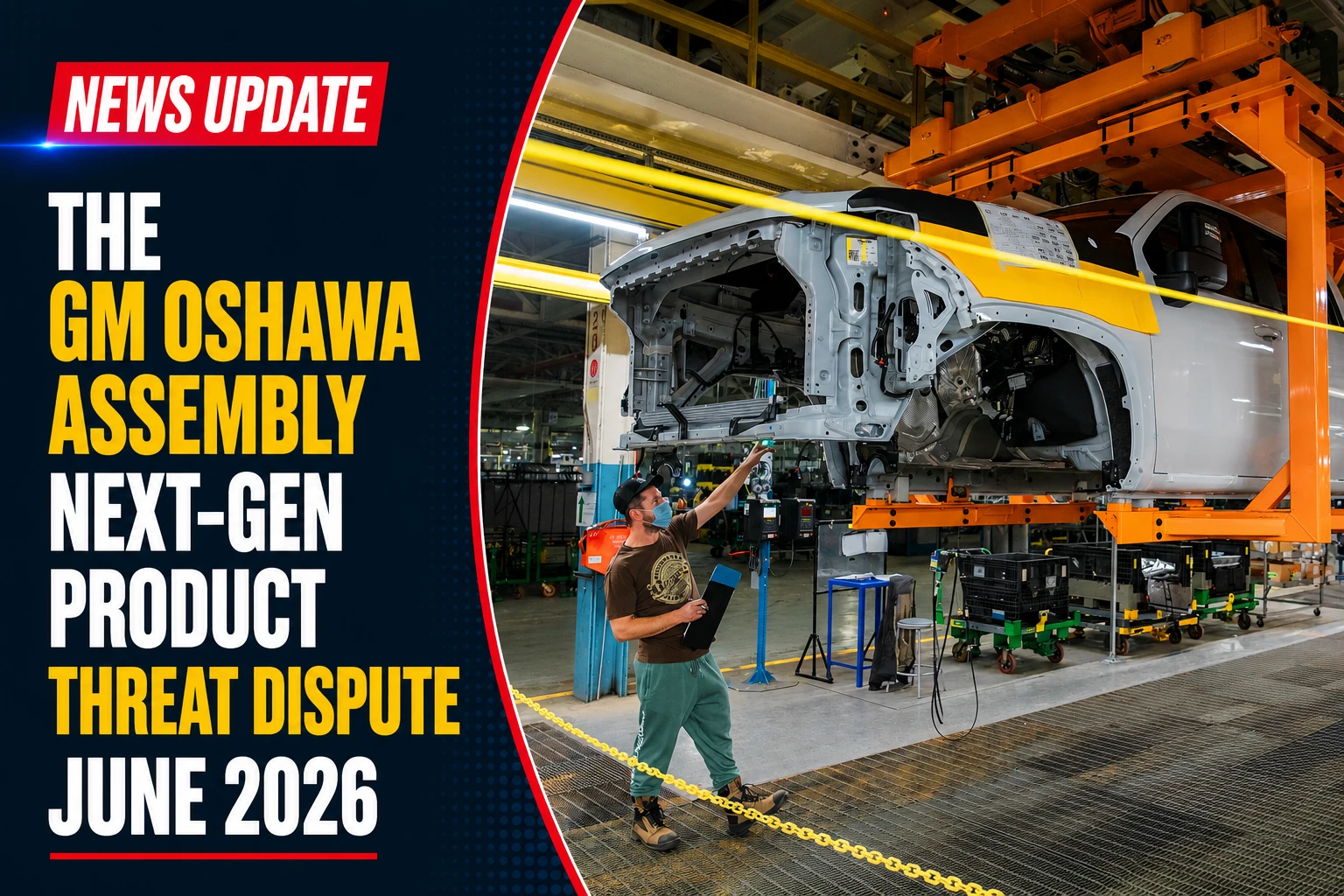
The automotive manufacturing corridors and labor union networks within the City of Oshawa have entered an intense corporate debate over the long-term stability of the region’s largest private employment asset. Tracked under industrial intelligence portfolios on Tuesday, June 23, 2026, severe structural concerns were raised following an expansive report by Pennsylvania-based AutoForecast Solutions (AFS). The analytics firm publicly claimed that General Motors treats its massive Oshawa Assembly Complex as little more than a strategic negotiation pawn within the ongoing GTHA Detroit Three collective bargaining matrix, suggesting that the facility is on track to lose all light-duty truck allocations when next-generation manufacturing begins later this year.
The analytical threat has triggered a direct corporate counter-offensive from General Motors Canada executives, who officially rejected the planned production scale-backs as inaccurate speculation designed to create unnecessary panic amid high-stakes contract deadlines.


The Algorithmic Volume Projections and the Single-Shift Hazard
The friction centers on the dual-production model of the Chevrolet Silverado, with the high-capacity Oshawa plant operating as the only facility in GM’s global assembly network equipped to build both light-duty and heavy-duty configurations on the same line.


-
The Forecaster Analysis: Sam Fiorani, Vice President of Global Vehicle Forecasting for AFS, asserted that GM historically leverages short-term product allocations to temporarily defuse structural tensions with the Canadian union, Unifor, without committing to permanent, multi-decade vehicle platforms. Fiorani argued that because numerous alternative facilities across the United States and Mexico already produce the light-duty Silverado, any volume dropped from the Oshawa grid could easily be absorbed by foreign factories.
-
The Shift-Reduction Vector: If the light-duty platform is stripped from the line, independent logistics experts warn the facility could face an immediate reduction down to a single operational shift. This potential downsizing comes as a heavy blow to a local workforce that already suffered a severe structural adjustment on February 2, 2026, when tariff-related supply chain friction resulted in the elimination of the plant’s third shift and the layoff of more than 500 autoworkers.
-
The Negotiation Counter-Strategy: The forecasting report explicitly claims that GM artificially allows rumors of a light-duty phase-out to circulate ahead of master contract arbitrations, enabling executive negotiators to later re-introduce the vehicle as a “bonus win” for the union at the bargaining table to secure favorable contract terms without offering new capital investments.
Analyzing Production Volumes and Manufacturing Asset Metrics
The underlying data indicates a steady decline in absolute assembly volumes at the local complex over successive operational years.
| Monitored Production Variable | 2024 Corporate Output Baseline | 2025 Standard Output Tracking | Projected Next-Gen Deployment Target |
| Annual Truck Assembly Volume | 152,190 Total Rolloffs | 125,758 Total Rolloffs | Subject to Active Contract Arbitrations |
| Active Shift Deployment Structure | Three Full Overlapping Shifts | Shift Elimination Announced | Two Standard Operational Shifts |
| Direct Assembly Employment Scale | Peak Workforce Capacity | 500+ Active Layoffs Executed | Shift Protection Dependent on Heavy-Duty |
General Motors Canada’s Executive Director of Communications, Jennifer Wright, aggressively pushed back against the independent analysis, clarifying that there is zero planned production scale-back scheduled for the Oshawa facility. While acknowledging that the precise global assembly locations for the next-generation light-duty line have not yet been publicly disclosed, Wright pointed directly to a recent $343 million capital injection into the Oshawa tooling grid as concrete evidence of the corporation’s long-term operational commitment to the local plant.
The industrial anxiety continues to dominate localized community forums and shop floors. Unifor National President Lana Payne reiterated that the union remains locked in its pattern-setting strategy with Ford Motor Company to establish a strong economic blueprint before turning their attention to GM and Stellantis. For thousands of local families across the Durham Region, the outcome of this multi-million-dollar corporate chess match will ultimately dictate whether the city’s manufacturing heart retains its multi-shift prominence or faces further consolidation.