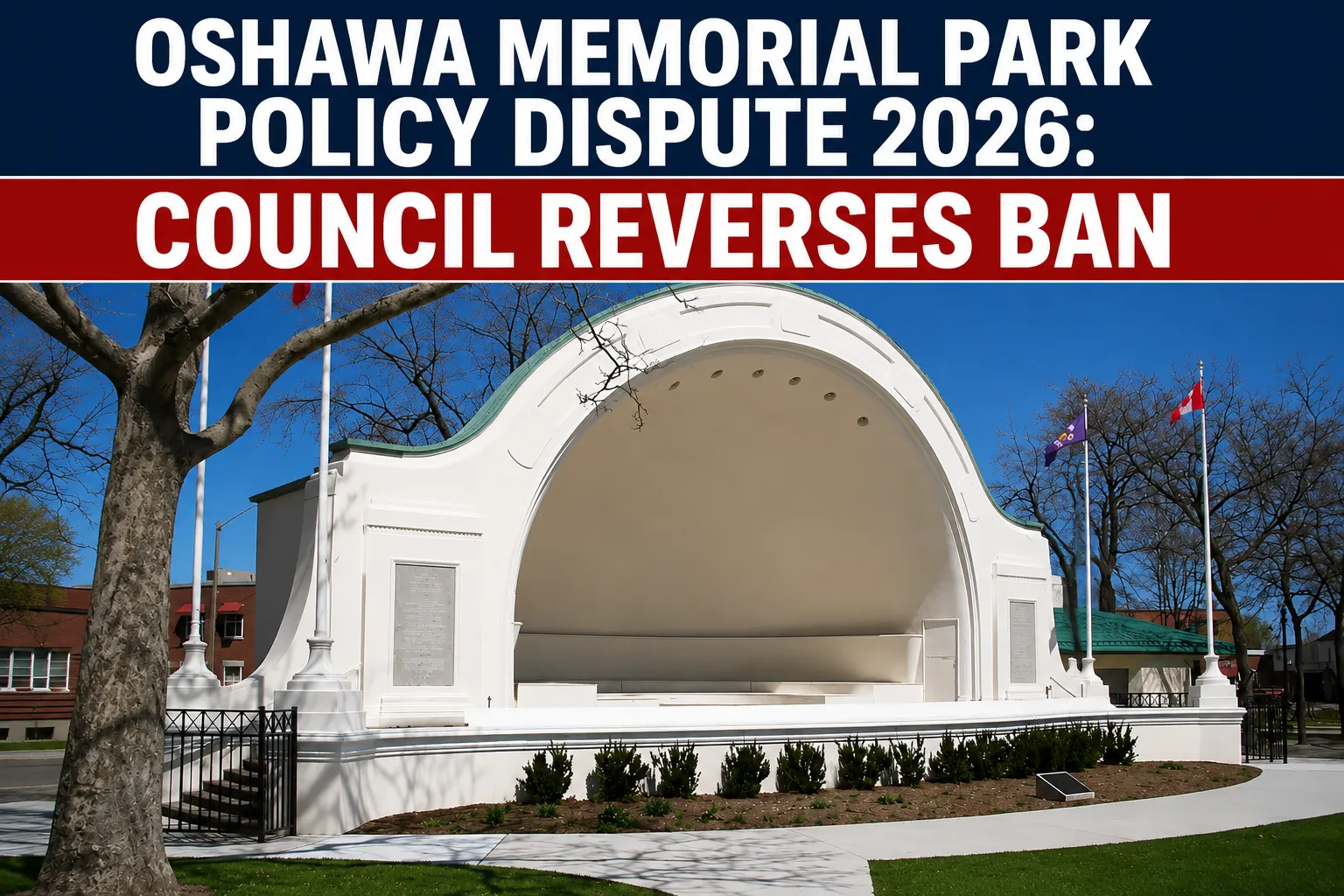
Oshawa City Council has officially bowed to weeks of intense public backlash, community mobilization, and political pressure by reversing a controversial, staff-initiated policy that had effectively banned the Durham Region Labour Council from using downtown’s Memorial Park. The abrupt administrative about-face, confirmed via public briefs by municipal officials on Wednesday, successfully resolves a two-month gridlock that had ignited furious accusations of bureaucratic gatekeeping, voter exclusion, and hidden political maneuvering within the region’s largest urban hub.
With the cross-party resolution finalized, municipal staff have officially re-booked the park footprint for Monday, September 7, 2026, marking the restoration of a generational civic tradition in a municipality whose foundational history is deeply intertwined with Canada’s industrial labor movement.
The Hidden Staff Policy and Permit Denials
The operational friction originally erupted earlier this spring when city staff quietly enacted sweeping new spatial restrictions for Memorial Park—completely bypassing direct council authorization or public debate, according to Ward 4 Councillor Derek Giberson.
Under the unannounced framework, staff began issuing blanket permit denials to community organizations, stating that all future usage had to align strictly with preserving the “heritage, dignity, and commemorative significance” of the park’s War Memorial and Cenotaph. Specifically, permits were restricted to military memorial ceremonies or performing arts displays localized entirely to the McLaughlin Bandshell, while explicitly declaring that “permits will not be issued for general use of the open park space.”
Among the high-profile casualties of this policy shift was the Durham Region Labour Council’s annual picnic. Organizers, including Vice-President Mary Fowler, expressed deep frustration, noting they had participated in routine planning sessions without ever being informed that their historic access to the central, accessible public square was being terminated.

Political Fallout and the Municipal Election Filter
The public fallout quickly escalated beyond typical municipal red tape. On social platforms and national media outlets, local residents heavily criticized the city, with many alleging the bureaucratic barriers were a thinly veiled strategy to prevent grassroots groups from distributing free food to unhoused populations who frequent the downtown core.


However, Regional Councillor Rick Kerr highlighted an entirely different, highly calculated undercurrent driving the administrative tension: the upcoming 2026 municipal election cycle slated for this autumn.
The annual Labour Day picnic has historically served as a high-profile staging ground for speeches from the region’s deeply entrenched New Democratic Party (NDP) base. Under strict municipal bylaws, utilizing corporate city property for active political campaigning or partisan electioneering is explicitly forbidden. Kerr had originally advocated for a strategic compromise, recommending the picnic be permanently relocated to the waterfront at Ed Broadbent Park—a massive new municipal asset named specifically after the legendary federal NDP leader and champion of labor rights.
A Century of Public Gathering Space
Despite the alternative site recommendations, labor advocates successfully argued that the deep historical context of Memorial Park made it irreplaceable. Established in 1924, the square has functioned as Oshawa’s vital, bleeding heart for over a century, serving as the central venue for the multi-day Fiesta Week street festival, family zones for Kars on King, and annual Remembrance Day ceremonies.
Most uniquely, the park is hallowed ground for Canadian labor history. It served as the literal staging ground for the historic 1937 General Motors strike, where 4,000 local automotive workers stood their ground to secure collective bargaining breakthroughs that fundamentally reshaped industrial worker protections across North America.
Oshawa Councillor Brian Nicholson confirmed that after intense closed-door mediation aimed at resolving logistical and compliance concerns, a formal agreement has been officially inked with the client. While local political camps will still face tight monitoring regarding campaign materials on the grass this September, the community has firmly reclaimed its historic right to assemble in the heart of the city.