Durham Time Machine | November 1, 1926 → November 1, 2026
Archive snapshot: a reconstruction from a contemporary annual directory, not a report of events on November 1, 1926.
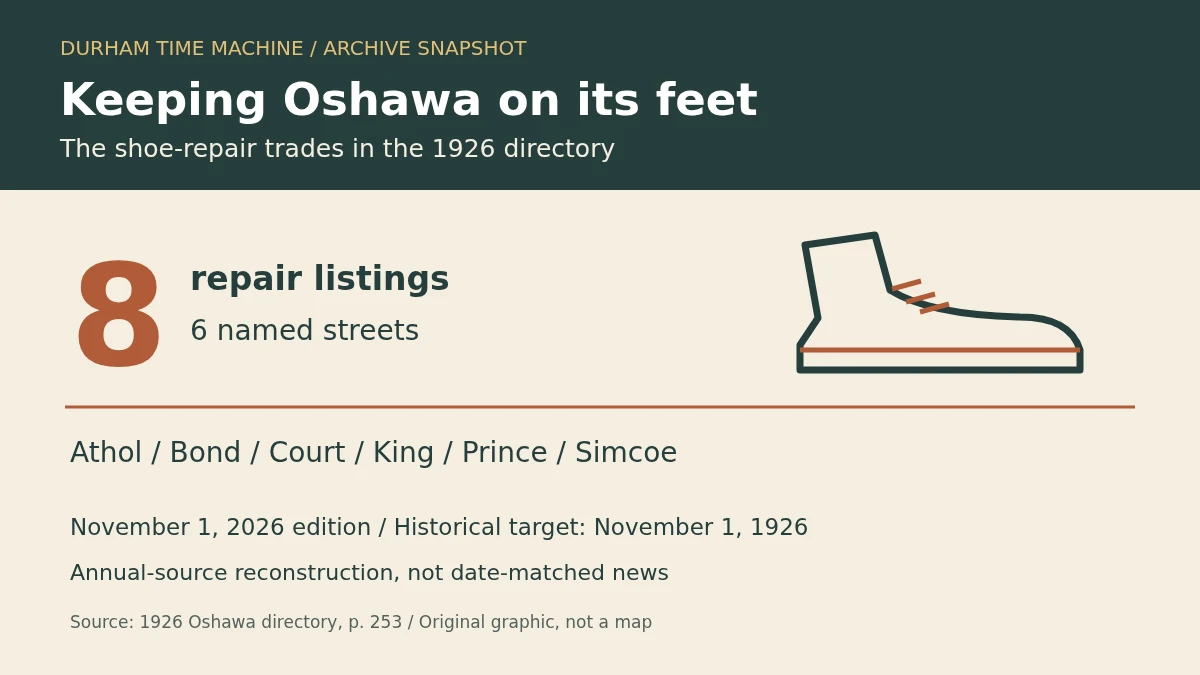
Look beyond the large employers and civic institutions in an old city directory and a different working city comes into view: the people and businesses available to mend everyday possessions. Oshawa’s 1926 directory gives shoe repair its own heading, with eight listings. Those few lines preserve a practical network of services across six named streets, from Bond and King to Court, Prince, Athol and Simcoe.
For this November 1 edition, the historical calendar points to Monday, November 1, 1926. An exact-date newspaper could not be verified because the Durham Region Newspapers archive and Oshawa newspaper index returned access-control challenges. We did not bypass them, and that access problem does not establish that a newspaper issue is missing. Instead, we turned to Henry Vernon & Son’s City of Oshawa Directory for 1926, whose introductory statement is dated May 1. It records a year’s directory picture, not the opening hours or transactions of a particular November day.
Eight names worth keeping together
The Shoe Repairers classification on printed page 253 supplies these eight entries. Each name and address has been checked against the scan; street directions are expanded here for clarity.
- K. Baran — 426 Simcoe South.
- A. L. Bouckley — 5 King East.
- Champion Shoe Repair — 17 Bond East.
- W. J. Coakwell — 329 Court.
- W. G. Jarvis — 13 Prince.
- J. S. Rookos — 77 Simcoe North.
- S. Systopul — 804 Simcoe South.
- Victory Shoe Repair — 12 Athol West.
The entries are more useful as a group than as eight isolated curiosities. They show that the directory did not confine this trade to a single street. Three listings use Simcoe, including two south-side addresses and one north-side address. Five others each use a different street name. That is a count of what this classification contains, not a claim that the compiler found every repairer in Oshawa.
Repair was a category of its own
Immediately above the repair listings sits a separate heading for shoe shining. Under it, the directory places P. Kilburn at 22 King West. The distinction is small but revealing: a reader seeking shoe care was offered more than one kind of service category. Shining and repairing were not merged into a single undifferentiated list.
That does not prove that a repairer never shined shoes, or that the listed shiner offered no other service. Directory headings organize information for finding a business; they are not exhaustive descriptions of the work performed inside it. What we can say is that the compiler made the distinction visible to readers. Preserving it gives a more accurate account than calling all nine entries cobblers or counting them all as repair shops.
Follow the address, not an imagined shopfront
Champion Shoe Repair’s Bond East address and Victory Shoe Repair’s Athol West address provide two especially clear starting points because their names identify the advertised trade. The other six entries use surnames and initials. Those initials should stay attached to the correct street number: W. J. Coakwell at 329 Court is a different research lead from W. G. Jarvis at 13 Prince.
We have not expanded those initials into full names here. Nor have we attached biographies, family origins or ownership histories to the entries. A familiar surname can encourage a tempting connection to another record, but a shared name alone is not sufficient identification. The directory gives us a name, a trade classification and an address; that combination is the evidence to carry forward.
Simcoe’s three entries also resist an easy shorthand. K. Baran at 426 Simcoe South and S. Systopul at 804 Simcoe South should not disappear into a general reference to downtown shops. J. S. Rookos is listed on Simcoe North. These directions matter even before any modern map is consulted. They preserve distinctions made by the source without pretending we have reconstructed travel routes or measured the area each business served.
What this tells us about everyday work
A repair listing brings maintenance into local history. It directs attention to work on things already owned, rather than only to the sale or manufacture of new goods. That is a useful change of focus when reading a business directory: the service economy becomes visible alongside the institutions and products that tend to dominate civic summaries.
But the page cannot tell us how many pairs of shoes were repaired, what a new sole cost, how long a repair lasted or whether customers chose repair because of price, preference or necessity. It names no tools and gives no staffing totals. We therefore cannot turn eight entries into a measure of household thrift, wages or environmental attitudes. Those would require different evidence, such as dated price lists, business accounts or well-supported personal recollections.
How to take the next research step
For a reader investigating a family business, start with the complete entry and its year. Then look for the same combination in adjacent annual directories. A changed address could suggest a move worth investigating; a missing listing would be a question, not automatic proof of closure. Street sections, assessment records and dated advertisements can help test those possibilities, with each source answering a different part of the question.
Oshawa Public Libraries’ city-directory collection is a useful starting point. We have not verified the modern location or surviving building corresponding to these historical addresses. This edition is therefore not a present-day walking guide, and its original graphic is an editorial illustration, not a period photograph or a map.
The modest discovery is still worth preserving: eight repair listings, plus a separately classified shoe shiner, give us a more detailed view of Oshawa’s everyday services in 1926. They make small-scale work findable without inventing a scene of customers arriving on this particular Monday a century ago.
Sources and archive credit
Primary source: Henry Vernon & Son, City of Oshawa Directory, 1926, printed page 253, right column (scan leaf 128). Introductory dating: scan leaf 2. Digitized by Oshawa Public Libraries and hosted by Internet Archive. Collection guidance is linked above.
Source note: Nine local listing facts were visually checked. This original text-and-link archive snapshot uses an annual source and does not establish events on November 1, 1926. No archive scan, photograph, advertisement or promotional wording is reproduced. Publication date: November 1, 2026, America/Toronto.
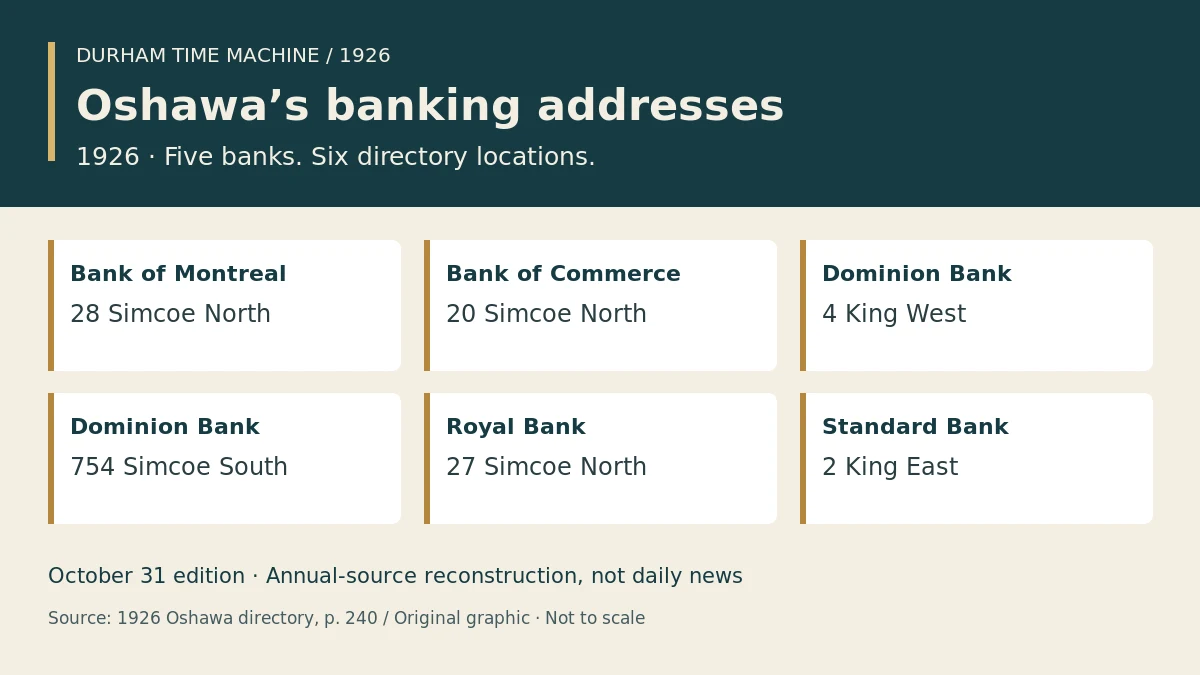
Read more in our History archive or explore another part of the same year in Oshawa’s 1926 banking snapshot.