Durham Time Machine | October 31, 1926 → October 31, 2026
Archive snapshot: this edition reconstructs a small part of Oshawa’s commercial geography from a contemporary annual directory. It does not report events on October 31, 1926.
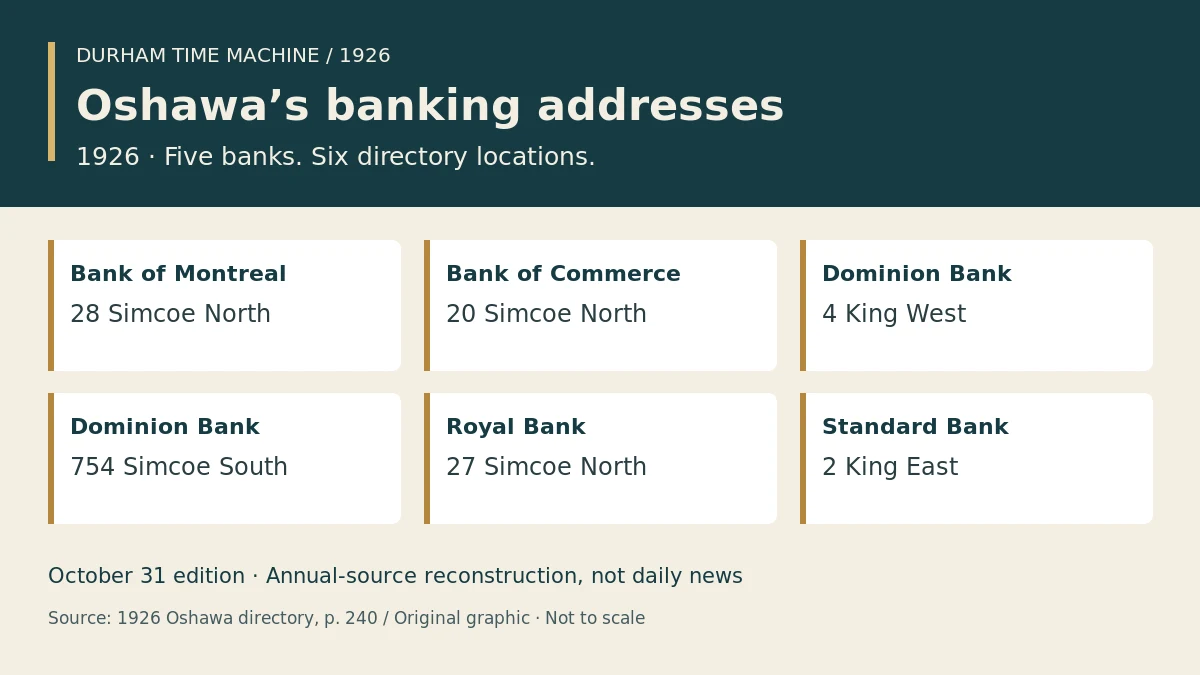
Five bank names and six addresses: that is the compact picture of local banking offered by the business listings in Oshawa’s 1926 city directory. There are no account balances, teller queues or interest-rate offers in this little list. Instead, it gives something especially useful to a local-history reader: a set of named institutions attached to specific street numbers.
For today’s century-back edition, the historical calendar lands on Sunday, October 31, 1926. We could not verify an exact-date newspaper or a nearby issue through the Durham Region Newspapers archive because its public access route returned an access-control challenge. We did not bypass it. Our alternative is Henry Vernon & Son’s 1926 City of Oshawa Directory, digitized from an original held by Oshawa Public Libraries. Its introductory statement is dated May 1, 1926. This is a window into the year, not evidence of Halloween activities or banking hours on that Sunday.
The six addresses on the page
The directory’s Banks classification on printed page 240 supplies the foundation for this snapshot. Read against the scan rather than accepted from automated text, the entries place:
- Bank of Montreal at 28 Simcoe North.
- Canadian Bank of Commerce, abbreviated in the directory, at 20 Simcoe North.
- Dominion Bank at 4 King West.
- A second Dominion Bank address at 754 Simcoe South.
- Royal Bank at 27 Simcoe North.
- Standard Bank at 2 King East.
These are historical directory addresses, with the directional abbreviations expanded for readability. They are not current branch listings. The distinction is important for anyone who wants to turn an appealing old address into a modern walking destination: a matching street number alone does not establish that a building, doorway or parcel is the same one.
A King-and-Simcoe pattern
Rearrange the entries by street rather than institution and a pattern becomes easy to see. Three addresses use Simcoe North, one uses Simcoe South, and two use King, on opposite directional sides. All six listed addresses therefore belong to just two named streets. This observation comes directly from the entries; it does not require a guess about branch size or which bank attracted the most customers.
The three Simcoe North numbers—20, 27 and 28—are particularly useful research anchors. They give a future investigation a small, defined set of addresses to compare with the directory’s street section, assessment records or dated photographs. But numerical proximity is not a measured walking distance. Nor does it prove that the bank interiors faced one another, occupied entire buildings or looked like the imposing stone banking halls often associated with the period.
King’s two entries also deserve to remain distinct. Dominion’s 4 King West and Standard’s 2 King East are separate listings, not interchangeable references to “a bank on King.” Keeping the institution, number and direction together is the difference between a usable historical lead and a vague recollection.
Why the second Dominion address matters
Dominion is the only bank in this classification given two addresses. Its line continues from King West to 754 Simcoe South. That continuation changes the count: five named banks do not mean five listed locations. It is a small detail, but overlooking it would erase part of the directory’s account of banking beyond the north-side Simcoe entries.
What it does not tell us is why Dominion maintained those addresses, which customers used either location, or whether the same services were available at both. The south-side listing is a sensible starting point for questions about neighbourhood access and commercial activity. It is not, on its own, an answer about workers’ payday routines, household savings or the bank’s business strategy.
A directory is a finding aid, not a balance sheet
A business classification arranges a city for someone trying to find a service. That purpose shapes what survives on this page. Names and addresses are prominent; customers’ experiences and financial conditions are absent. Counting these entries cannot establish the number of residents with accounts, the availability of credit, or the completeness of the city’s financial services. It also cannot establish that each address was still occupied by the same bank months after the directory’s introductory date.
That limitation is also an invitation to do better research. A dated advertisement might establish the hours a bank claimed to keep. A municipal assessment record could help connect an address to a property. A bank record or a dated local report might explain an opening, move or closure. Each would answer a different question. None should be silently supplied by an annual list that does not contain it.
Oshawa Public Libraries’ city-directory guide explains the collection’s value for researching residents and businesses. For readers beginning with a family name or an old address, today’s six entries demonstrate a practical approach: preserve the year, the spelling, the street direction and the page reference before following the next lead.
What stands there now?
We have not verified the modern location or surviving building corresponding to each historical entry. This edition therefore makes no claim about present-day tenants, bank successors or heritage status. Its original graphic is a designed address summary, not a historical photograph or a geographically scaled map.
The useful discovery is modest but concrete: in this 1926 classification, Oshawa’s five named banks were represented by six addresses along King and Simcoe, including Dominion’s additional south-side address. That is a clearer starting point for exploring the city’s financial history than an imagined scene of customers arriving on a particular October morning.
Sources and archive credit
Primary source: Henry Vernon & Son, City of Oshawa Directory, 1926, printed page 240, Banks classification; introductory date verified on scan leaf 2. Digitized by Oshawa Public Libraries; hosted by Internet Archive. Collection guidance: Oshawa City Directories.
Source note: All six address facts were visually checked against the original scan. This is original text-and-link reporting from an annual source, not date-matched newspaper news. No archive scan, advertisement or photograph is reproduced. No promotional claims about banks are adopted as fact. Publication date: October 31, 2026, America/Toronto.
Explore more in our History archive, including the different services recorded in Oshawa’s 1926 information network.