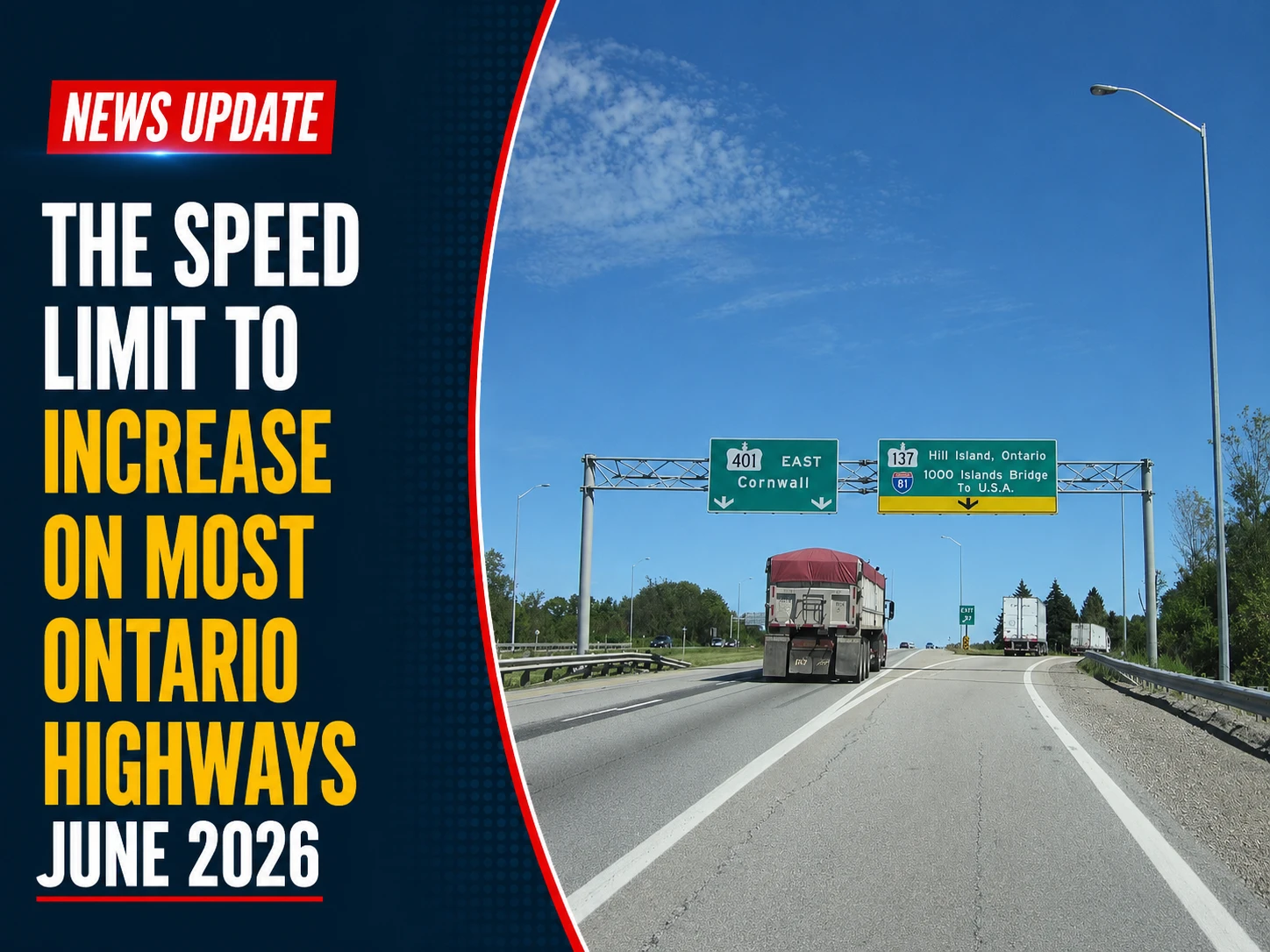
The multi-lane transportation arteries and provincial logistics corridors across southern Ontario have entered a phase of major structural change. Tracked under provincial legislative portfolios on Wednesday, June 24, 2026, transportation planners finalized the master operational maps for The Speed limit to increase on most Ontario highways June 2026. Announced officially by Transportation Minister Prabmeet Sarkaria during a regional staging briefing, the Ontario government is permanently raising the maximum allowable speed thresholds from 100 km/h to 110 km/h across an additional 938 kilometers of provincial freeways, legalizing faster transit flows for millions of commercial trucks and daily commuters.
The far-reaching regulatory transition means that once the staggered rollout concludes by September 30, nearly 89 percent of Ontario’s master 400-series freeway network will operate at a standard 110 km/h baseline, up from just 43 percent today.
The Staggered Signage Rollout and Commuter Travel Projections
The engineering shift relies on a multi-stage field deployment to safely alter thousands of physical overhead and roadside speed marker boards across the province.
-
The Initial Launch Phase: The structural speed limit expansion takes effect on Friday, June 26, 2026. Field crews will begin the immediate physical swap of signage across rural eastern corridors, focusing heavily on targeted long-distance segments of Highway 401 and Highway 416.
-
The Secondary Network Integration: Following the initial eastern deployment, engineering installation teams will expand the 110 km/h parameters across the remainder of the network. This comprehensive rollout covers core commuter segments of the Queen Elizabeth Way (QEW), Highway 400, Highway 402, Highway 403, and Highway 417, wrapping up entirely by September 30, 2026.
-
The Scaled Commute Yields: Provincial logistics modeling suggests that the increased speeds will provide substantial travel time reductions across major commercial routes. Under standard flowing conditions, drivers navigating from Sarnia to Toronto stand to recover approximately 20 minutes, while motorists charting the inter-provincial corridor from Toronto to Ottawa could save nearly 30 minutes of total travel time.
Analyzing the 2026 Provincial Speed Limits Infrastructure Footprint
The technical reviews conducted by Ministry of Transportation civil engineers confirm that the target corridors were originally built to handle the higher speeds safely.
| Monitored Provincial Network Node | Previous Statutory Limitation | Newly Enforced Speed Limit | Systemic Implementation Deadline |
| Eastern Highway 401 & 416 Segments | 100 km/h Standard | 110 km/h Upgraded | Immediate Launch: Friday, June 26, 2026 |
| GTHA Highway 401 (Durham Link) | 100 km/h Standard | 110 km/h Upgraded | Staggered Multi-Phase Fall Target |
| QEW, Highway 400, 402, 403, 417 | 100 km/h Standard | 110 km/h Upgraded | Final Completion: September 30, 2026 |
| Pre-Existing Pilot Corridors | 110 km/h Standard | 110 km/h Confirmed | Active / Monitored since 2022/2024 sweeps |
Ministry engineers emphasized that the 110 km/h baseline will only be implemented on controlled-access freeways designed with wide shoulders, gentle curve geometry, and long acceleration lanes capable of managing faster vehicle flows. While highway safety advocates note that high-speed collisions can increase the severity of vehicle damage, the province pointed to highly successful safety data from pilot zones launched in 2022 and 2024 as solid proof that the design of modern freeways naturally accommodates the higher limit.
Ontario Provincial Police (OPP) highway enforcement teams remind drivers that stunt driving laws remain strictly unchanged. Any motorist clocked traveling at 150 km/h or higher—or exceeding the new 110 km/h limit by 40 km/h or more—will face immediate, mandatory roadside vehicle impoundments and driver’s license suspensions under the province’s Moving Ontarians More Safely Act.
Durham Region drivers, commercial shipping lines, and daily highway commuters looking to download specific interactive maps of the upcoming speed limit change zones, track ongoing ministry roadwork notices, or review provincial highway safety metrics can explore the centralized transportation portal online at news.ontario.ca.