Several Ontario laws and regulations taking effect in September will bring changes for drivers, renters, landlords and post-secondary students, including measures that directly affect residents in Durham Region.
The changes include new rules under Ontario’s Residential Tenancies Act, major adjustments to provincial student assistance and higher speed limits on several highways, including routes running through Durham.


New Rules for Ontario Landlords and Tenants
Changes to Ontario’s Residential Tenancies Act will take effect on Sept. 21.


Landlords who provide at least 120 days’ notice to end a tenancy so a unit can be used for their own purposes will no longer have to provide one month’s rent as compensation or offer the tenant another rental unit.
Tenants facing eviction because of unpaid rent will also have less time to resolve their arrears. An N4 notice will provide seven days to pay the outstanding rent instead of the current 14-day period.
Other amendments provide additional requirements when tenants temporarily leave rental units for renovations or repairs.
When a tenant provides written notice that they intend to return, the landlord must provide an estimated date for when the unit will be ready. Any changes to that date must also be communicated in writing.
Once the unit becomes available, landlords must notify the tenant and provide at least 60 days for them to move back.
The rules surrounding claims of bad-faith evictions are also changing. Tenants will have until the later of two years after leaving the unit or six months after renovations are completed to file certain claims.
For personal-use evictions, the landlord or qualifying family member named in the notice must physically occupy the rental unit within 60 days.
Earlier changes that took effect July 1 also increased maximum penalties for offences under the Residential Tenancies Act. Individuals can now face fines of up to $100,000, while corporations can face penalties of up to $500,000.
OSAP Changes Affect Ontario Students
Students returning to college or university will also see major changes to the Ontario Student Assistance Program.
For programs beginning on or after Aug. 1, a maximum of 25 per cent of provincial student assistance can be provided as non-repayable grants. At least 75 per cent will be issued as loans.
Previously, grants could account for as much as 85 per cent of a student’s assistance package.
Students attending career colleges will receive their provincial OSAP assistance entirely as loans.
Ontario is also allowing post-secondary tuition fees to increase by up to two per cent annually following a seven-year tuition freeze.
Durham Highways Moving to 110 km/h
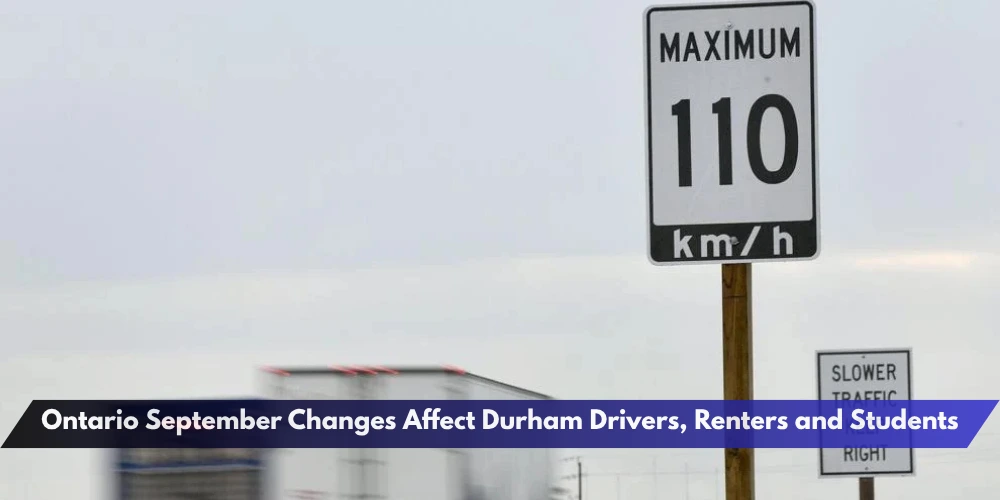
Drivers will see another major change on Sept. 30 when Ontario completes the expansion of 110 km/h speed limits across hundreds of kilometres of provincial highways.
Several of the affected highways run directly through Durham Region.
The speed limit will increase from 100 km/h to 110 km/h on:
- Highway 407 from Brock Road to Highway 35/115
- Highway 412 from Highway 401 to Highway 407
- Highway 418 from Highway 401 to Highway 407
- Highway 403 from the QEW to Highway 401
- Highway 404 from Highway 401 to Mulock Drive
- Highway 406 from Westchester Avenue to Highway 58
- sections of the Queen Elizabeth Way
The province says the changes will cover approximately 938 kilometres of 400-series highways.
Drivers should also remember that travelling at 150 km/h or faster can result in stunt-driving charges, including on highways where the posted limit is 110 km/h.
The changes mean September will bring significant adjustments for many Ontario residents, with Durham drivers, tenants, landlords and students among those directly affected.