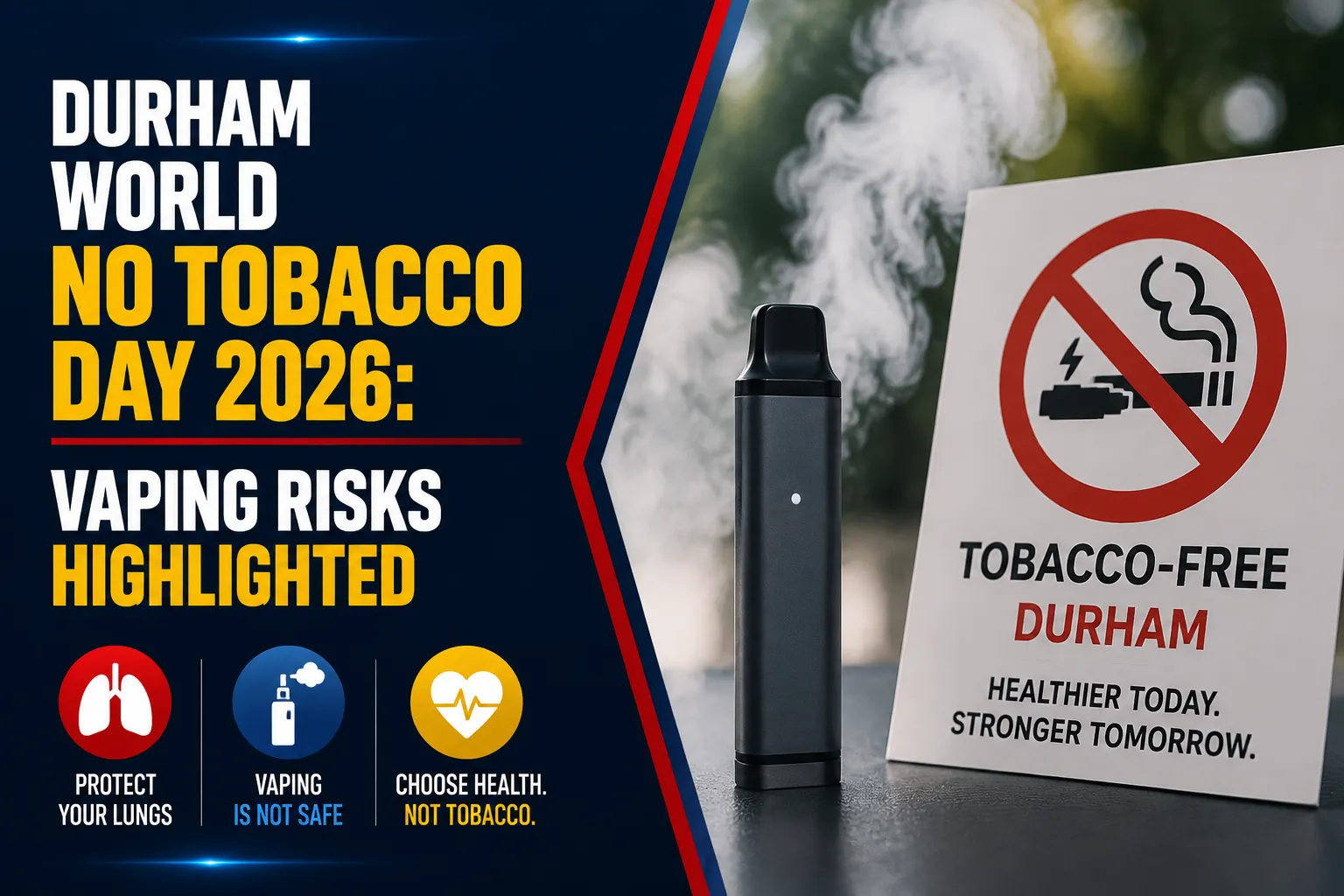
The Durham Region Health Department has launched a comprehensive public health offensive to disrupt youth nicotine dependency loops across local secondary and post-secondary student networks. Aligning with the World Health Organization’s (WHO) global Durham World No Tobacco Day 2026 campaign on Sunday, May 31, 2026, regional medical officers are escalating efforts to expose the marketing strategies deployed by modern commercial nicotine manufacturers.
The public awareness push focuses heavily on countering industrial manipulation tactics, specifically targeting the high-volume deployment of synthetic flavoring agents and algorithm-driven social media loops engineered to hook vulnerable adolescent populations.


The Architecture of Youth Chemical Addiction
Frontline medical officials are sounding alarms over the rapid rise of electronic cigarette usage and high-capacity vaping hardware within local school boards. According to data validated from the most recent Ontario Student Drug Use and Health Survey, approximately 13.4 percent of students enrolled in grades 7 through 12 across Ontario reported active vaping usage over the past calendar year.


The widespread public health threat is compounded by severe, long-term physiological risks: adolescent exposure to high-concentration nicotine directly damages developing neurological pathways, permanently magnifying the risk profile for lifelong chemical addiction.
| Public Health Nicotine Metric | Documented Provincial & Regional Impact |
| Annual Provincial Tobacco Fatalities | 16,000 deaths across Ontario per year |
| Adolescent Vaping Prevalence (Grades 7–12) | 13.4% of students reporting annual usage |
| Primary Industrial Masking Additives | Refined sugars, candy/fruit flavors, synthetic cooling agents |
| Core Regulatory Advocacy Target | Complete legislative ban on youth-appealing flavors |
Public health nurse Ann-Marie Ho emphasized that the long-term clinical impacts of persistent chemical vapor exposure remain a profound concern due to evolving epidemiological data. Ho noted that manufacturers intentionally infuse vapor oils with refined sugars, fruit concentrates, and synthetic cooling chemicals to mask the natural, chemical harshness of high-dose nicotine. By lowering the sensory barrier to inhalation, these additives allow youth to draw deeper vapor volumes into the lungs, accelerating the delivery of toxins to the brain and significantly compressing the timeline required to establish deep physical addiction.
Provincial Policy Advocacy and Cessation Networks
First established by the WHO back in 1987, the annual focus of World No Tobacco Day has shifted to advocate for immediate provincial and federal legislative updates. Durham health teams are formally throwing their weight behind calls for a total ban on all characterizing fruit and candy flavors across all electronic nicotine delivery systems. Public health officials argue that cutting off access to these commercial flavor profiles is a critical defense mechanism needed to safeguard local schools from predatory commercial outreach.
To support residents trying to break out of dependency cycles, the health department is coordinating localized extraction resources alongside family physicians. The region has updated its digital diagnostic databases, offering free access to step-by-step cessation toolkits, nicotine replacement protocols, and second-hand vapor protection strategies. Local families and individuals seeking support to quit smoking or vaping can download active intervention plans directly via the municipality’s health portal at durham.ca/TobaccoAndVaping.