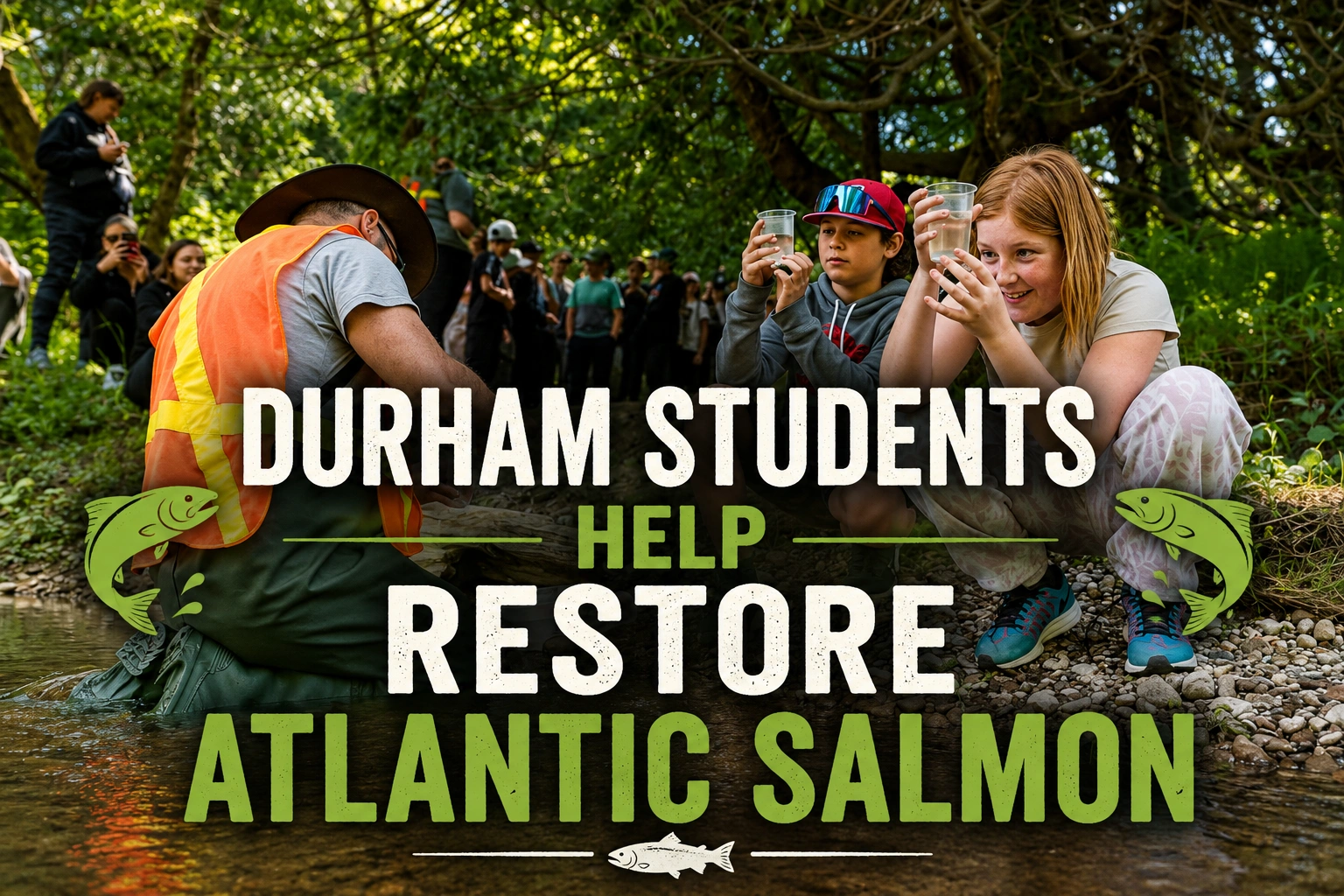
Durham Students are playing an important role in helping restore Atlantic salmon populations to Lake Ontario through a hands-on conservation project that combines environmental education with wildlife restoration.
The initiative recently culminated in a special release event at Greenwood Conservation Area in Ajax, where students gathered to release dozens of young Atlantic salmon into Duffins Creek. The creek flows directly into Lake Ontario and serves as an important habitat for fish as they begin their journey in the wild.


The project involved Grade 6 students at Sunderland Public School in Brock Township, who spent several months caring for salmon eggs and newly hatched fish inside their classroom. Beginning in January, more than 100 Atlantic salmon eggs were placed in a specialized incubation tank where students monitored their development daily.


Throughout the school year, students were responsible for checking water temperatures, monitoring oxygen levels, maintaining equipment, and feeding the fish after they hatched. The young conservationists carefully tracked the health of the salmon while learning about aquatic ecosystems, environmental stewardship, and species restoration.
Their dedication paid off when 93 healthy juvenile salmon were successfully released into Duffins Creek during a celebration attended by students, teachers, and environmental program coordinators.
The project is part of the Lake Ontario Atlantic Salmon Restoration Program, operated by the Ontario Federation of Anglers and Hunters Foundation. The initiative places salmon eggs in classrooms across Ontario, allowing students to participate directly in conservation efforts while learning about local environmental issues.
More than 80 classrooms participate in the program annually, helping raise and release Atlantic salmon as part of broader efforts to restore a species that once thrived in Lake Ontario.
Program coordinator Ben Teskey praised the students for their commitment and care throughout the project. During the release event, he reminded participants that their efforts contribute to a larger environmental mission aimed at restoring a species that disappeared from Lake Ontario more than a century ago.
Historically, Lake Ontario supported the largest freshwater population of Atlantic salmon in the world. The species flourished in the lake’s cold waters and river systems for thousands of years. However, extensive overfishing, pollution, deforestation, and dam construction during the nineteenth century led to the local extinction of Atlantic salmon by the late 1800s.
Conservation groups have spent years working to reverse that decline and re-establish self-sustaining salmon populations within the watershed.
Teacher Pam Freitag, who has led the project at Sunderland Public School for several years, said students quickly become emotionally invested in the fish. She noted that the experience helps teach responsibility, empathy, and environmental awareness.
Beyond science education, the project encourages students to understand the importance of protecting wildlife and maintaining healthy ecosystems. Participants gain firsthand experience caring for living creatures while learning how human actions can affect the environment.
Students Emma Mitchell and Eric Batpie were among those heavily involved in caring for the fish. Both expressed excitement about helping a species in need while also acknowledging the emotional connection they developed throughout the project.
Emma said she wanted to help because she loves animals and nature, while Eric explained that helping restore Atlantic salmon was an opportunity to support the environment and protect wildlife.
At the release event, students took turns carefully releasing individual fish into the creek, many even giving their salmon names before watching them swim away.
Environmental education programs such as this continue to play a valuable role in Durham Region schools by connecting students directly to conservation efforts. By combining classroom learning with real-world action, projects like the Atlantic Salmon Restoration Program help inspire future generations of environmental stewards.
As the young salmon begin their journey toward Lake Ontario, the students who cared for them can take pride in knowing they contributed to an important effort to restore one of the region’s historic native species.