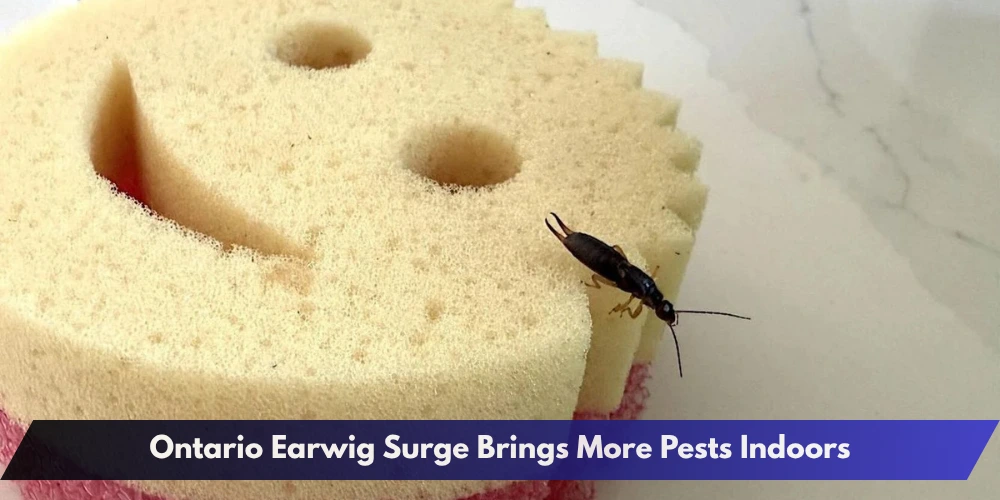
The Ontario Earwig Surge is bringing unusually high numbers of the insects into homes and gardens this summer, with sightings reported across southern Ontario, including Clarington.
Experts believe favourable winter and spring conditions may have helped more earwigs survive and reproduce. Deep, persistent snow can insulate the ground from extreme cold, while wet spring weather provides the cool and damp environments the insects prefer.


Residents who have noticed earwigs crawling across kitchen counters, bathrooms, basements or patios are therefore not necessarily dealing with an isolated household problem.


Earwigs are mainly nuisance pests
European earwigs are reddish-brown insects that can grow to approximately two centimetres long. They are easily recognized by the forceps-like pincers located at the rear of their bodies.
Despite their intimidating appearance, earwigs are not considered directly harmful to people. Health Canada describes them as nuisance pests that do not transmit disease. They can also be beneficial outdoors because they consume decaying material, aphids, insect larvae and slug eggs.
Earwigs may occasionally use their pincers for defence, but they are not aggressive and generally avoid contact with people.
They also do not normally establish reproducing colonies inside houses. Finding several indoors usually means they entered from nearby outdoor hiding places.
Why numbers may be higher
Adult earwigs survive the winter underground or beneath protected material such as leaves, mulch and logs.
A thick covering of snow can act as insulation, protecting insects from severe temperature changes. When this is followed by a damp spring, survival and breeding conditions may improve.
Earwigs prefer cool, dark and moist locations. They are frequently found underneath stones, flowerpots, boards, garden debris and heavily watered mulch.
The Ontario Earwig Surge may become more noticeable indoors when hot or dry weather causes the insects to search for cooler, more humid shelter.
They can enter through gaps around foundations, doors, windows, vents and utility openings. Earwigs may also be carried indoors in firewood, garden supplies or potted plants.
How to remove earwigs indoors
A small number of earwigs can usually be removed with a vacuum cleaner, tissue or paper towel.
Sticky traps may also catch them, although these products should be placed where children and pets cannot reach them.
Residents finding large numbers indoors should first look for moisture problems or entry points rather than relying only on insect-control products.
Leaking taps, pipes and downspouts should be repaired. Damp basements, crawl spaces and areas around exterior walls should be kept as dry as possible.
Cracks around doors, windows, foundations and vents can be sealed, while damaged screens and door sweeps should be replaced.
Reduce outdoor hiding places
Managing the Ontario Earwig Surge begins outside the home.
Health Canada recommends removing debris and reducing the damp hiding places earwigs use. Wood, mulch, leaves and other organic material should not be allowed to build up directly against foundations.
Firewood should be stored away from the house and raised above the ground. Empty containers, boards and other objects that trap moisture should also be removed.
Gardeners can place rolled or folded damp newspaper near affected plants overnight. Earwigs attracted to the shelter can be shaken into soapy water the following morning.
Shallow containers partly filled with vegetable or fish oil may also attract and trap earwigs. Traps should be positioned carefully to avoid harming pets or wildlife.
Pesticide use in Ontario is regulated, and homeowners should only use products permitted for the intended purpose while following every label instruction.
Although earwigs can damage tender leaves, flowers and vegetables, complete elimination is rarely necessary. Removing moisture, sealing entry points and reducing outdoor shelter will usually provide the most effective long-term control.