








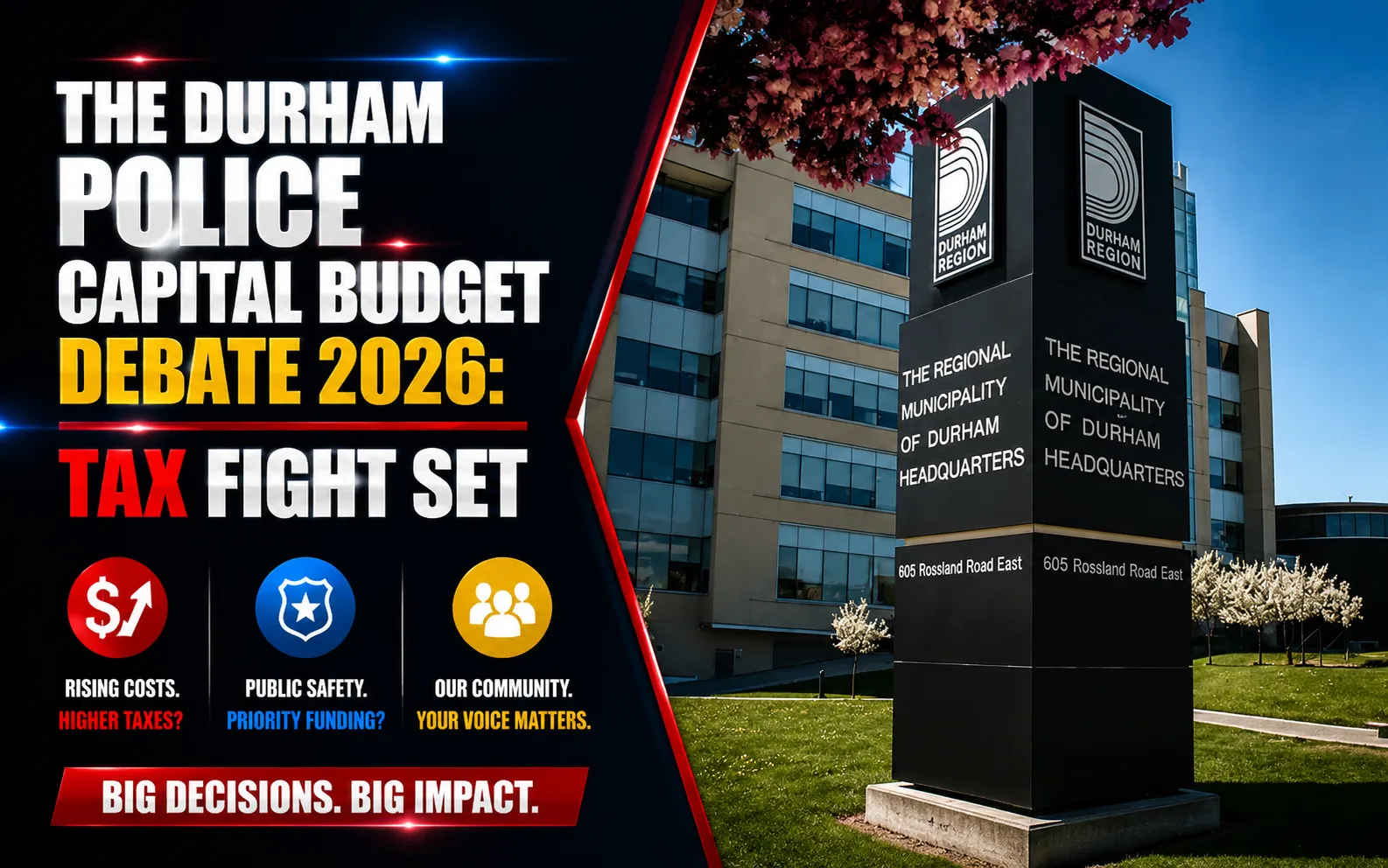
Durham Regional Council has voted down a strategic committee proposal to delay financial tracking of its historic law enforcement expansion plan, forcing a high-stakes legislative showdown ahead of the autumn municipal elections. Under the political filings tracking The Durham Police Capital Budget Debate 2026, lawmakers locked into an intensive floor debate during their Wednesday, May 27, 2026 assembly. A clear majority rejected an attempt by outgoing Regional Chair John Henry to push the ten-year, $1.1 billion Durham Regional Police Service (DRPS) capital forecast onto the next generation of politicians.
The successful legislative intervention forces regional treasury staff to immediately begin mapping out alternative financial frameworks to absorb the massive infrastructure costs without triggering a devastating tax spike.

The Battle for Fiscal Floor Debate
The political gridlock originally crystallized during a regional Finance and Administration Committee hearing on May 12, where Chair John Henry introduced a motion to defer all critical funding choices for the police infrastructure envelope directly into the 2027 fiscal planning cycle. However, during Wednesday’s full council session, Oshawa Councillor Brian Nicholson staged a successful procedural counter-offensive. Seconded by fellow Oshawa Councillor Tito-Dante Marimpietri, the floor challenge defeated the deferral maneuver in an 18-9 vote, forcing the current roster of politicians to actively confront the funding crisis.


The underlying urgency behind the immediate financial audit stems from severe tax projection models delivered alongside the initial proposal. Presenters at the meeting—including Ajax Mayor Shaun Collier, who serves as Chair of the Durham Regional Police Services Board, and DRPS Chief Peter Moreira—outlined critical infrastructure requirements. However, initial budget parameters warned that the capital plan could spike localized property tax burdens by as much as 10 percent.
Nicholson strongly criticized this threshold, declaring that any elected official who signed off on a double-digit property tax escalation would likely face defeat at the ballot box this October.
Mandating Alternative Financial Extractions
To defuse the projected tax spike, council subsequently passed two back-to-back, unanimous motions designed to protect local homeowners while ensuring emergency services remain functionally funded. The new directives legally order regional treasury teams to collaborate with DRPS administrative leads to craft a highly optimized “timing, financing, and business plan.”
Furthermore, staff are explicitly mandated to investigate “all financial options” beyond standard property tax levies. This framework directs analysts to explore long-term municipal debt issuance, the optimization of localized development charges tied to population growth, and targeted capital reserve draws.
With the October municipal election looming, the successful navigation of The Durham Police Capital Budget Debate 2026 is positioned to serve as a defining fiscal benchmark for regional candidates looking to balance community safety against local affordability limits.