








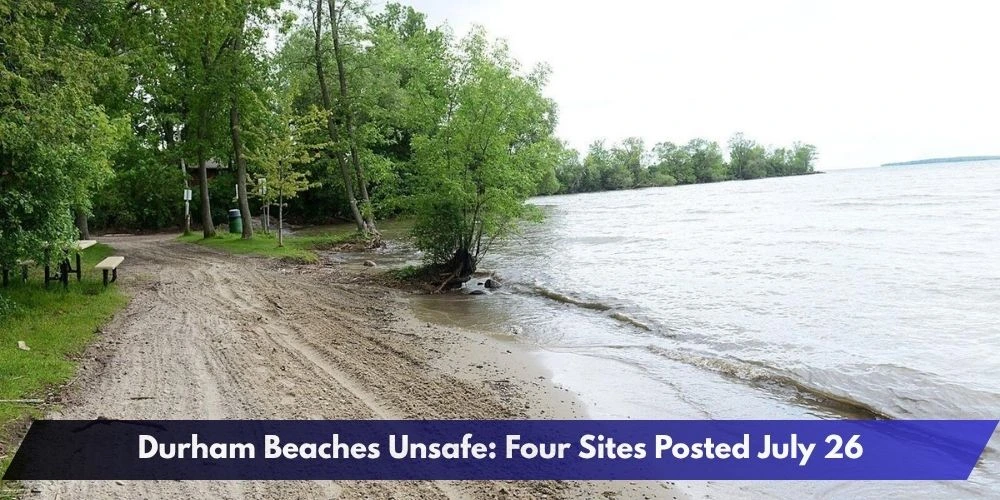
Four public beaches in Durham Region were listed as unsafe for swimming as of Sunday, July 26 at 2 p.m.
The latest Durham beaches unsafe list includes Beaverton North Beach, Beaverton South Beach, Bowmanville West Beach and Lakeview East Beach.


The results are based on samples collected on July 23. Residents should check for posted warning signs and review the latest Durham Region Health Department information before entering the water because beach conditions can change after testing.


Durham Beaches Unsafe for Swimming
Residents are advised to stay out of the water at the following four locations:
- Beaverton North Beach in Brock, near Wellington Street and Victoria Street
- Beaverton South Beach in Brock, near Simcoe Street and Harbour Park Crescent
- Bowmanville West Beach in Clarington, near West Beach Road and Cove Road
- Lakeview East Beach in Oshawa, near Simcoe Street South and Lakeview Park Avenue
The latest report represents a change for Clarington. Bowmanville East Beach, which was previously listed as unsafe, is now listed as safe. Bowmanville West Beach is now the affected Bowmanville location.
Durham Region Health Department monitors 15 public beaches from the beginning of June through the end of August. Water samples are tested for elevated levels of bacteria to determine whether a beach is suitable for swimming.
Eleven Durham Beaches Listed as Safe
The following beaches were listed as safe for swimming in the July 26 report:
- Bowmanville East Beach in Clarington
- Frenchman’s Bay East Beach in Pickering
- Frenchman’s Bay West Beach in Pickering
- Iroquois Beach in Whitby
- Kinsmen Beach in Scugog
- Lakeview West Beach in Oshawa
- Newcastle Central Beach in Clarington
- Paradise Beach in Ajax
- Rowan Beach in Caesarea, Scugog
- Thorah Centennial Park Beach in Brock
- Whitby Beach in Whitby
A safe test result does not guarantee that conditions will remain safe throughout the day. Heavy rain, runoff, waves, large numbers of birds and other environmental factors can quickly affect water quality.
Visitors should look for warning signs at the beach even when the most recently published test result was safe.
Why Beaches Are Posted as Unsafe
Durham Region posts a beach as unsafe when testing finds elevated E. coli levels above the provincial recreational-water standard of 200 E. coli per 100 millilitres of water. The Public Health Ontario laboratory in Peterborough analyzes the Region’s beach-water samples.
High bacteria levels can increase the risk of minor skin problems, eye, nose and throat infections and upset stomachs. Young children, older adults and people with weakened immune systems face a greater risk of becoming ill.
Pollution can come from stormwater runoff, animal droppings, sewer overflows, poorly maintained septic systems, agricultural runoff and waste from boats. Wind, rain, sunlight and water temperature can also influence bacterial levels.
Avoid Swimming After Heavy Rain
Durham Region advises people not to swim for at least 48 hours after heavy rainfall because runoff can carry additional bacteria into lakes and rivers.
Visitors should also stay out of the water when:
- The water looks cloudy or discoloured
- They cannot see their feet while standing in waist-deep water
- Large numbers of birds are present
- There is floating debris, garbage or an unusual smell
- A beach warning or blue-green algae advisory is posted
Children and pets should not enter water that appears to contain blue-green algae. Durham Region advises residents not to use affected water for drinking, cooking, washing dishes or rinsing food.
The Region publishes weekly results for all 15 monitored beaches through its Check&Go! Durham portal until Labour Day.
The current Durham beaches unsafe information should be updated when the next test results are released or if public health officials change the status of any beach.