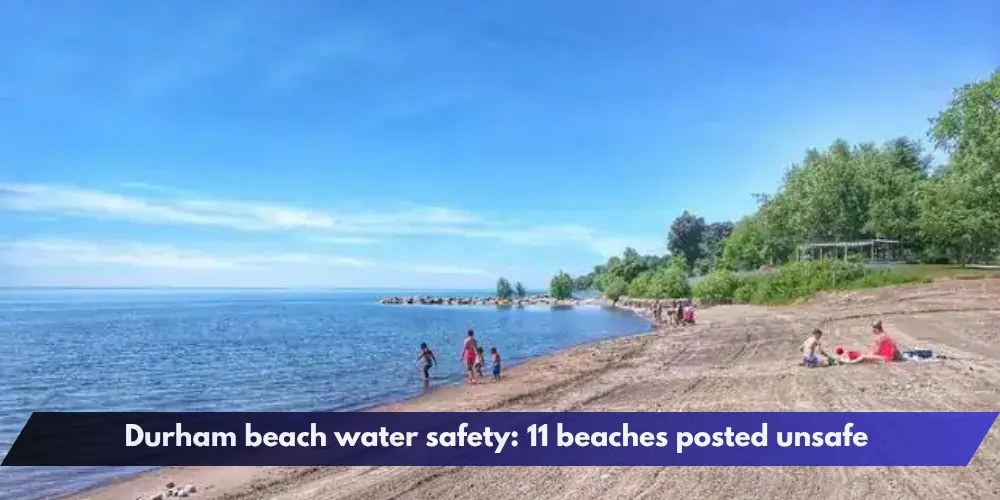
Eleven of Durham Region’s 15 monitored public beaches have been posted as unsafe for swimming after the latest round of water testing found elevated bacteria levels at locations across the region.
The latest Durham beach water safety results leave only four monitored beaches open for swimming: Frenchman’s Bay East and Frenchman’s Bay West in Pickering, along with Bowmanville East Beach and Bowmanville West Beach in Clarington.


Durham Region Health Department tests public beach water throughout the summer and posts warning signs when bacteria levels exceed provincial recreational-water standards.


Beaches posted unsafe across Durham
The 11 beaches listed as unsafe for swimming in the latest results are:
- Paradise Beach in Ajax
- Beaverton North Beach in Brock
- Beaverton South Beach in Brock
- Thorah Centennial Park in Brock
- Newcastle Beach Central in Clarington
- Lakeview Beach East in Oshawa
- Lakeview Beach West in Oshawa
- Kinsmen Beach in Scugog
- Rowan Beach in Scugog
- Iroquois Beach in Whitby
- Whitby Beach at Heydenshore Park in Whitby
The four beaches not posted in the latest report are Frenchman’s Bay East and West in Pickering and Bowmanville East and West in Clarington.
The affected locations include beaches on Lake Ontario, Lake Simcoe and Lake Scugog. Rowan Beach is in Caesarea in Scugog, while Kinsmen Beach is in Port Perry. The three monitored Brock locations are on Lake Simcoe.
Heavy rain can increase bacteria levels
Durham Region says beach water is tested for bacteria throughout the swimming season so residents can make informed decisions before entering the water.
A beach is posted as unsafe for swimming when E. coli levels exceed the provincial standard of 200 E. coli per 100 millilitres of water.
Recent rainfall can contribute to poor water quality because runoff may carry bacteria and other contaminants from roads, storm sewers, animal waste and surrounding land into lakes and rivers.
The Health Department advises residents not to swim at any beach for at least 48 hours after heavy rainfall, even if a beach is not currently posted. Water conditions can change quickly between weekly tests.
What does a beach posting mean?
A posted beach should not be treated as safe for swimming until updated testing shows bacteria levels have returned to acceptable levels and the warning is removed.
Durham Region says exposure to contaminated recreational water can lead to problems including skin, eye, nose and throat infections, as well as upset stomach.
Young children, older adults and people with weakened immune systems may face a greater risk of infection.
Residents should also avoid swimming when water is cloudy enough that they cannot see their feet while standing in waist-deep water.
A posting does not necessarily mean the entire beach property is closed. It is a warning that the water is considered unsafe for swimming based on the latest test results.
Check conditions before heading to the beach
Durham Region monitors 15 public beaches during the summer and publishes current inspection results through its Check&GO! Durham portal.
The Health Department says beach conditions can change due to rainfall, runoff, wind, water temperature and other environmental factors. Residents should therefore check the latest results before leaving home and look for warning signs when they arrive.
The latest Durham beach water safety results leave most of the region’s monitored swimming locations posted, with 11 of 15 currently listed as unsafe. Residents looking to swim can still consider the four beaches not posted in the latest results, but should continue following the Region’s advice to stay out of the water for at least 48 hours after heavy rain.