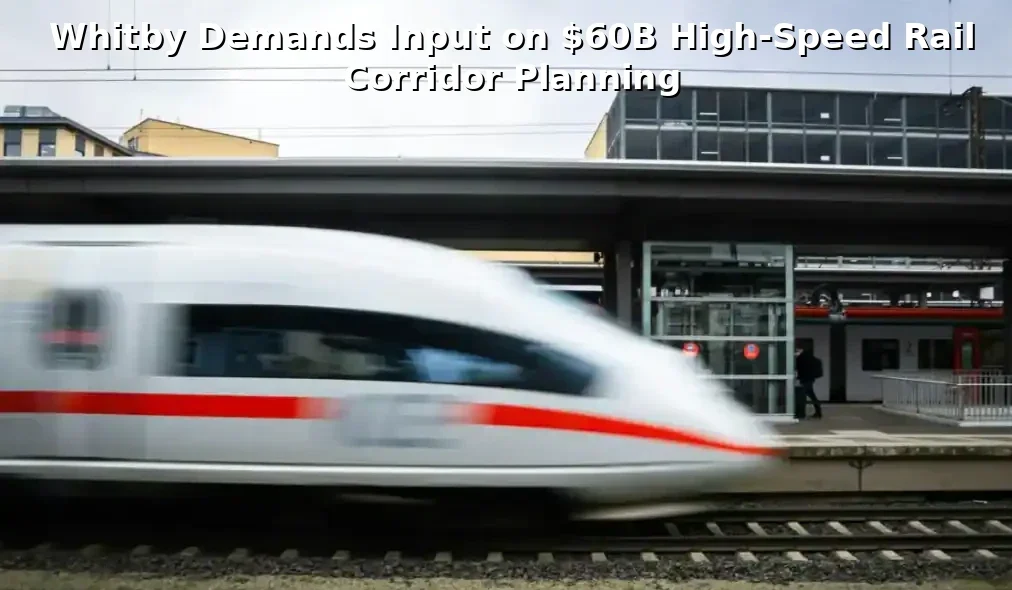
The Town of Whitby is formally requesting a seat at the consultation table as the federal government moves forward with plans for Canada’s first-ever high-speed rail line. Although the current proposed route for the project—which spans from Quebec City to Toronto—does not include a station stop in Whitby, Mayor Elizabeth Roy has raised concerns regarding the potential impact on local land use and infrastructure. As the project enters a critical development phase under the newly formed Crown corporation, Alto, Whitby officials are seeking transparent engagement to ensure the Whitby high-speed rail planning process does not conflict with existing agricultural lands or the planned GO train expansion to Bowmanville.
In a formal letter to Transport Minister Steve MacKinnon, Mayor Roy and CAO Matt Gaskell emphasized that while they support the “transformative potential” of the $60 billion to $90 billion project, the town must be a constructive partner in its design. The mayor noted that several routing options currently under assessment could run north of Whitby’s urban areas, potentially requiring road realignments and significant grade separations. Without early and detailed briefings, the Whitby high-speed rail planning could lead to “integration challenges” with municipal networks and long-term growth management strategies already in place for the Durham Region.
The federal government, led by Prime Minister Mark Carney, has defended the project as a “nation-building” undertaking that will create 50,000 jobs and contribute $35 billion to the economy. However, the proposal faces growing opposition from conservation groups, farming associations, and rural communities concerned about land expropriation. To address these fears, Alto has spent much of early 2026 hosting information sessions, with the Prime Minister clarifying that the actual track will only require a 10-metre swath of land. Despite these assurances, a recent poll shows that 60 per cent of respondents remain skeptical that the line will ever be built, given the massive capital requirements and logistical hurdles.
Whitby’s request for technical briefings includes a demand for specific data on corridor alignment options, anticipated land requirements, and environmental constraints “within or adjacent to Whitby.” The town is particularly concerned about how a high-speed line—designed for speeds up to 300 km/h—will interact with the rural-urban fringe and the sensitive ecosystems of the Frontenac Arc. By securing a seat at the table, the town aims to maximize regional benefits while safeguarding the interests of local businesses and residents who may be affected by the 10-kilometre-wide planning corridor currently under review.
As the first segment of construction between Ottawa and Montreal is slated to begin by 2030, the pressure is on for municipalities along the spine of the line to align their local transit and development goals. For Whitby, the focus remains on ensuring that the Whitby high-speed rail planning is a collaborative effort rather than a top-down federal mandate. The town’s leadership maintains that early intervention is the only way to protect agricultural heritage and ensure that the multi-billion-dollar investment truly serves the needs of the Durham Region’s rapidly growing population.