Aug. 26 update: Unifor calls for stronger worker protections
Unifor is calling on Ottawa to go further in protecting Canadian workers as the trade dispute with the United States puts renewed pressure on the auto industry and other manufacturing sectors.
The development adds to concerns around the Oshawa trade tariff impact, where General Motors operates one of Durham Region’s largest manufacturing facilities.


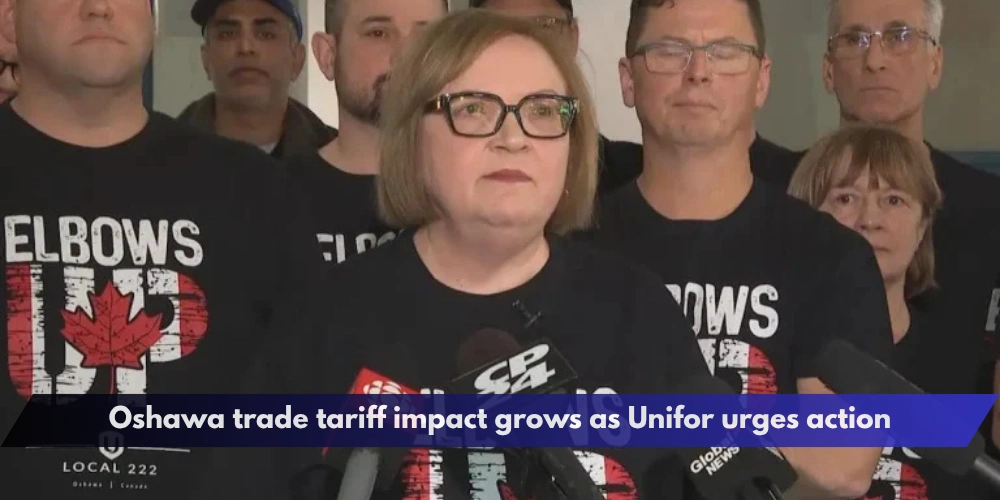
Unifor National President Lana Payne said the union supports Canada’s decision to respond to the latest U.S. tariffs with matching countermeasures but wants stronger domestic policies to keep workers employed.


The federal government announced Aug. 25 that Canada will impose matching tariffs on $27.6 billion worth of U.S. imports beginning Sept. 8. Ottawa also introduced a $7.5-billion package of financing, Employment Insurance measures, retraining programs and other assistance for businesses and workers affected by tariffs.
Unifor welcomed the counter-tariffs but said Canada should also accelerate domestic procurement, develop stronger national industrial strategies and encourage companies and governments to purchase Canadian-made products.
The union is particularly concerned about Canada’s highly integrated auto sector. Unifor has argued that continued tariff uncertainty makes it more difficult for companies to plan production and threatens workers on both sides of the Canada-U.S. border.
That concern has a direct Oshawa connection.
Unifor represents approximately 2,750 workers at GM Oshawa Assembly, according to the union. Negotiations with General Motors began Aug. 10 amid ongoing tariff uncertainty.
On Aug. 22, Unifor announced tentative agreements covering more than 4,600 GM workers at Oshawa Assembly, CAMI Assembly in Ingersoll, the St. Catharines Propulsion Plant and the Woodstock Parts Distribution Centre.
The agreements have been unanimously endorsed by Unifor’s GM bargaining committee, but they still require member ratification. Meetings are scheduled for Aug. 29 and 30.
Unifor is also asking Ottawa to make broader improvements to Employment Insurance.
The federal tariff-response package extends several temporary EI measures and introduces additional worker and employer supports. Unifor says those changes provide relief but do not address longer-term concerns such as qualifying-hour requirements, benefit rates and support for part-time, seasonal and precarious workers.
For Oshawa, the continuing trade dispute remains closely tied to the future of automotive manufacturing and the thousands of workers and suppliers connected to GM’s local operations.