








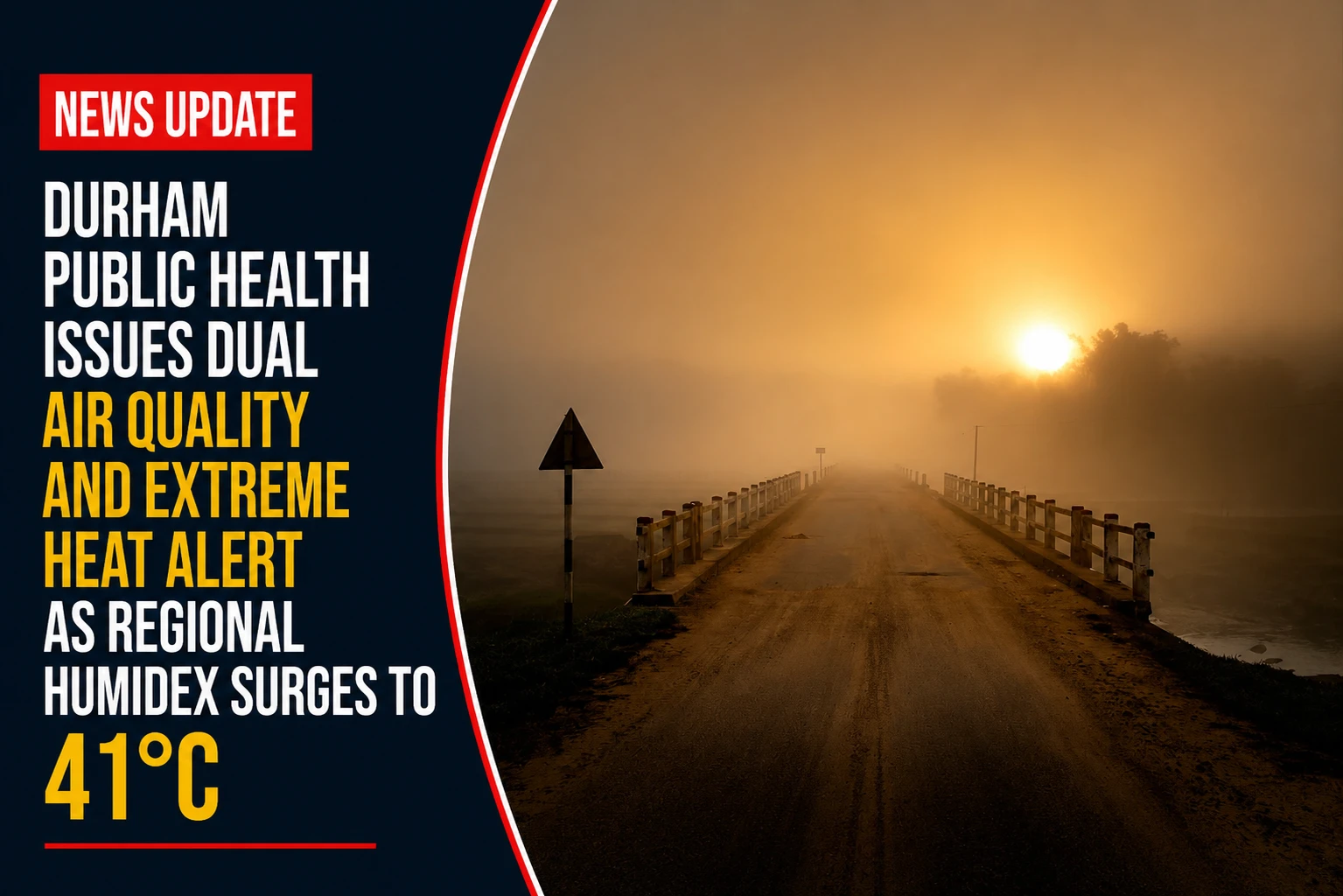
The municipal health boards, emergency medical services, and regional environment networks within the Durham Region are mobilizing emergency wellness protocols. Tracked under provincial meteorology, public health safety, and environmental protection portfolios on Wednesday, July 15, 2026, climate monitoring technicians finalized the region-wide severe warning July 15 weather: Wildfire smoke and high that feels like 41 C in southern Ontario. Operating under extended Environment Canada statutory heat warnings, local communities are bracing for a hazardous environmental combination as record-setting summer humidity matches poor atmospheric visibility driven by drifting domestic forest fires.
Regional health directors are urging residents to significantly reduce heavy outdoor physical activity, as the dense concentration of airborne fine particulate matter creates immediate respiratory stress alongside intense thermal conditions.


The Multi-Day Extreme Humidex and Wildfire Smoke Influx
The localized weather pattern combines a high-pressure heat dome with trans-provincial upper-level smoke currents, compressing air quality across the urban footprint.


-
The Ambient Peak: While traditional mercury baselines are hovering around a daytime maximum of 33°C, the high concentration of low-level atmospheric moisture will drive the regional humidex to an absolute perceived index of 41°C.
-
The Atmospheric Particulate Shift: Winds are carrying extensive, heavy smoke plumes originating directly from active wildfires burning in northwestern Ontario. The drifting soot layers are severely impacting municipal air quality parameters across Toronto, Oshawa, and the wider Golden Horseshoe grid.
-
The Convective Shower Risk: Weather tracking units indicate a 30% localized probability of severe late-afternoon showers and pop-up thunderstorms, carrying over into the night hours as hot air masses collide with local lake breezes.
-
The Nocturnal Threshold: Overnight recovery will remain structurally limited, with low temperatures dropping to a sticky, humid baseline of 20°C, preventing natural residential cooling cycles.
Analyzing the Public Health Symptom Matrix and Thursday Climate Transition
Regional emergency workers are warning residents to actively check family members and outdoor workers for specific physiological warning indicators.
| Environmental Threat Classification | Documented Public Health Symptoms Matrix | Immediate Emergency Remediation Actions | Secondary/Rare Clinical Indicators | Upcoming Thursday Climate Transition Grid |
|
Humidex Heat Stress (↗ Perceived 41°C High) |
• Throbbing headache. • Acute nausea / dizziness. • Dark urine production. • Intense physical fatigue. |
• Immediate halt to physical labor. • Move to air-conditioned facilities. • Consume chilled water arrays. |
Severe muscle cramping and heat stroke-induced disorientation. | Sunny and Clear: Maximum temperature setting drops down to a manageable 30°C. |
|
Wildfire Particulate Smoke (↗ PM2.5 Influx) |
• Eye and nose irritation. • Scratchy throat / dryness. • Persistent mild coughing. |
• Absolute limits on outdoor time. • Seal home ventilation intakes. • Deploy indoor HEPA filtration. |
Structural wheezing, acute chest pains, and chronic respiratory inflammation. | Atmospheric Clearing: Prevailing weather systems push smoke loops north, dropping overnight lows to 18°C. |
The Environment Canada Meteorological Division, the Ontario Ministry of Health, and individual regional public works environmental tracking teams handle ongoing air quality health index logging, humidex verification, and severe storm tracking.
Durham residents, outdoor contractors, and community athletic organizers looking to check real-time localized Air Quality Health Index (AQHI) values, track live radar arrays for the late-afternoon storm front, or locate public air-conditioned cooling stations across the region can access the platforms online through the central Environment Canada portal, view medical advisories via the Durham Public Health portal, or monitor regional climate indicators through the Durham Region public safety network.