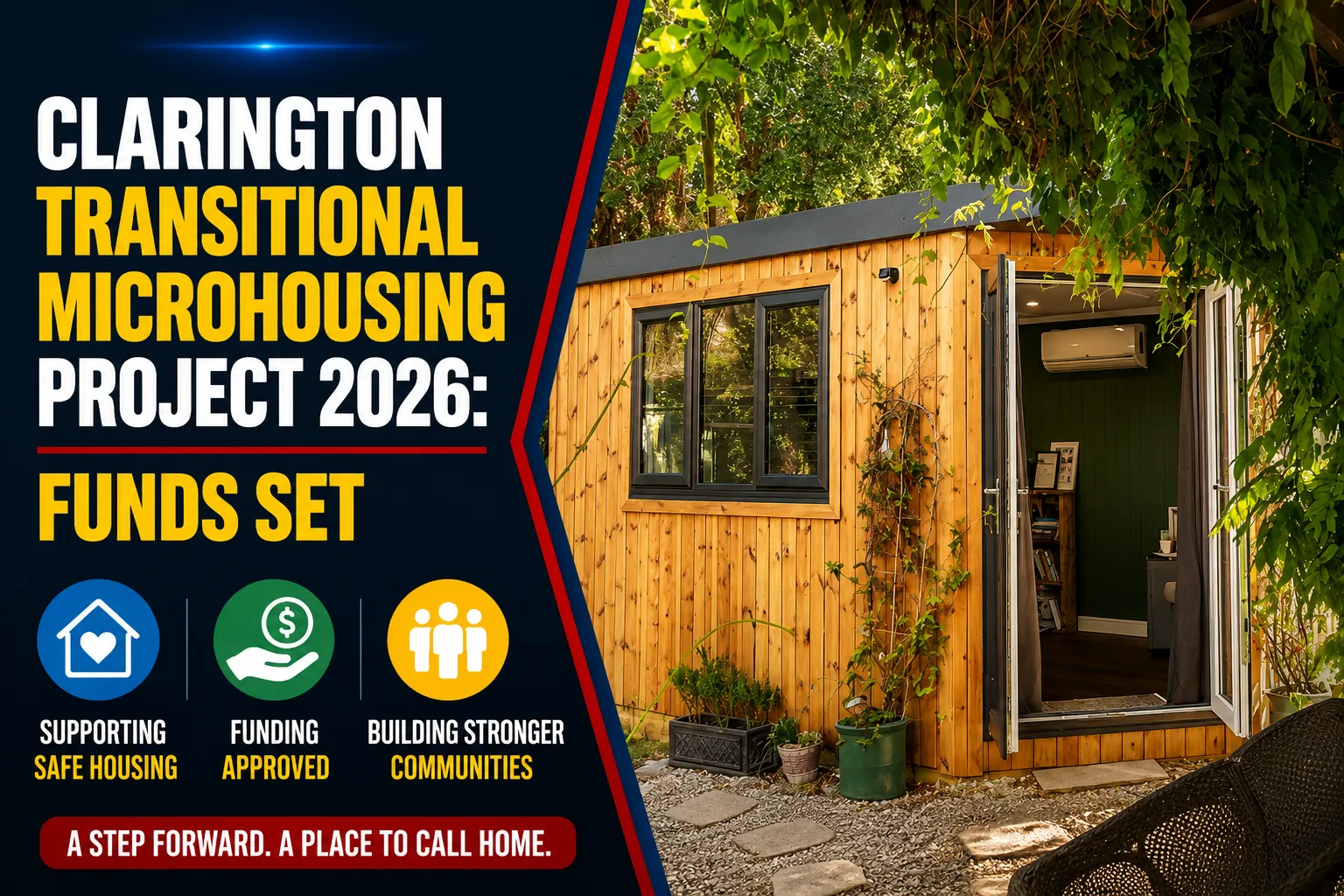
Clarington Municipality has approved an immediate capital funding framework to accelerate temporary housing solutions for the region’s most vulnerable unhoused populations. Under the active legislative file tracking the Clarington Transitional MicroHousing Project 2026, lawmakers voted during a late-May assembly to provide substantial financial incentives to the Durham Region Non-Profit Housing Corporation (DRNPHC). The collaborative venture is engineered to introduce a rapid-build, modular cabin community on Maple Grove Road in Bowmanville to intercept a growing urban encampment crisis.
Though staff confirm a formal, finalized planning application has not yet been logged into the municipal registry, the preliminary vote guarantees massive cost reductions to ensure the project remains economically viable for the non-profit developer.
The Mechanics of the Encampment Transition
Data presented to lawmakers during a comprehensive corporate brief highlighted the severe pressures squeezing regional public health services, documenting over 1,600 individuals currently experiencing active homelessness across the Durham Region.
The proposed micro-housing model is designed to fill a critical gap in the existing emergency shelter system by appealing directly to unsheltered individuals who historically refuse conventional indoor mass shelters.
| Infrastructure Parameter | Micro-Housing Cabin Community Profile |
| Total Planned Units | 50 prefabricated, private modular cabins |
| Proposed Location Node | Maple Grove Road corridor (Bowmanville) |
| Shared Civic Amenities | Communal kitchen, showers, laundry, and washrooms |
| Operational Protocol | 24-hour on-site security and wraparound medical supports |
| Municipal Funding Grant | $355,000 infrastructure cash + $5,000 application fee waiver |
The physical layout relies on quick-to-assemble, portable, and heavily insulated prefabricated cabins. While each structure offers residents a private, lockable living quarter, the community utilizes a shared central hub containing communal washrooms, showers, laundry facilities, and a commercial kitchen.
To break the localized cycle of long-term homelessness, the community will be governed by continuous, 24/7 on-site social work and psychiatric support teams. This operational model mirrors successful modular bridge housing hubs run by the Elizabeth Fry Society in Peterborough and John Howard Society initiatives in British Columbia.
Orono Seniors Housing Allocation
Simultaneously, Clarington Council expanded its affordable housing strategy into the rural community of Orono. The Durham County Senior Citizens Lodge presented a major expansion plan targeting their established property at 200 Station Street.
The senior citizens lodge currently manages 41 active residential units on the parcel. The newly endorsed blueprint seeks to construct an expansion wing containing 58 one-bedroom affordable units, which will be priced strictly at or below the Canada Mortgage and Housing Corporation (CMHC) average market rent thresholds.
To ensure the senior housing expansion can clear local water and roadway infrastructure connection requirements without delay, council approved an emergency financial relief package. Clarington will completely waive all municipal Zoning By-law Amendment and Site Plan application fees, provide a direct grant-in-lieu to cover standard Building Permit costs, and inject $255,000 in cash pulled straight from the town’s provincial Building Faster Funding reserves to cover structural hookups.