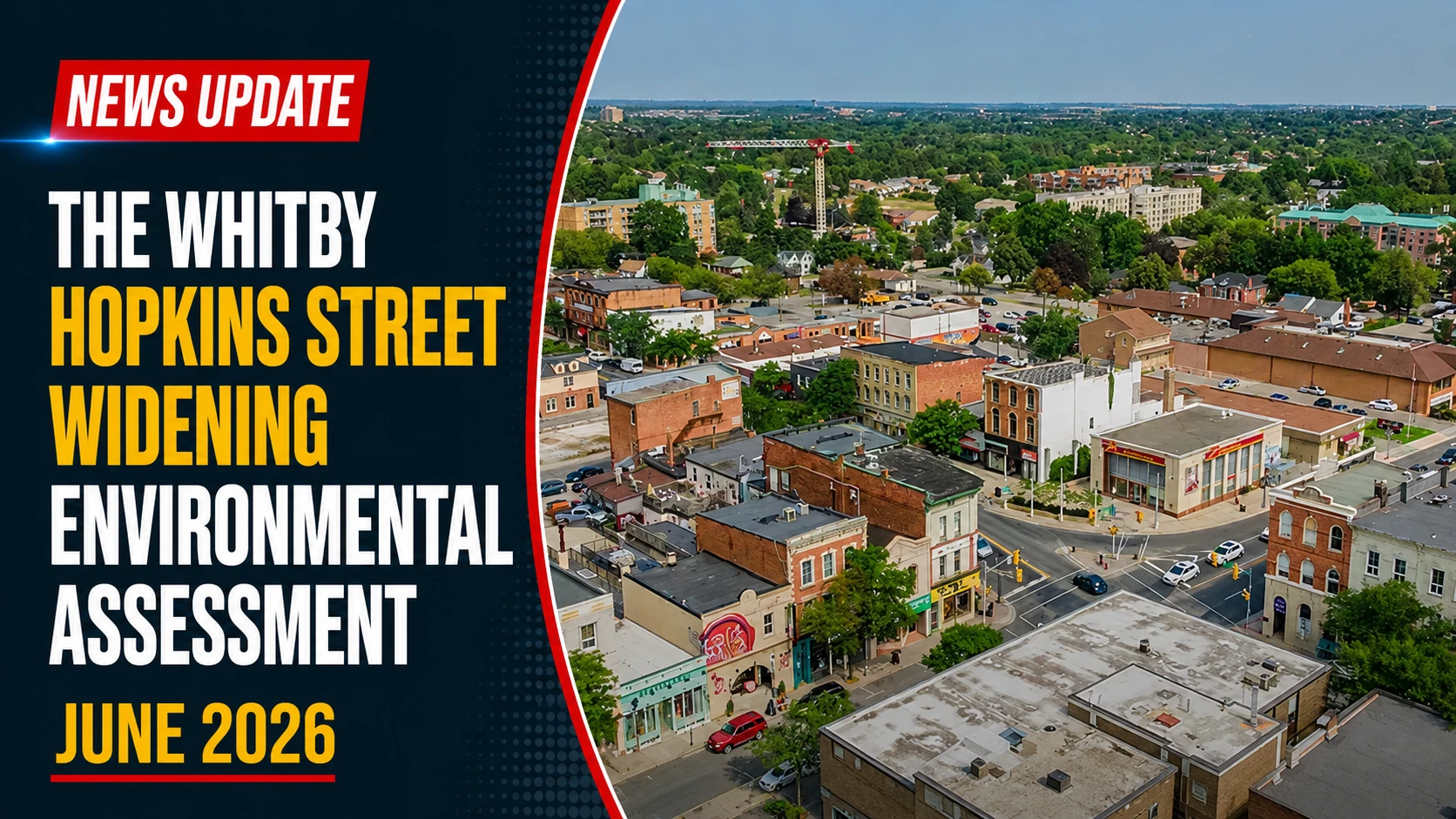
The arterial transit grids and civil engineering frameworks within the Town of Whitby have transitioned into an active phase of public evaluation. Tracked under regional transportation infrastructure registries on Tuesday, June 23, 2026, Durham Region public works planners finalized the technical staging details for The Whitby Hopkins Street Widening Environmental Assessment June 2026. Operating under the provincial Municipal Class Environmental Assessment (MCEA) system, the targeted infrastructure project is moving swiftly toward finalizing the ultimate design parameters required to completely reconstruct a vital north-south commercial link, addressing chronic safety deficiencies and rapid industrial traffic growth.
The primary engineering goal centers on converting the existing roadway profile into a highly efficient multi-functional lane system, paired with an advanced grade-separation bridge structure to isolate surface vehicular movements from active commercial rail operations.
The Project Alignment, Phase Management, and Rail Intersections
The physical construction zone covers a highly traveled commercial and logistics corridor, providing a vital connecting link between municipal transit networks and major regional highways.
-
The Geographic Corridor: The target construction sector spans along Hopkins Street (designated regionally as Regional Road 36), stretching from the Consumers Drive intersection (Regional Road 25) north to Dundas Street.
-
The Track Isolation Vector: A core element of the construction plan is the installation of a massive grade separation over the Canadian Pacific Kansas City (CPKC) rail corridor. By building a dedicated overpass structure, the region will permanently remove the existing level crossing, preventing chronic traffic gridlock caused by freight train switchings.
-
The Planning Status: Regional planners confirmed that Phase 1 (problem identification) and Phase 2 (alternative design evaluation) were satisfied through the long-term Durham Transportation Master Plan (TMP). The current study is operating as a Schedule “B” project, focusing heavily on fine-tuning neighborhood intersection modifications and active multi-use pedestrian infrastructure.
Analyzing Infrastructure Timelines and Public Consultation Networks
Regional engineers have finalized the public engagement timelines, establishing a structured comment window to gather feedback from local business owners and residents before compiling the final Project File Report.
| Monitored Development Asset Node | Primary Structural Modification | Public Engagement Mechanism | Core Feedback Submission Deadline |
| Hopkins Street Corridor | Reconstruction & 2-Way Center Turn Lane | Public Information Centre (PIC) | Thursday, July 9, 2026 |
| CPKC Rail Intersection Grid | New concrete-and-steel grade separation overpass | In-person session at Anderson CVI | Ongoing engineering design reviews |
| Multi-Use Active Transit Paths | Integrated cycling and protected walking lanes | Digital feedback hub at durham.ca | 30-Day public review cycle at study completion |
Following an in-person public gathering held at Anderson CVI earlier this month on June 10, all technical engineering blueprints, environmental noise studies, and lane layout materials have been uploaded to the region’s dedicated digital portal at durham.ca/HopkinsStreetEA. Local logistics firms and property owners are being urged to audit the planned driveway modifications and turning radii revisions, as the implementation of a continuous center left-turn lane will structurally alter how heavy transport trucks access commercial loading bays along the route.
At the conclusion of the public comment window on July 9, regional consultation coordinators will assemble all public input to finalize the master report. Once complete, a formal Notice of Study Completion will be issued, triggering a mandatory 30-day public review window before the region can officially transition the project into active property procurement and utility relocation phases.