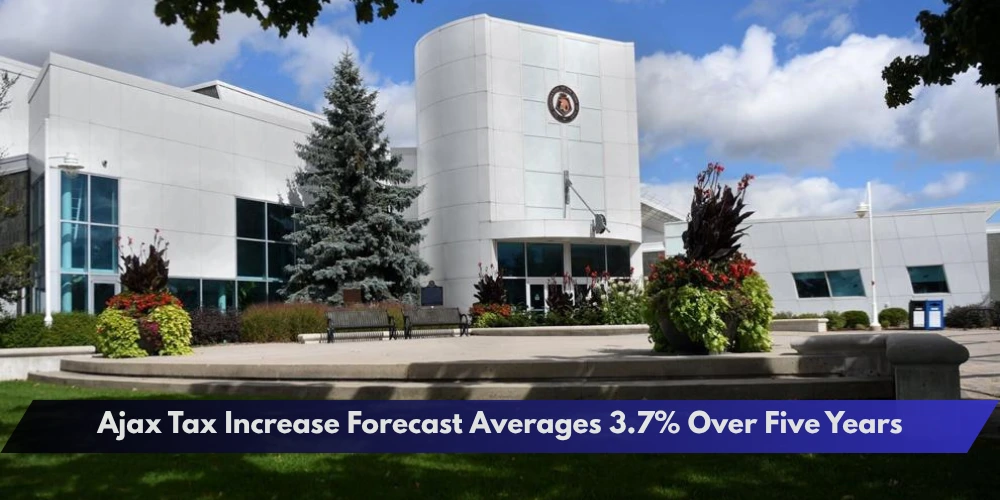
The Ajax Tax Increase forecast could average 3.7 per cent annually over the next five years under the town’s newly updated financial stability plan, but that figure does not include inflation or the separate two per cent infrastructure levy normally added to local tax bills.
Ajax council recently approved changes to the way the town plans to fund capital projects, maintain reserves and deal with its long-term infrastructure needs.

The updated strategy moves away from a previous rule that limited annual reserve spending and instead gives the municipality more flexibility to address its asset-management backlog.


However, some councillors and residents remain concerned about the pressure the new approach could place on taxpayers.
Ajax Removes Previous 90% Spending Cap
Under the town’s previous financial stability plan, Ajax used an annual spending-cap guideline equal to 90 per cent of annual reserve revenues.
That meant the town attempted to limit how much reserve revenue could be used each year for the capital budget and long-range capital forecast.
According to the staff report, the idea behind the cap was to gradually strengthen municipal reserve balances by preventing the town from spending all of the revenue flowing into those accounts.
However, financial conditions have changed.
Staff said revenues from outside sources, including Casino Ajax and Elexicon, have declined over time.
As those revenues weakened, officials concluded that the 90 per cent cap no longer gave the municipality enough flexibility to maintain services while paying for necessary infrastructure.
Council Supports No-Cap Financial Scenario
Council ultimately supported the option recommended by staff, which removes the spending cap entirely.
Instead of setting a fixed percentage limit, the new approach is designed to balance infrastructure and asset-management requirements against reserve targets.
Staff said this option would require the least amount of tax-funded debt, produce the lowest forecasted tax increases among the scenarios considered and help address Ajax’s existing asset-management backlog.
That does not mean tax pressures disappear.
The town’s director of finance and treasurer, Julie Mepham, confirmed the projected average Ajax Tax Increase of 3.7 per cent does not include inflation.
It also excludes the town’s two per cent infrastructure levy, unless council decides not to impose that levy in a particular year.
That distinction is important because the actual change residents see on their municipal tax bill could therefore be higher than the 3.7 per cent headline forecast.
Infrastructure Levy Raises Concerns
The two per cent infrastructure levy has become a major point of debate.
Ajax resident Doug Glass told council that inflation and the infrastructure levy have already contributed heavily to tax increases in recent years.
He questioned whether the new financial plan provides enough relief to residents dealing with rising household costs.
Ward 2 Coun. Nancy Henry also expressed concern that taxpayers are looking for a break and said she did not see that relief reflected in the chosen plan.
The concerns highlight the challenge facing council: maintaining municipal infrastructure and services while trying to control property-tax increases.
Mayor Supported Different Spending Cap
Mayor Shaun Collier had proposed a different approach.
His preferred option would have introduced either a 70 per cent spending cap or a $23.5-million cap, whichever was lower.
Any remaining capital funding gap would then have been financed through additional debenture borrowing.
Collier argued that this approach would help rebuild Ajax’s reserves more quickly.
He also suggested that stronger reserves could eventually make it possible to eliminate the two per cent infrastructure levy.
However, council’s vote on his proposal ended in a tie, meaning the motion failed.
The no-cap approach recommended by staff therefore moved forward.
Tax Forecast Does Not Equal Final Annual Tax Bills
The five-year forecast should not be interpreted as a guarantee that Ajax residents will see exactly a 3.7 per cent increase every year.
Municipal tax decisions are made through annual budget processes, and future councils can make changes based on economic conditions, service requirements, new revenues and infrastructure priorities.
Inflation could also add further pressure.
Because the current forecast excludes inflation and the infrastructure levy, residents should view the 3.7 per cent number as a planning estimate rather than the final amount that will necessarily appear on future tax bills.
Ajax Balances Infrastructure Needs and Affordability
The broader issue behind the new plan is how Ajax pays for aging infrastructure and future capital projects while maintaining sustainable reserves.
Staff believe the approved approach gives the town the flexibility needed to address its asset-management backlog while limiting reliance on debt.
Critics, however, argue that taxpayers may continue facing significant annual increases without enough scrutiny of which projects are truly necessary.
The Ajax Tax Increase forecast will therefore remain an important issue as council prepares future budgets and decides whether the two per cent infrastructure levy should continue each year.