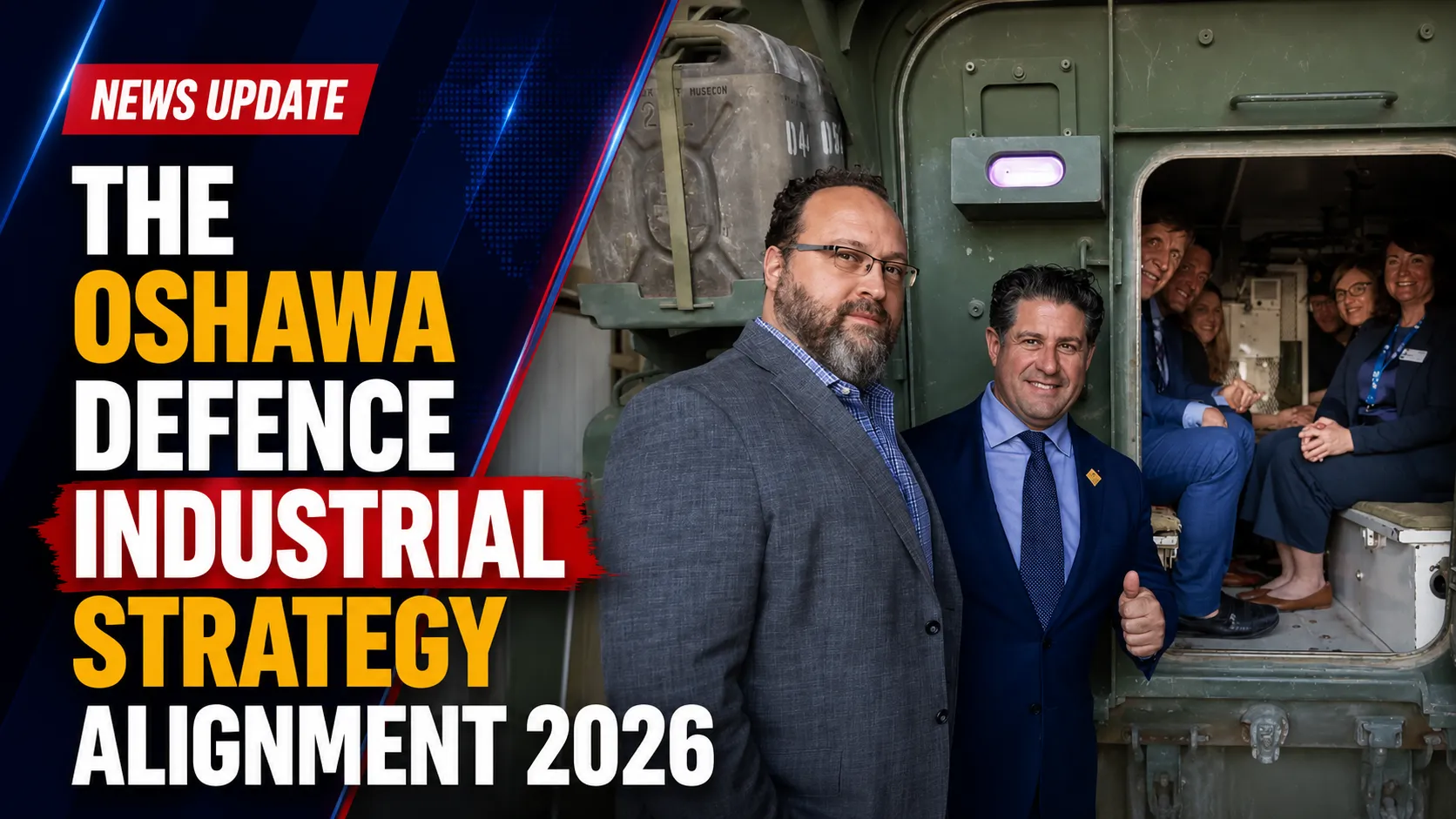
The City of Oshawa has formally pivoted its manufacturing infrastructure to capture a major share of Ontario’s newly unveiled, first-ever $6 billion Defence Industrial Strategy. Under the active commercial tracking portfolio The Oshawa Defence Industrial Strategy Alignment 2026, municipal officials and the Automotive Parts Manufacturers’ Association (APMA) confirmed on June 2, 2026, the activation of the city’s Integrated National Defence Innovation Corridor. Earmarked to support Canada’s massive $81 billion, five-year national security spending ramp-up, the local strategy aims to secure thousands of high-value aerospace, cyber defense, and tactical vehicle production lines.
The strategic shift follows Premier Doug Ford’s formal announcement at the Canadian Association of Defence and Security Industries (CADSI) summit, outlining a ten-year provincial retooling roadmap engineered to inject 43,000 advanced technical jobs into trade-disrupted sectors by 2035.
The Multi-Modal Defense Corridor Architecture
Oshawa’s operational response centers on its pre-zoned, heavy-industrial corridors, which combine standard automotive manufacturing footprints with highly specialized military testing assets. By linking legacy automotive assembly networks with bleeding-edge academic research facilities, local administrators have structured an end-to-end defense pipeline designed to compress traditional federal procurement timelines.
The municipality’s defense infrastructure relies on four core tactical pillars to draw international military contractors away from competing American and European markets:
-
The ACE Wind Tunnel Facility: Positioned as a premier asset, the world-class ACE climatic aerodynamic center has been modernized via a recent $5 million FedDev Ontario investment into a formal defense technology hub. Legally recognized as a NATO DIANA-capable facility, the tunnel can simulate extreme, non-fragmented Arctic climates to stress-test advanced aerospace electronics, drone systems, and heavy military hardware under severe polar warfare conditions.
-
Multi-Modal Supply Chains: Oshawa stands as one of the few Canadian manufacturing hubs featuring a deepwater seaport linked directly to international shipping routes via the St. Lawrence Seaway, mirrored on land by direct transcontinental CP and CN rail spurs, the Oshawa Executive Airport, and immediate proximity to Highway 401.
-
The GM Tech Ecosystem: The strategy directly leverages the GM Canadian Technical Centre and the high-velocity CTC McLaughlin Advanced Technology Track to test autonomous armored drivetrains, heavy logistics fleets, and hard-tech AI terrain mapping.
-
Aggressive Fiscal Incentives: To lower barriers to entry for manufacturing firms looking to build new facilities, Oshawa offers a 100% development charge exemption on all new industrial construction, backed by immediate access to a rolling pool of 35,000 highly trained tech and engineering students across four regional post-secondary institutions.
Navigating Trillion-Dollar NATO Investment Pledges
The economic parameters driving the provincial defense framework reflect a shifting global trade and security landscape. Under updated NATO Defence Investment Pledges, allied nations are aggressively scaling up budgets to hit a mandatory 5% GDP defense spending threshold by 2035. Crucially for Ontario, the treaty guidelines permit member states to divert up to 1.5% of their total defense commitments directly into domestic infrastructure projects, including cyber defense, supply chain resilience arrays, and dual-use innovation zones.
| Macroeconomic Projections | Ontario Defense Targets by 2035 |
| Provincial GDP Contribution | Over $6.0 Billion in Net Economic Output |
| Annual Tax Revenue Yield | $400 Million in Continuous Government Revenue |
| Targeted Employment Creation | 43,000 Specialized Advanced Manufacturing Positions |
| Oshawa Post-2018 Job Baseline | 7,000+ Existing Jobs Added via Local Incentives |
The remaining 3.5% of the NATO allocation—representing an estimated $150 billion annual procurement pool—will flow straight into core equipment contracts, tactical personnel arrays, and heavy ammunition manufacturing.
Oshawa Mayor Dan Carter emphasized that this massive capital surge represents the most significant industrial retooling opportunity the country has encountered since the Second World War. By deploying its specialized municipal infrastructure, zero upfront development penalties, and deep-water transport channels, Oshawa is positioning its local labor force to function as the core staging ground for Canada’s sovereign defense supply chain.