A high-stakes municipal showdown over urban growth boundaries, environmental preservation, and Indigenous sovereignty has reached a boiling point in western Durham. Ahead of a highly anticipated, marathon Pickering City Council meeting, the Mississaugas of Scugog Island First Nation (MSIFN) have formally reaffirmed their absolute opposition to an ambitious proposal that aims to convert a massive swath of agricultural land into high-density suburban neighborhoods. The public intervention, led by MSIFN Chief Kelly LaRocca, underscores a widening diplomatic rift between regional Indigenous leadership and Pickering Mayor Kevin Ashe’s administration regarding the legal scope of treaty obligations.
The developer-driven infrastructure push has mobilized a powerful coalition of First Nation leaders, environmental advocacy groups, and local municipal councillors who warn that fast-tracking the secondary plan could inflict irreversible damage on local watersheds, agricultural security, and Indigenous historical sites.


The 16,000-Hectare Expansion Plan
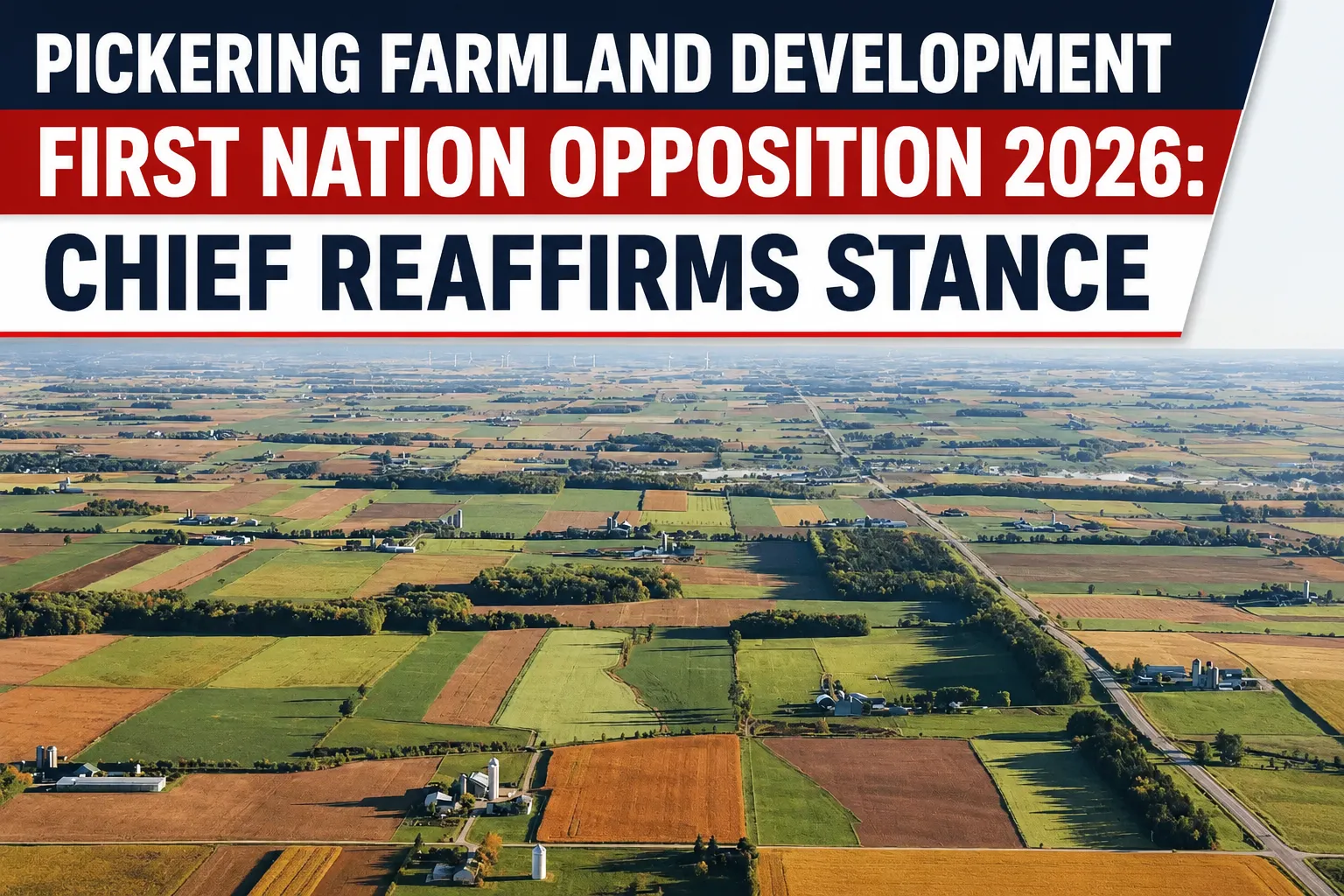
At the heart of the intense debate is a sweeping long-term growth strategy initiated by the Northeast Pickering Landowners Group—a private consortium of developers. The group’s proposal outlines a massive, 25-year urbanization framework designed to fundamentally reshape the municipality’s northern rural geography:


-
The Scale: The secondary plan seeks to systematically develop 16,000 hectares of pristine farmland over the next quarter-century.
-
Demographic Influx: The planned subdivisions, commercial plazas, and utility grids are projected to inject more than 72,000 new residents into what is currently an active agricultural ecosystem.
-
Geographic Boundaries: The targeted land block forms a vast rural square, bounded precisely by the Sixth Concession to the south, Eighth Concession to the north, Westney Road to the west, and Lakeridge Road to the east.
Breakdown in Meaningful Dialogue
While municipal staff originally deferred the plan two months ago to compile updated impact reports, Mayor Kevin Ashe executed a closed-door meeting with Chief Kelly LaRocca on April 20 in an attempt to hash out structural differences and establish a formal consultation protocol. However, Chief LaRocca confirmed that the meeting resolved very little. In a strongly worded public statement, LaRocca emphasized that MSIFN’s rigid opposition to the development remains completely unchanged.
Chief LaRocca pointed out that the First Nation’s core grievances center on unresolved procedural failures regarding “meaningful dialogue,” acute inconsistencies with overarching provincial planning acts, and an absolute failure by city planners to calculate the cumulative environmental toll of the project. Most critically, the First Nation maintains that advancing the development without comprehensive, independent archeological and environmental surveys poses an immediate, adverse threat to protected Aboriginal and treaty rights. While LaRocca noted that technical talks with city staff are ongoing, she firmly reiterated that no formal agreement has been signed, and the community will not compromise on its legal right to proper, deep-level consultation.
The “Speeding Train” of Provincial Mandates
The Indigenous block is receiving fierce logistical backing from prominent regional grassroots organizations like Stop Sprawl Durham. Environmental activists are demanding an immediate, total pause on the secondary plan, labeling the developer-led push as fiscally, socially, and environmentally irresponsible. They are lobbing intense pressure at council to defer all voting until multi-year hydrogeological and ecological impact studies are fully completed to protect local groundwater tables.
However, the political reality at Pickering City Hall remains deeply complicated by aggressive housing targets dictated by the Ontario provincial government at Queen’s Park. Commenting on the mounting civic friction, veteran Pickering Ward 1 Councillor Maurice Brenner offered a sobering assessment of council’s actual statutory leverage. Brenner noted that completely stopping urban development from eventually cannibalizing the northeast Pickering farmlands may largely be out of local council’s legal hands due to sweeping provincial interventions designed to bypass standard municipal red tape. “It’s like a speeding train,” Brenner remarked regarding the momentum of the housing push, “and we don’t have the power to stop it.” As the public gallery fills for the evening’s council session, the collision between municipal development mandates and Indigenous constitutional rights looks set to define the region’s urban planning battleground for years to come.