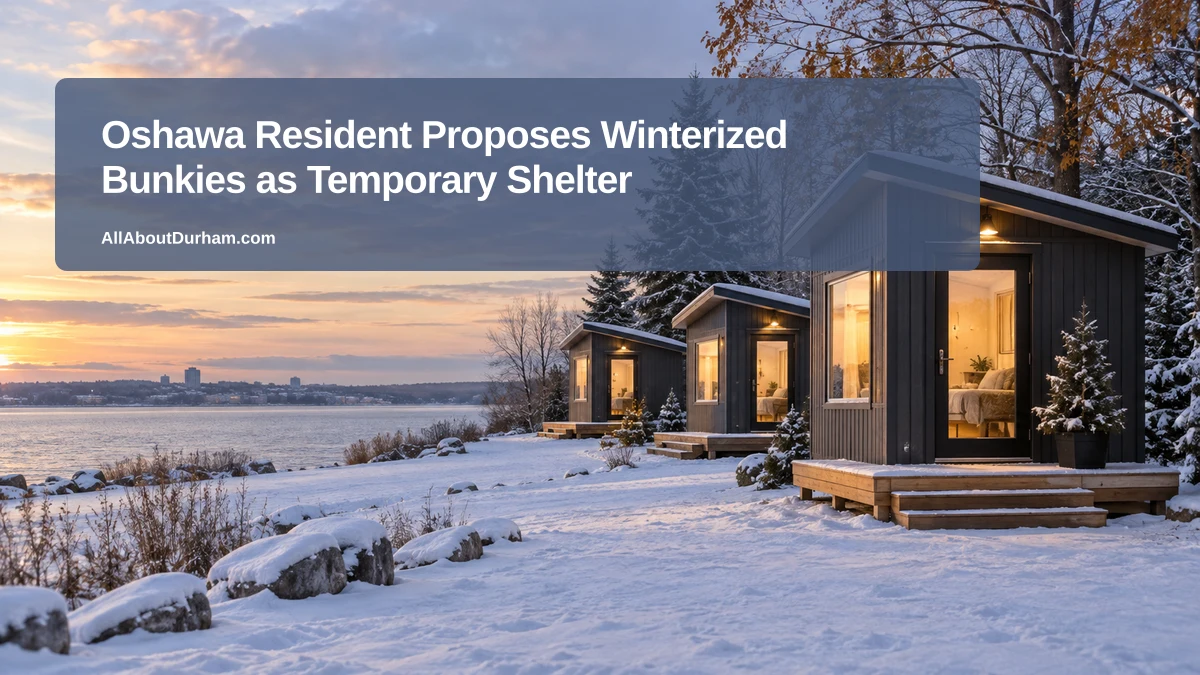
An Oshawa resident is proposing that the city explore winterized “bunkies” as temporary shelter for people experiencing homelessness, while acknowledging that the idea would require review of land, funding, construction, servicing and operating requirements.
Christeen Thornton described the proposal in a social-media post supplied to All About Durham. She suggested that small, insulated structures could provide people with a private place to sleep, with shared access to facilities such as showers and washrooms. She also raised the possibility of solar power and collaboration among local organizations.
Thornton presented the idea as a way to create safer, more stable temporary shelter close to the people who need it. She argued that moving people between parts of the city does not solve homelessness and said Oshawa has surplus land that could be considered. The post does not identify a site, budget, operating organization, funding commitment or municipal approval.


Thornton also said she visited Steve’s Sheds on Bloor to discuss the idea. That statement is attributed to her post; there is no confirmation that the company has endorsed the proposal, agreed to supply structures for residential use or participated in a City of Oshawa project.
Permits and residential use would need careful review
Oshawa’s accessory-structures guidance says a storage-only shed may qualify for a building-permit exemption in specified circumstances, including limits on size, height, attachment and plumbing. The city also states that an accessory structure must still comply with the Ontario Building Code and the zoning by-law, even when a permit is not required.
Those rules do not establish that a structure intended for people to occupy overnight could avoid approvals simply because it is small, low or not dug into the ground. Oshawa lists construction of a building, adding a dwelling unit and changes to heating or plumbing among projects that can require a permit. The applicable classification, zoning, building-code requirements, fire and life-safety measures, accessibility, servicing, site conditions and any occupancy approvals would have to be determined for a specific proposal.
Winter operation would raise additional practical questions. A proponent would need reliable heat, ventilation, insulation, electrical service, water and wastewater arrangements, snow and ice management, emergency access, security and maintenance. Solar panels might be part of an eventual design, but their capacity, storage and winter reliability would need engineering review. No cost estimate for Thornton’s concept has been independently verified.
Temporary shelter is not automatically Housing First
The federal government describes Housing First as moving people experiencing homelessness into stable, long-term housing quickly, with supports. That model includes tenant choice and a landlord-tenant relationship. A cluster of temporary bunkies could potentially be considered as shelter or transitional accommodation, but it should not be described as Housing First without evidence that it meets the model’s requirements.
Thornton’s proposal remains an idea for exploration, not an announced City of Oshawa program. Before it could proceed, the city and any potential partners would need to assess ownership or access to land, approvals, capital and operating costs, resident selection, support services, winter safety, insurance and accountability. Public consultation and coordination with Durham Region’s homelessness and housing services would also be relevant questions.
Sources and verification note
This report is based on a social-media post by Christeen Thornton supplied to All About Durham and checked against the City of Oshawa’s accessory-structures guidance, its building-permits information, the city’s shed and garage construction guide, and Housing, Infrastructure and Communities Canada’s Housing First explanation.
Verification pending: the supplied material did not include the original social-media URL or an exact publication date. Public web searches located no retrievable copy of this specific post, so the article remains a draft until the original post can be independently linked and dated. The photograph accompanying the social-media post was not reused.