Durham Time Machine — September 7, 1926 ↔ September 7, 2026
The Tuesday after Labour Day sounds like a natural moment to picture Oshawa’s children returning to classrooms. The historical record available to this newsroom does not let us make that claim. We could not open an exact-date newspaper issue for September 7, 1926: the surviving Oshawa Daily Reformer run is behind an archive access challenge that we will not bypass, and the accessible Oshawa Public Libraries collection on Internet Archive has no issue for that date.
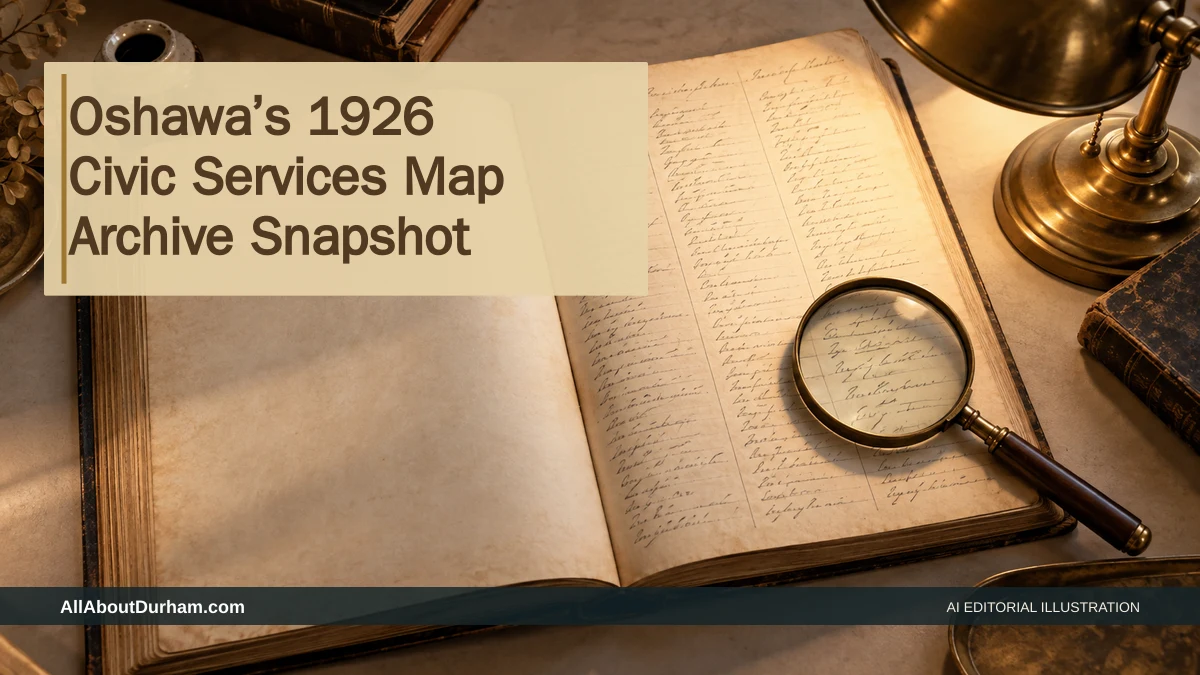
This edition is therefore a sourced reconstruction and archive snapshot, not a report of events on one school day. Its primary evidence is the public-domain 1926 City of Oshawa Directory, published May 1, 1926 and digitized from an original held by Oshawa Public Libraries. The directory can identify educational institutions, addresses, principals and civic offices listed that year. It cannot establish the school calendar, attendance, lessons, opening-day ceremonies or anything else that happened on September 7.
What the directory does provide is a revealing map of how learning was organized in a fast-growing industrial city.
A secondary school at 301 Simcoe Street North
The directory placed Oshawa Collegiate at 301 Simcoe Street North. It also named H. S. Smith as chairman of the Board of Education and J. A. McGibbon as secretary-treasurer, with the board’s offices in the Dominion Bank Chambers.
Those entries show education operating through both a school building and a civic administration. The annual book was meant to help residents locate people, institutions and services, so its compact listing connected the classroom to the machinery of local government. It does not say how many pupils attended the collegiate, what subjects they studied that Tuesday or whether classes were in session.
There is a notable thread to the present. The official O’Neill Collegiate and Vocational Institute website says the school is in Oshawa and serves Grades 9 through 12. The modern school’s identity and programs should not simply be projected backward onto the 1926 entry, but the continuing presence of secondary education in the city makes the directory’s address more than an isolated line in an old book.
Eight public-school entries—and a useful contradiction
Under “Public Schools,” the directory listed eight locations: Albert Street, Cedardale, Centre Street, King Street East, Mary Street, Ritson Road, Simcoe Street North and Simcoe Street South. It supplied a principal for each listing: Miss T. Patten, L. E. Smith, A. Jacklin, Miss E. M. Holmes, Miss H. Keddie, H. Knight, Miss J. W. Garrow and Miss G. L. Annand respectively.
That page creates a small but important source problem. The promotional civic profile near the front of the same directory claimed that Oshawa had seven public schools and one high school. The detailed educational list contains eight public-school entries. We have not silently “fixed” the inconsistency or chosen whichever number sounds better. It may reflect timing, classification or an editorial error, but the directory alone does not explain it.
This is exactly why annual directories need to be read critically. They are authoritative evidence of what their compilers printed, but they are not infallible databases. The safest conclusion is that the directory individually named eight public-school entries while its promotional introduction gave a total of seven. Both statements belong in the ledger; neither should be converted into an unsupported certainty about enrolment or opening dates.
Separate and faith-based education had addresses too
The educational section also listed a Separate School at 202 Simcoe Street North and St. Joseph Convent at 171 Simcoe Street North. Those addresses place multiple educational institutions along the same important north-south corridor as the collegiate.
Again, the directory establishes names and locations, not a daily schedule or a complete institutional history. It does not tell us which pupils entered those buildings on September 7, what grades were taught, how classrooms were arranged or what the school day felt like. Reporting those details would require additional primary records.
The geographical fact is still useful. Simcoe Street North was not merely a commercial or residential route in the directory’s civic map; it also carried a cluster of educational institutions. A reader navigating the city by address could find the collegiate, the separate school and St. Joseph Convent within the same listed street corridor.
Two colleges beyond the public-school list
The directory’s “Colleges” subsection named Oshawa Missionary College on Kingston Road and Bishop Bethune College at 254 Simcoe Street South. For Bishop Bethune College it also identified Miss W. M. Wilson, B.A., as principal.
These entries broaden the picture. Oshawa’s 1926 education map was not limited to the public board and its elementary or secondary schools. The directory’s compilers treated two colleges as distinct civic institutions worthy of their own subsection.
That does not prove the size, curriculum or denominational life of either college on the historical date. It does show that a person consulting the annual directory could locate formal learning in several institutional forms and in several parts of the city.
The public library had a children’s librarian
Education in the directory extended beyond schools. On the facing page, the Public Library was listed at 44 Simcoe Street South. Mrs. D. V. Oke was named librarian, H. Rowland assistant librarian and Miss B. Millichamp children’s librarian.
The presence of a specifically identified children’s librarian is a strong local fact. It tells us that children’s library service had an assigned staff role in the 1926 civic directory. It does not reveal how many young readers visited, what they borrowed or whether the library opened on September 7.
Today, Oshawa Public Libraries lists five service locations. Its official locations page includes the McLaughlin Branch at 65 Debwewin Miikan (formerly Bagot Street), along with branches at Delpark Homes Centre, Jess Hann and John Aker Northview and a kiosk at the Civic Community Centre. That modern network is not a measure of service quality across a century; it is a careful then-and-now contrast in physical reach—from one listed address and three named staff roles in the 1926 directory to a current multi-location system.
What this snapshot can—and cannot—tell us
The strongest story supported by the source is one of civic geography. In 1926, the directory mapped a collegiate, eight individually named public-school entries, a separate school, a convent, two colleges and a public library with a children’s librarian. It also named the education board’s officers and office location.
The source cannot tell us that September 7 was the first day of school. It cannot supply classroom scenes, enrolment totals for an individual institution, timetables, ceremonies or memories. Those absences matter, especially in a series tied to a calendar date.
So the honest view through today’s Durham Time Machine is not a staged “back-to-school morning.” It is the administrative and physical framework that Oshawa residents could find in a book published during 1926: places to learn, people responsible for leading them and a public library that explicitly included children in its staffing structure.
Sources and further reading
- 1926 City of Oshawa Directory, Henry Vernon & Son, published May 1, 1926; printed pages 256–257 and the promotional civic profile. Digitized by Oshawa Public Libraries and marked Public Domain.
- Oshawa Public Libraries: Oshawa directories
- Oshawa Public Libraries: current locations
- O’Neill Collegiate and Vocational Institute: About Us
- Oshawa Public Libraries: Local History & Genealogy
Source note: This is original editorial work and a sourced reconstruction of Oshawa’s education geography for September 7, 1926. The annual directory was published May 1 and cannot establish that classes opened, pupils attended or any particular school event occurred on September 7. The directory itself conflicts on the number of public schools: its promotional profile says seven, while its detailed list names eight entries. No archive scan, photograph, advertisement, source headline or protected wording has been reproduced. Names and addresses used here were checked against the legible directory scan; uncertain OCR was not published as fact.